Franchise Strategies
Jan 30, 2026
Estimate franchise startup costs, royalties, breakeven timelines, and common financial pitfalls to avoid failed investments.

Every year, many entrepreneurs invest in franchises hoping for success, but poor financial planning often leads to failure. A franchise investment calculator helps you evaluate costs, revenue, and risks before committing. These tools analyze startup fees, recurring costs, and breakeven timelines, using data from the Franchise Disclosure Document (FDD).
Key takeaways:
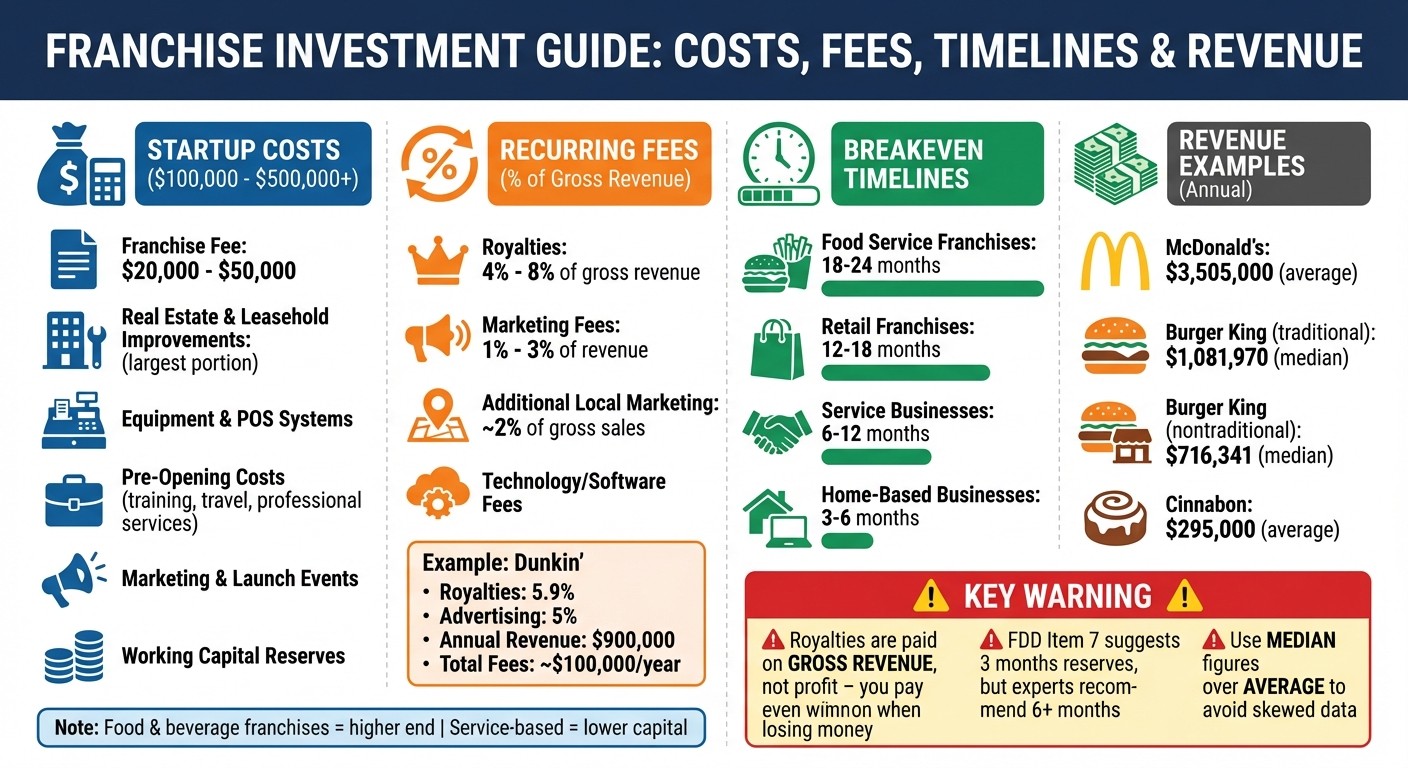
Startup Costs: Ranges from $100,000 to $500,000+, including franchise fees ($20,000–$50,000), real estate, and equipment.
Recurring Fees: Royalties (4%–8% of revenue) and marketing fees (1%–3%) can significantly impact profits.
Breakeven Timelines: Food franchises may take 18–24 months, while home-based businesses often stabilize in 3–6 months.
Revenue Risks: Overestimating sales or underestimating costs can lead to financial trouble.
To avoid common pitfalls, verify all cost assumptions, consult franchise experts, and prepare for unexpected expenses. Accurate projections and sufficient capital reserves are critical for success.
Franchise Investment Cost Breakdown: Startup Fees, Recurring Costs & Breakeven Timelines
Franchise Math 101: ROI, Margins, and Break-Even Explained Franchise Fridays with Jeff Dudan #188
Key Components of Franchise Investment Calculations
Breaking down the key elements of franchise investment helps pinpoint where projections might go off track. Typically, franchise investments fall into three main categories: upfront costs, recurring expenses, and revenue assumptions. Each category comes with its own risks and variables, which can heavily influence your financial outcomes. Let’s take a closer look at these components to see how they interact and affect your overall investment.
Initial Franchise Fees and Start-Up Costs
The franchise fee - ranging from $20,000 to $50,000 - is just the starting point. The bulk of your investment will likely go toward additional expenses. For example, real estate and leasehold improvements often dominate the budget, covering renovations, fixtures, and branding needs. On top of that, you’ll need to account for equipment costs, such as furniture, kitchen appliances, or point-of-sale (POS) systems.
Smaller expenses can quickly add up as well. Pre-opening costs like training, travel, and professional services can significantly increase your overall start-up costs. Don’t forget about marketing efforts for your opening, such as promotional campaigns and launch events. Most importantly, having enough working capital is essential to cover initial operations.
In total, start-up costs typically fall between $100,000 and $500,000, though this varies by industry. Food and beverage franchises tend to be on the higher end, while service-based franchises often require less capital. If you’re able to use a pre-equipped space, you might save significantly on build-out expenses.
Ongoing Costs: Royalties, Marketing, and Operational Expenses
After your initial investment, recurring fees will continue to impact your finances. Royalties are usually the largest recurring expense, ranging from 4% to 8% of gross revenue. Since royalties are based on gross sales rather than net profit, you’ll owe these fees even during months when your business operates at a loss. For instance, Dunkin' requires 5.9% in royalties plus an additional 5% for advertising fees. If your franchise generates $900,000 annually, these fees alone could total nearly $100,000.
Marketing fees typically range from 1% to 3% of revenue and are split between national branding efforts and local advertising. In some cases, franchisors may also require an additional 2% of gross sales for local marketing initiatives.
Other operational costs can quietly eat into your profits. These may include technology fees, audit charges, or mandatory software subscriptions, which are often detailed in FDD Item 6. For example, centralized call center fees might be worthwhile if they lead to more customers, but you’ll need to weigh the cost against the return on investment.
Revenue Projections and Market Variables
After accounting for costs, revenue projections become the next critical focus. These forecasts determine potential profitability but are also where errors often occur. If your franchisor provides Item 19 Financial Performance Representations, prioritize median sales figures over averages, as averages can be skewed by outliers. For instance, Burger King's FDD shows median annual sales of $1,081,970 for traditional locations compared to $716,341 for nontraditional ones.
When Item 19 data isn’t available, you can estimate gross sales by dividing total royalty payments (from FDD Item 21) by the royalty rate and the number of operating units. However, this method has its flaws, as it doesn’t account for factors like seasonal fluctuations, regional differences, or cash flow timing. For example, tax preparation franchises experience peak revenue between January and April, while business-to-business franchises may face delayed cash collections due to extended credit terms.
Market conditions add another layer of complexity. Protected territories may not fully shield you from competition, as franchisors might still sell through websites, catalogs, or alternative outlets in your area. You’ll also need to evaluate whether demand is stable or tied to a passing trend. For instance, McDonald's franchises average $3,505,000 in annual revenue, while Cinnabon units bring in about $295,000. These stark contrasts underscore the importance of factors like market positioning, location, and consumer demand - considerations that generic calculators often fail to fully address.
Common Financial Mistakes in Franchise Ownership
Avoiding common financial pitfalls is essential for franchise success. Even with detailed planning, franchisees often make errors that can derail their business. Understanding these missteps can help set realistic expectations and make better financial decisions.
Overestimating Revenue and Underestimating Costs
One of the most frequent mistakes is confusing gross sales with actual profit. While large gross sales figures might seem impressive, they don’t account for the costs that eat into profitability. Lesley Fair, a Senior Attorney at the FTC, explains:
Providing franchisees' gross sales also has the potential for deception because it doesn't factor in their actual costs or profits. An outlet with high gross sales on paper might be losing money because of high overhead, rent, and other expenses.
Another issue is relying on average income figures instead of median values. Averages can be misleading, as a few high-performing outlets can skew the numbers, masking underwhelming results from the majority. Fair adds:
Calculating earnings [by average income] can allow the results from a few highly successful outlets to hide the disappointing results from other franchises.
For example, while a McDonald’s location might average $3,505,000 annually and a Cinnabon $295,000, these figures don’t reflect the wide range of actual performance. Factors like real estate costs, local labor rates, and unexpected delays can push expenses far beyond initial estimates. Many franchisees also overlook budgeting for their own compensation, further distorting their profitability outlook.
Ignoring Economic and Market Trends
External market forces are another area where franchisees often falter. Projections based on ideal conditions can lead to trouble when local factors - such as consumer behavior, competition, or economic trends - are ignored. It’s crucial to ensure that earnings claims reflect the realities of your specific region.
Market saturation is another risk. Franchisors that expand too quickly can create competition among their own outlets, including company-owned locations. Even in cases where "protected territories" are offered, exclusivity isn’t always guaranteed.
Insufficient Capital Reserves
Perhaps the most dangerous mistake is underestimating the amount of working capital needed. The FDD’s Item 7 typically includes "additional funds" to cover the first three months of operation, but this rarely accounts for the full ramp-up period. For instance, food service franchises often take 18–24 months to reach breakeven, while retail franchises may need 12–18 months. Without sufficient reserves, franchisees risk running out of cash before their business stabilizes.
Compounding the issue is that royalties are calculated based on gross revenue, not profit. As the FTC highlights:
Typically, you must pay royalties for the right to use the franchisor's name, even if you are losing money.
When early revenue is overestimated and capital needs are underestimated, a cash shortfall can hit at the worst possible time. Many experts recommend having at least six months of operating capital - double what most FDDs suggest - to weather the challenging early stages when expenses often exceed income.
How to Use Franchise Investment Calculators Effectively
Avoiding financial missteps with a franchise investment calculator means carefully examining every assumption and verifying all numbers before committing your money. By following these steps, you can refine your projections and make well-informed decisions.
Gather Accurate and Complete Data
Start by reviewing FDD Item 7, which provides a range of startup costs. As mentioned earlier, this section is your starting point for cost estimates. However, as Ricardo Fontana from FranchiseBA points out:
Item 7 shows estimated startup costs, not performance. It's a regulated snapshot of what it may take to get in the game - not a projection of how your specific location will do once it's open.
Understand the assumptions behind these figures. For example, converting an existing "second-generation" space can significantly reduce build-out costs compared to starting from scratch.
Next, check FDD Item 19 for historical sales and average revenue data. Keep in mind, though, that it often excludes net profit figures and may focus on top-performing units. Cross-reference this data with ongoing fees outlined in FDD Items 5 and 6. Also, consider location-specific hidden fees that might not appear in the documents.
Reach out to current and former franchisees using the contact list in FDD Item 20. Ask them if their actual startup costs and revenues matched the franchisor's estimates. These conversations can uncover unexpected expenses or delays that aren’t mentioned in the official documentation.
Once you’ve gathered and validated your data, the next step is to test your projections under different scenarios.
Test Multiple Scenarios
Create best-case, worst-case, and average-case scenarios to fully understand your risk exposure. Start by calculating your Total Venture Development Cost, which combines the franchise package cost with additional expenses. Then, determine your Adjusted Operating Profit by subtracting what your investment capital could have earned in a money market account. Including opportunity costs in your calculations gives a more realistic view of profitability.
Make sure your projections account for adequate working capital. Many businesses take longer than the three-month reserve suggested in FDD Item 7 to stabilize. For example, food service franchises often need 18–24 months to break even, retail franchises 12–18 months, and service businesses 6–12 months. Running projections with at least six months of operating capital provides a more realistic safety net.
Don’t forget to include your personal expenses during this ramp-up period. As HIRE YOURSELF warns:
Undercapitalization poses a major risk.
Consult with Franchise Experts
Consult with an experienced franchise attorney and accountant to review the FDD and your financial projections. These professionals are skilled at spotting red flags in franchisor financials. For instance, if a franchisor relies heavily on one-time franchise fees rather than ongoing royalties, it could signal a focus on selling franchises rather than supporting franchisee success.
Experts can also evaluate whether the unit economics make sense for scaling to multiple locations, which is critical if you’re considering expansion. They’ll ensure your calculator distinguishes between fixed costs (e.g., rent, insurance) and variable costs (e.g., labor, inventory), helping you understand how profitability may shift as revenue changes.
Lastly, work with your advisors to calculate your time to recovery. Divide your Total Venture Development Cost by your Adjusted Monthly Operating Profit to determine how many months it will take to recoup your initial investment. This analysis helps you weigh the potential return against the time and capital required, guiding your final decision.
Lessons from Failed Franchise Investments
Franchise failures highlight how flawed financial projections can lead to business collapse and personal financial ruin. The examples below illustrate the risks involved and the consequences of miscalculations.
Case Study: Overestimating Market Demand
Steve Sloney’s experience with a Burgerim franchise in Bingham Farms, Michigan, is a cautionary tale. He opened the franchise in December 2018, expecting high profitability based on optimistic projections. His plan assumed a break-even point of $15,000 in weekly sales, but actual revenue only reached $10,000 to $12,000 per week. Combined with high food and labor costs, his working capital quickly drained, and the business closed after just seven months.
Phil Schreuders faced an even steeper downfall with his Burgerim in Burbank, California. He initially estimated buildout costs at $350,000, but the final bill soared to $550,000. With monthly losses of $34,000 due to high rent, loans, and labor costs, he was forced to sell his home to cover debts. The franchise lasted only eight months before shutting down.
Case Study: Ignoring Ongoing Costs
Marc Genece’s Burgerim franchise in South Florida serves as another example of misjudged financial planning. He invested $350,000 of inheritance money and took out $100,000 in loans, opening the location in July 2018. Despite initial projections of profitability, monthly rent of $11,000 and high food costs created immediate negative cash flow. The store, which generated only $40,000 in monthly sales, was evicted within 10 months.
The broader collapse of Burgerim underscores systemic issues. Despite collecting $45 million in franchise fees, the company ended 2018 with just $50,000 in cash, partly because it failed to collect the required 5% royalty and 2% advertising fees from franchisees. Michel Buchbut, Burgerim’s Chief Restructuring Officer, summed it up bluntly:
"It was so stupid. How do you not collect the royalty and survive? How do you do that? You're in the wrong business."
Franchisees also struggled with operating costs, as labor expenses consumed about 50% of revenue, while food costs took up 35% to 40%.
Key Takeaways from Franchise Failures
Verify cost estimates: Speak with current or recent franchisees to get a realistic picture of expenses. For instance, Phil Schreuders faced a 57% cost overrun when his buildout costs ballooned from $350,000 to $550,000, crippling his business before it even got off the ground.
Stress-test revenue assumptions: Falling short of revenue targets, as Steve Sloney experienced, can quickly lead to financial disaster.
Account for recurring fees: Include all ongoing costs in monthly calculations to avoid running out of capital prematurely. Steven Greene, an attorney at Matthews & Greene, noted:
"Instead of building a company store and replicating it, they let their initial franchisees be their test cases. Their estimates on buildout costs, operating costs and expected revenue were grossly inaccurate."
The fallout from Burgerim’s collapse was severe. The State of California ordered the company to refund $57 million in franchise fees to roughly 1,500 investors. These failures underscore the importance of thorough financial analysis before committing to any franchise opportunity.
Conclusion: Making Informed Franchise Investments
Achieving success with your franchise requires careful, data-driven planning - an idea that has been central to this guide. Tools like investment calculators are only as reliable as the data and assumptions you feed into them. Before making any commitments, double-check the estimates provided in Item 7 of the Franchise Disclosure Document. Keep in mind that these figures are good-faith approximations, not guarantees. Consider the low-end estimate as the bare minimum and plan for extra cash reserves to cover unexpected expenses. This thoughtful preparation can help you avoid the common pitfalls and missteps outlined earlier.
Take the time to consult with existing franchisees listed in Item 20 to confirm costs and breakeven timelines. Additionally, have a franchise attorney and CPA review your financial assumptions and unit economics. As Lesley Fair, Senior Attorney at the FTC, wisely advises:
"Paying an attorney and an accountant up front could save you thousands (and a thousand headaches) in the future."
This level of diligence ensures your financial plans are grounded in reality and not just optimism.
Put your assumptions to the test by considering conservative scenarios - lower-than-expected revenues, higher-than-expected costs, and longer ramp-up periods. Don’t forget to weigh opportunity costs by comparing this investment to other potential ventures. And most importantly, be prepared to walk away if the numbers don’t add up. A successful franchise investment isn’t just about ambition - it’s about rigorous analysis and the discipline to say no when the risk outweighs the reward.
FAQs
What should I keep in mind when using a franchise investment calculator?
When using a franchise investment calculator, it's crucial to enter accurate and realistic financial information. Start by assessing your available resources, such as liquid cash for the initial investment, your credit score, and household income. These elements play a big role in determining your borrowing capacity and overall budget.
Be sure to include all associated costs, like franchise fees, equipment, inventory, and ongoing expenses such as royalties and advertising. Also, consider the type of location you're aiming for - whether it's a home-based setup, a storefront, or a mobile operation - as this choice can greatly influence both costs and revenue potential.
By thoroughly analyzing these factors and comparing them to industry standards, the calculator can help you make well-informed decisions and steer clear of common financial risks in franchise ownership.
What steps can I take to avoid financial mistakes when investing in a franchise?
Avoiding financial missteps in franchise ownership begins with thorough research and realistic financial planning. Start by using franchise investment calculators to get a clear picture of how your budget aligns with the franchise's startup costs, ongoing expenses, and potential earnings. Don’t skip over the Franchise Disclosure Document (FDD) - pay special attention to Item 7, which lays out estimated costs and potential financial risks.
You’ll also need to take a hard look at your personal finances. Assess your liquid capital, credit score, and household income to ensure you’re not stretching yourself too thin. For extra guidance, tap into reliable resources like government publications or seek advice from industry experts. By combining smart budgeting, strategic planning, and setting realistic expectations, you can minimize the chances of making expensive mistakes.
Why should I consult franchise experts before making an investment?
Consulting with franchise experts is crucial when considering a franchise opportunity. These professionals can help you assess whether the financial aspects of a franchise align with your goals and resources. They’ll break down key numbers like startup costs, recurring expenses, and expected earnings, giving you a clear picture of what to expect financially.
Beyond the numbers, experts can steer you away from common errors - like relying on overly optimistic forecasts or misunderstanding financial data - that could lead to expensive missteps. Their experience equips you with the tools to make well-informed decisions, ultimately boosting your chances of success and safeguarding your investment.
