Franchise Strategies
Jan 17, 2026
Franchise investing demands careful financial planning, FDD scrutiny, and sector selection to find high-growth, long-term winners.

Investing in a franchise offers a shortcut to business ownership by leveraging established brands and proven systems. But not all franchises are equal, and choosing the right one is critical to success. Here's what you need to know:
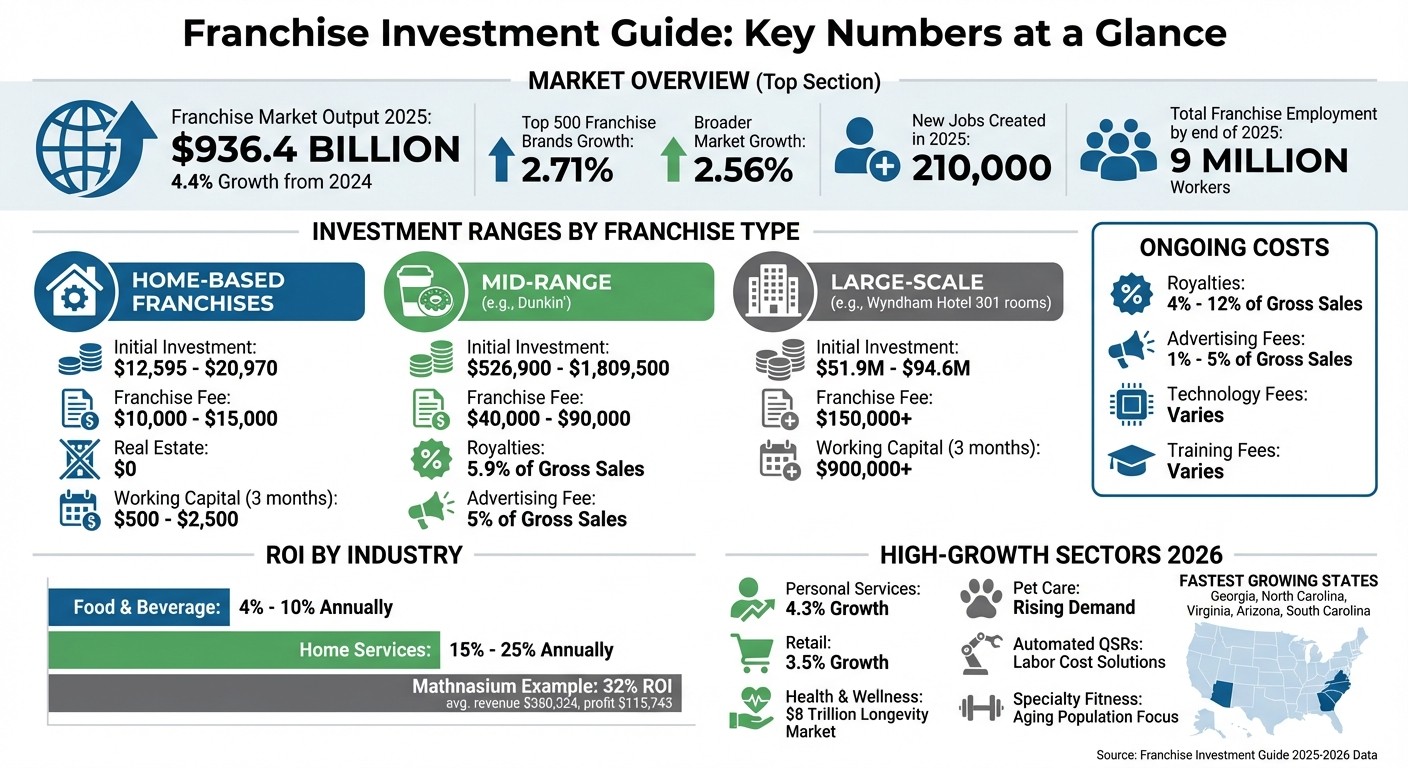
Franchise Growth: Top 500 franchise brands grew 2.71% between 2024–2025, outperforming the broader market (2.56% growth).
Costs: Initial investments range from $12,595 for home-based franchises to over $50 million for large-scale operations like hotels. Key costs include franchise fees, royalties (4%-12% of sales), and advertising fees.
High-Growth Sectors: Health and wellness, pet care, automated quick-service restaurants, and specialized fitness for aging populations are thriving in 2026.
Market Trends: Franchise output is projected to hit $936.4 billion in 2025, with personal services and retail leading growth.
Due Diligence: Review Franchise Disclosure Documents (FDDs) carefully, focusing on fees, profitability, franchisee turnover, and legal history.
Key to success: Assess your finances, research market demand, and consult professionals before committing. Franchise Ki can guide you through funding, legal reviews, and long-term planning.
Franchise Investment Costs and ROI by Business Type 2025-2026
Your Complete Guide to Finding Your Perfect Franchise: 2025 Update
Step 1: Franchise Investment Basics
Before diving into franchise ownership, it’s important to get a clear picture of the financial commitment involved. The investment needed can vary widely. For instance, home-based franchises like CruiseOne or Dream Vacations might cost between $12,595 and $20,970 to get started. On the other hand, bigger names like Dunkin' require investments ranging from $526,900 to $1,809,500, while opening a 301-room Wyndham Hotel can soar between $51.9 million and $94.6 million.
"The initial investment for a single unit franchise typically falls in the $100,000 to $300,000 range." – Michael H. Seid, Founder and Managing Director, Michael H. Seid & Associates
One of the biggest factors influencing franchise investment is real estate. Home-based or mobile businesses sidestep this cost entirely. But for brick-and-mortar franchises, like restaurants or hotels, real estate expenses can include property purchases, leases, construction, and specialized equipment. Beyond that, most franchisors require liquid capital - cash reserves you can tap into for emergencies or personal expenses while your franchise grows. Experts often suggest having enough savings to cover personal expenses for up to two years, giving your business time to gain traction.
This foundational understanding of franchise costs sets the stage for exploring financial metrics and ongoing fees.
Financial Requirements Explained
Franchisors assess your financial readiness based on three main criteria: liquid capital, net worth, and total investment capacity. Liquid capital is the cash you have available that isn’t tied up in long-term assets like retirement accounts or real estate. Net worth is calculated by subtracting your liabilities from your total assets, and total investment capacity reflects how much you can safely invest without jeopardizing your financial stability.
Before contacting a franchisor, take time to audit your finances. Determine your total available capital, review your credit score, and assess how much risk you’re comfortable taking. For example, if a franchisor requires $150,000 in liquid capital but you only have $80,000, you might be stretching yourself too thin. This step helps you focus on franchises that align with your financial situation.
Once you’ve evaluated your financial standing, it’s time to dig into the specific costs tied to the franchise.
Franchise Fees and Recurring Costs
The franchise fee is the upfront payment that gives you access to the brand, its trademarks, and proprietary systems. For example, Dunkin's franchise fee typically falls between $40,000 and $90,000. However, that’s just the beginning. Franchisees also pay ongoing royalties - usually 4% to 12% of gross sales. Dunkin', for instance, averages around 5.9%. Additionally, most franchises charge advertising fees, often 1% to 5% of gross sales, with Dunkin' commonly requiring about 5%.
Other recurring costs include technology fees for systems like point-of-sale software, training fees for new employees, and mandatory purchases from approved suppliers. These expenses don’t pause, even if your business hasn’t yet turned a profit. This is why reviewing the Franchise Disclosure Document (FDD) is so important - specifically Items 5, 6, and 7, which detail all associated fees and costs.
Cost Category | Low-Investment (Home-Based) | High-Investment (Hotel/Retail) |
|---|---|---|
Real Estate | $0 (Home-based/Mobile) | Millions (Purchase/Lease/Construction) |
Franchise Fee | $10,000 – $15,000 | $150,000+ |
Equipment | Minimal (Computer/Software) | Specialized (FF&E, Technology Systems) |
Inventory | Low to None | $1M+ (Opening Inventory) |
Working Capital | $500 – $2,500 (3 months) | $900,000+ (3 months) |
Step 2: Market Trends and Industry Forecasts
Understanding market trends is key to spotting long-term franchise opportunities. For 2025, the franchise sector is set to grow by 2.4%, outpacing the broader U.S. economy's projected growth of 1.9%. Total franchise output is expected to surpass $936.4 billion, a 4.4% jump from 2024, while creating around 210,000 new jobs. By the end of 2025, franchise employment is projected to exceed 9 million workers.
Certain sectors are leading this growth. Personal services and retail franchises are forecasted to grow by 4.3% and 3.5%, respectively. Within these categories, niche markets are emerging as standout performers. For instance, the global longevity market - focused on preventative health and wellness - is projected to exceed $8 trillion. A notable example is the Ultimate Longevity Center, launched in January 2026 by Sequel Brands, Tony Robbins, and Gary Brecka. This franchise combines fitness, recovery, and diagnostic services into a membership-based model aimed at capitalizing on this massive market.
"The 10 hottest growth areas in franchising today are Asian Food, Beverages, Business Services, Children's Education & Enrichment, Health & Wellness, Junk Removal/Dumpster Rentals, Personal Care, Pets, Recreation, and Restoration." – Tracy Stapp Herold, Special Projects Editor, Entrepreneur Magazine
Technology is also playing a pivotal role in driving efficiency and profitability. AI tools are streamlining home services like plumbing and HVAC, while automotive franchises such as Optic-Kleer are leveraging advanced driver-assistance systems (ADAS) recalibration. These services can generate $250–$600 per job with nearly 100% margins. As of January 2026, Optic-Kleer, with over 200 locations worldwide, reported average annual sales of $218,000 for its mobile services, with top performers reaching $437,000 at approximately 65% profit margins.
High-Growth Sectors in 2026
Several sectors are fueling franchise growth in 2026:
Mental Health and Neurodiverse Support: Franchises in this space are booming, driven by reduced stigma and the rise of corporate wellness programs. Many are adopting teletherapy platforms and hybrid wellness models to cater to Gen Z, Millennials, and seniors.
Pet Wellness: Services like hydrotherapy, mobile pet fitness, and behavioral wellness are becoming more popular as pet owners increasingly prioritize their pets' health.
Automated Quick-Service Restaurants (QSRs): These franchises are reshaping the restaurant industry with drive-thru-only layouts, ghost kitchens, and automated kitchen technologies. These innovations address rising labor costs and real estate challenges.
Specialty Fitness for Aging Populations: Programs focusing on fall prevention, functional strength, and cognitive-fitness hybrids are gaining traction, spurred by demographic shifts in the U.S..
Sustainable Retail: Resale-focused franchises and eco-conscious brands are thriving as Gen Z and Millennials favor reusability and locally sourced products.
Geographically, states like Georgia, North Carolina, Virginia, Arizona, and South Carolina are seeing the fastest franchise expansion.
While these trends highlight promising opportunities, evaluating a franchise's claims through its Franchise Disclosure Document (FDD) is critical.
How to Review Franchise Disclosure Documents (FDDs)
The FDD is your go-to resource for assessing a franchise's financial health and growth potential. Under the FTC's Franchise Rule, franchisors must provide this document at least 14 days before signing a contract or exchanging money. The FDD includes 23 mandatory sections, each offering insights into the franchise system.
"Providing the FDD doesn't establish that a franchisor is reputable – it's required by law, after all – but if a franchisor doesn't promptly provide this mandatory document... it doesn't speak well of their approach to legal compliance." – Lesley Fair, Senior Attorney, FTC
Here are some key sections to review:
Item 3 (Litigation): This section details the franchisor's legal history. A pattern of lawsuits from franchisees could signal systemic issues.
Item 19 (Financial Performance Representations): While optional, this section is critical. If a franchisor makes verbal earnings claims that aren't documented here, it's a major red flag.
Item 20 (System Health and Turnover): This part includes charts showing growth and owner turnover. High closure or transfer rates may indicate poor profitability or inadequate support.
Item 21 (Financial Statements): This section provides audited financial statements from the past three years. It helps determine whether the franchisor relies more on royalty payments or selling new franchises. A healthy franchise system typically generates most of its revenue from recurring royalties.
Item 12 (Territory Restrictions): This section clarifies whether you'll have an exclusive or protected territory and if the franchisor can compete in your area through e-commerce or other channels.
Before making any commitments, consult professionals. Have an independent accountant review Item 21 and a franchise attorney examine Item 22 (Contracts). Additionally, speak with both current and former franchisees to verify the franchisor's support claims and understand profitability timelines. It's also wise to ask recent franchisees (in business for 1–2 years) how long it took to break even, as this often takes longer than initial projections suggest.
Step 3: Due Diligence and Risk Assessment
Once you've analyzed market trends and reviewed franchise disclosures, the next step is to dive into risk assessment through thorough due diligence. This involves verifying claims, speaking with franchisees, and evaluating your financial readiness.
Start by taking an honest look at your skills and financial situation. Are you comfortable adhering to a strict operational model, or do you prefer making independent business decisions? This self-reflection can help you avoid costly missteps later.
What to Include in Due Diligence
A comprehensive due diligence process should cover five main areas: legal review, financial verification, franchisee interviews, operational assessment, and market analysis.
Legal and Financial Review
Begin by consulting a franchise-specific attorney and an independent accountant. They’ll help you review the Franchise Agreement, Operating Manual, and financial statements. Pay close attention to whether the Franchise Disclosure Document (FDD) aligns with the Franchise Agreement, particularly regarding territory rights, fees, and renewal terms. Confirm that the franchisor’s primary income comes from ongoing franchisee royalties rather than one-time fees.
Franchisee Interviews
Speaking with current and former franchisees is invaluable. Use Item 20 of the FDD to find their contact information and ask questions like:
How long did it take to break even?
Does the franchisor provide the promised support?
Would you invest in this franchise again knowing what you know now?
The International Franchise Association suggests asking:
"With the knowledge you have today, would you still make an investment in the franchise opportunity?" – International Franchise Association
Avoid relying solely on franchisees recommended by the franchisor. Reach out to recent operators and those who have left the system for a balanced perspective.
Operational Assessment
Examine the Operating Manual before signing. It details daily requirements, such as approved suppliers, equipment needs, and operational protocols. Keep in mind that franchisors can update the manual, potentially requiring costly upgrades like remodels or new technology. To gauge ongoing support, request to meet the field consultants assigned to your territory.
Market Analysis
Evaluate local demand for the franchise’s products or services. Does the brand already have strong recognition in your area, or will you need to invest heavily in marketing? Study the competitive landscape and review Item 12 of the FDD to understand how the franchisor plans to compete in your market. Think about whether the product has lasting appeal or is tied to a short-term trend.
Financial Verification
Verify all earnings claims by reviewing Item 19 of the FDD and ask for written evidence to back them up. Be cautious of "average income" figures, as a few high-performing locations can skew the numbers.
"Big revenues are impressive only if profits remain after subtracting costs." – David Humphrey, 2023-24 IFA Chair
Stay alert for red flags, such as high-pressure sales tactics, incomplete FDDs, or rushed timelines for signing agreements. Be wary of being asked to sign documents stating you didn’t receive earnings claims if you actually did. A history of lawsuits (Item 3) or high closure rates (Item 20) can also indicate systemic problems.
"A high-pressure 'Act now!!' sales pitch is your cue to head for the exit." – Lesley Fair, Senior Attorney, FTC
Phased Investment Strategy
Spreading out your investment in stages can help you manage cash flow and reduce the risk of running out of funds before your business becomes profitable. Breaking your investment into phases ensures you maintain liquidity throughout the process.
Pre-Launch Phase: This includes the initial franchise fee, legal and accounting costs, site selection expenses, lease deposits, and permits. For instance, McDonald’s requires a minimum of $500,000 in liquid assets, with total startup costs ranging from $1.3 million to $2.3 million.
Build-Out Phase: Allocate funds for leasehold improvements, equipment purchases, initial inventory, and signage. Be prepared for unexpected costs, such as construction delays or additional code requirements.
Launch Phase: Budget for grand opening marketing, staff training, and insurance premiums. Many franchisors require specific promotional spending during the initial weeks, so account for these separately from ongoing marketing costs.
Early Growth Phase: You’ll need working capital to cover utilities, payroll, and royalty payments, even if the business hasn’t reached profitability yet. Royalties are typically a percentage of gross sales (usually between 4.6% and 12.5%) and must be paid regardless of profit margins.
Plan for a financial safety net that can cover both personal and business expenses for 12 to 24 months. Since many franchises don’t break even in the first year, having liquid reserves is critical to avoid making rushed decisions during the ramp-up phase.
Franchise Ki’s consultants can assist in creating a realistic phased investment plan tailored to your opportunity. Drawing from their experience with hundreds of franchise launches, they can help set expectations for the timeline to profitability. A phased approach ensures you stay financially stable as you progress in your franchise journey.
Step 4: Using Franchise Ki's Support System
Once you've done your homework and mapped out a clear plan, having expert support can make all the difference in turning your franchise dreams into reality. With Franchise Ki, you get a structured system that helps simplify the entire process - from choosing the right franchise to managing your business long-term. This support becomes the backbone of your franchise journey.
The Four-Step Process
Franchise Ki's method is built around four key stages, designed to guide you through every part of the franchise experience.
Franchise Matching: This is where it all begins. Consultants take a close look at your finances, goals, and experience to pair you with a franchise model that suits you. The idea is to find a business that fits your strengths, rather than forcing you into a role that doesn’t feel natural.
Funding Guidance: Once a match is made, the next step is figuring out how to fund it. Franchise Ki offers advice on how to secure and allocate your capital, following the phased investment plan you’ve already developed.
Negotiation Help: Signing a franchise agreement can be daunting. That’s why this stage focuses on helping you navigate contract discussions. Their experts break down the fine print, ensuring you understand every clause and that your interests are protected.
Ongoing Support: The journey doesn’t end once you’re up and running. Franchise Ki provides operational coaching, marketing advice, and strategic guidance to help your business grow and adapt to changing market conditions.
Proven Track Record
Franchise Ki’s leadership team is packed with experience and success stories. Take CEO Bennett Maxwell, for example. He grew Dirty Dough Cookies into a thriving business and sold it within just two years. Then there’s CRO Liam Chase, who helped a client grow from 13 units to nearly 70 in just one quarter. Their hands-on, results-oriented approach ensures you’re not just starting a business - you’re building a path to long-term success.
Step 5: ROI Projections and Long-Term Success
Once you've chosen a franchise and secured funding, the big question becomes: when will you see a return on your investment? Understanding how to calculate ROI and pinpoint what drives steady growth is what sets successful franchisees apart. After addressing initial risks, your focus should shift to strengthening your ROI and crafting strategies for sustainable growth.
How to Calculate ROI and Break-Even Points
Getting a clear picture of ROI starts with accurate accounting. The formula is simple: divide your net profit by your total investment, then multiply by 100. Your total investment includes franchise fees, real estate, construction, equipment, inventory, and working capital. Net profit, on the other hand, is what’s left after covering all expenses like rent, labor, royalties (often a percentage of gross sales), marketing fees, technology fees, and taxes.
ROI can vary widely depending on the industry. For example, food and beverage franchises often yield between 4% and 10% annually, while home services can reach 15% to 25%. A good case study is Mathnasium franchisees: as of April 2025, they reported average annual revenue of $360,324 with an operating profit of about $115,743 - an impressive ROI of roughly 32%.
Another key factor is understanding your break-even timeline, which directly impacts profitability. It often takes over a year to break even, and some franchises may never get there. That’s why having adequate working capital is critical - it helps you weather the ramp-up period. Be prepared for hidden costs like technology upgrades, professional fees, and required marketing initiatives, as these can push your break-even point further out if not accounted for upfront.
Don’t rely solely on Item 19 in the Franchise Disclosure Document (FDD). While it provides Financial Performance Representations, it might only highlight the best-performing units or omit net profit details. Instead, reach out to current and former franchisees listed in Item 20 of the FDD. They can provide firsthand insights about how long it took to break even and what their actual expenses looked like.
Strategies for Long-Term Growth
Once you’ve nailed down your ROI and break-even analysis, the next step is planning for growth. Expanding to multiple locations is one of the best ways to build steady, scalable revenue. Take Derek and Jillian Pipkorn, for example. They opened their first Mathnasium location in Greater Milwaukee in 2017. By January 2025, they had grown to six locations. Scaling up like this allows you to spread administrative costs across several units and streamline operations, making each new location easier to manage.
Operational efficiency is the backbone of lasting profitability. According to Franchise Business Review:
"franchise owners who can manage their businesses efficiently tend to be the most profitable"
This means fine-tuning daily operations, prioritizing customer satisfaction, and fully leveraging the training and marketing resources provided by your franchisor. The goal is to focus on strategies that drive high-level growth.
To keep growth sustainable, reinvestment is a must. Start budgeting for reinvestment from day one. Franchisors often require periodic updates like renovations, new signage, or equipment replacements to maintain brand standards. These costs aren’t optional, so include them in your long-term financial planning to avoid unexpected expenses.
Finally, maintain a detailed competitor map. This should outline independent businesses, rival franchises, and even other locations of your own brand. This map will help you spot market saturation risks and identify expansion opportunities before they become obvious to others.
Conclusion: Starting Your Franchise Investment Journey
Selecting the right franchise isn’t about chasing the latest trends. It’s about taking a hard look at yourself, conducting detailed market research, and doing your homework. Before you sign anything, think carefully about your motivations, skills, financial situation, and willingness to work within an established system. This level of honest self-reflection can make the difference between thriving as a franchisee or facing unnecessary challenges.
As you wrap up your initial research, keep this in mind: The Federal Trade Commission mandates that franchisors provide the Franchise Disclosure Document (FDD) at least 14 days before signing a contract or paying any fees. Use this time wisely. Dive into the FDD, speak with current and former franchisees, and assemble a trusted team that includes a franchise attorney, an accountant, and an experienced consultant. As the Franchise Research Institute puts it:
"The greatest predictor of a franchisee's success is the quality of their interdependent relationship with the franchise company".
Expert advice can be a game-changer. With over 3,000 franchise brands in the U.S., sorting through options on your own can feel overwhelming. That’s where Franchise Ki comes in. Their free consulting services connect you with pre-screened opportunities that align with your goals, skills, and budget. Backed by a knowledgeable team, Franchise Ki helps you make informed decisions.
Success in franchising takes more than just money. It demands your time, energy, and focus. Spend at least a week working in a franchise location to get a firsthand look at daily operations before committing. Attend a Discovery Day to meet the corporate team and ask the tough questions. And consider creating an informal advisory board of seasoned professionals who can offer honest feedback and guidance.
FAQs
What key factors should I consider before investing in a franchise?
When deciding on a franchise, start by assessing the market potential. Focus on industries that show steady growth and promise longevity. For example, areas like health-focused dining or boutique fitness often attract consistent demand. A well-defined target market and limited competition can be good indicators of a strong opportunity.
Next, take a close look at the franchisor’s track record. Investigate their financial stability, leadership experience, and overall reputation. The Franchise Disclosure Document (FDD) is a critical resource here - it provides details on fees, financial performance, and any legal issues. Make sure you understand the total investment required, including upfront fees, royalties, and working capital (commonly ranging from $50,000 to $150,000). This will help you evaluate profitability and estimate how long it might take to break even.
Lastly, think about the ownership model that best suits your personal goals. Whether you want to be actively involved in daily operations or prefer a more hands-off approach, ensure the franchise provides adequate training, support, and marketing tools. Take the time to dig deep - ask questions about contracts, renewal terms, and ongoing support. Doing your homework will help you make a well-informed decision.
How can I evaluate the financial health and future potential of a franchise?
To get a clear picture of a franchise’s financial health, begin by examining its Franchise Disclosure Document (FDD). This document is packed with critical financial information, such as initial fees, royalty rates, and advertising contributions. For instance, you might find details like a $150,000 initial fee paired with a 6% royalty rate, which can help you estimate both the upfront investment and ongoing expenses. Keep an eye out for patterns like steady revenue growth, solid profit margins, and consistent same-store sales. Additionally, review the number of operating units over the past 3–5 years - steady growth often indicates strong demand, while frequent turnover might signal underlying issues.
Next, dig into franchisee success rates. A solid support system - think training programs and marketing assistance - can often be a good indicator of profitability. Look for disclosed data on average net profits and ROI benchmarks. For example, a franchise offering a 15%–20% ROI with a payback period of 3–4 years is generally in line with typical U.S. franchise standards.
Lastly, don’t overlook industry trends. Investigate whether the franchise’s sector, like fast-casual dining or senior care, is projected to grow in the U.S. over the next 5–10 years. By combining this industry outlook with the financial details from the FDD and franchisee performance metrics, you’ll gain a well-rounded understanding of the franchise’s current stability and future potential.
What are the top emerging franchise industries to watch for in 2026?
Franchise opportunities in 2026 are predicted to flourish across several booming industries. Leading the charge are sectors like AI-powered home services, senior care, and mobile food concepts - think food trucks and automated drive-thrus. These areas are evolving rapidly to meet modern consumer needs.
Other fast-growing categories include Asian cuisine, health and wellness, children's education and enrichment, and pet care. These industries are drawing attention as they align with shifting lifestyles and rising demand for convenience and quality.
Additionally, sectors such as business services, junk removal and dumpster rentals, personal care, and recreation and restoration services are showing strong growth potential. These reflect a broader trend toward specialized services and innovative solutions. For those considering franchise investments, these industries offer exciting possibilities to explore.
