Franchise Strategies
Jan 16, 2026
Compare four lesser-known franchises with lower entry costs—from mobile restoration and batteries to indoor golf and home-based wellness—with investment ranges and support details.
Looking to invest in a franchise without the hefty fees and competition of big-name brands? Lesser-known franchises like Fibrenew, Batteries Plus, The Back Nine, and BlueSage offer affordable entry points, protected territories, and niche markets with high growth potential. Here's a quick summary of what each franchise brings to the table:
Fibrenew: Specializes in leather, plastic, and vinyl restoration with a low-cost, mobile service model. Initial investment: $100,595–$121,825.
Batteries Plus: Offers batteries, lighting, and phone repair with multiple revenue streams. Initial investment: $262,646–$496,996.
The Back Nine: Indoor golf simulators with semi-passive management and year-round demand. Initial investment: $250,000–$400,000.
BlueSage: Focuses on wellness and mental health with a home-based, membership-driven model. Initial investment: $144,498–$345,648.
These franchises cater to diverse markets, from sustainability and repair to wellness and recreation. Whether you're hands-on or prefer a semi-passive setup, these options provide flexibility and growth opportunities. Below is a quick comparison to help you decide.
Quick Comparison
Franchise | Initial Investment | Key Features | Ongoing Costs | Target Market |
|---|---|---|---|---|
Fibrenew | $100,595–$121,825 | Mobile service, restoration niche | $795 monthly royalty | Automotive, home, business |
Batteries Plus | $262,646–$496,996 | Retail, phone repair, multiple streams | 5% royalty, 1% marketing fee | Retail, commercial accounts |
The Back Nine | $250,000–$400,000 | Indoor golf, semi-passive management | 7% royalty | Golf enthusiasts, event spaces |
BlueSage | $144,498–$345,648 | Wellness, home-based, membership model | Variable | Wellness and mental health |
These options highlight the growing appeal of niche franchises with lower competition and scalable opportunities. Choose based on your budget, management style, and market interests.
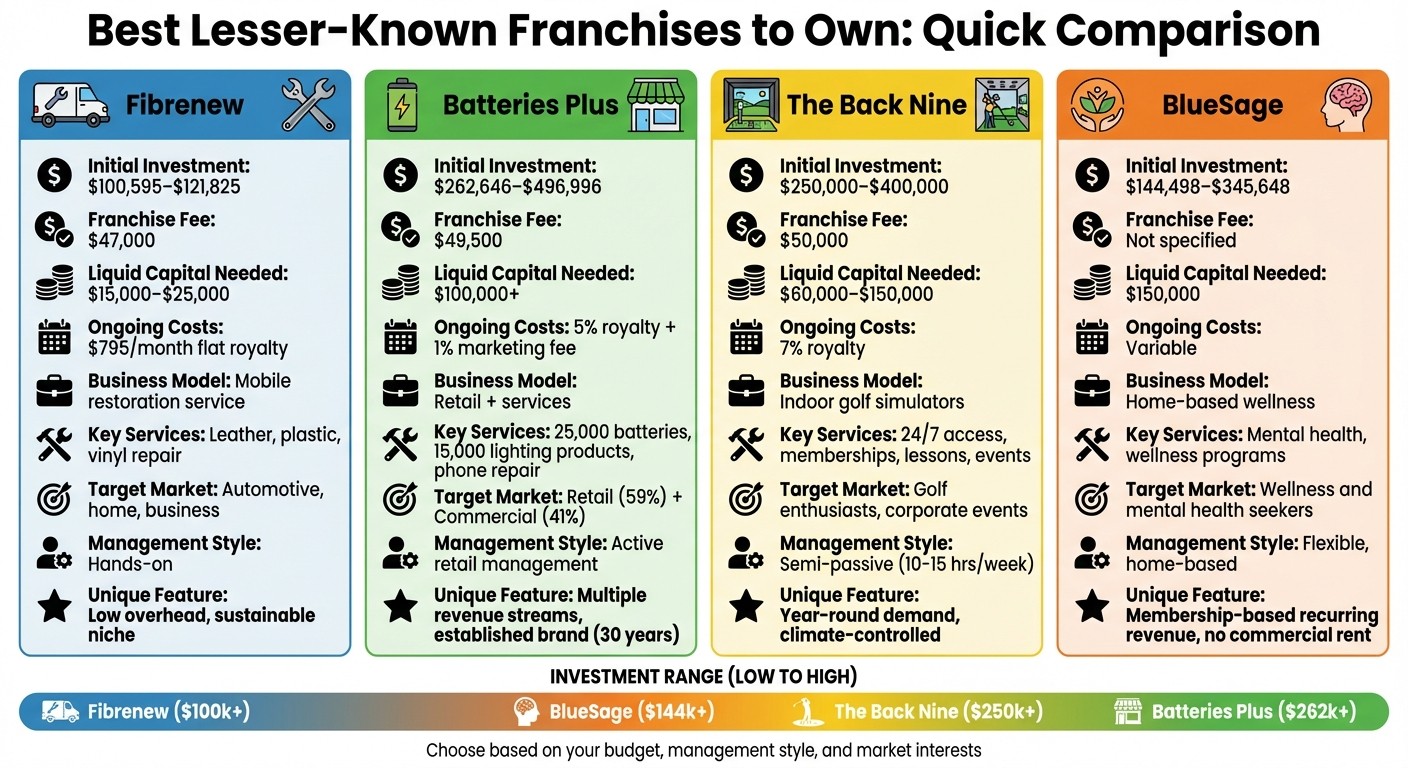
Comparison of 4 Best Lesser-Known Franchises: Investment Costs and Key Features
Top 5 Franchise Opportunities You’ve Never Heard Of (But Should Consider)
1. Fibrenew
Fibrenew focuses on restoration and repair services, specializing in fixing leather, plastic, and vinyl for clients in the automotive, home, and business sectors. Instead of replacing damaged items, they restore them, which aligns perfectly with growing consumer preferences for repair over replacement in today’s circular economy. Their business model offers a sustainable alternative and comes with clear investment guidelines for potential franchisees.
Investment Requirements
Getting started with a Fibrenew franchise requires an initial investment between $100,595 and $121,825, which includes a franchise fee of $47,000. Franchisees need $15,000 to $25,000 in liquid capital and a minimum net worth of $100,000. A flat monthly royalty fee of $795 ensures predictable costs, regardless of business growth. For veterans, there’s a $4,700 discount on the franchise fee [23,24].
Market Potential
The home services market is expected to hit $1.03 trillion between 2025 and 2029. Fibrenew taps into this massive opportunity by serving a wide range of sectors, including automotive, residential, commercial, medical, marine, and aviation. With rising home prices, more people are choosing restoration over replacement, making Fibrenew’s services even more appealing. Plus, their mobile service model keeps overhead costs low while allowing franchisees to efficiently reach a variety of customers.
Support and Training
Fibrenew provides a thorough, three-phase training program that includes 70 hours of classroom instruction and two weeks of hands-on technical training. After the initial launch, franchisees continue to receive support through multiple channels like phone, video chat, email, text, or a dedicated app. Weekly Zoom workshops every Wednesday morning offer additional guidance [20,23]. Impressively, 97% of franchisees recommend the brand, and 94% believe senior management fosters a strong team culture.
Franchisees also gain access to proprietary restoration products developed in-house, giving them a competitive edge that others can’t replicate [18,20].
"The field support, new products, marketing strategies, and technology are remarkable. They improve competitiveness, efficiency, and profitability." - Bill Bedsole, Franchisee
2. Batteries Plus
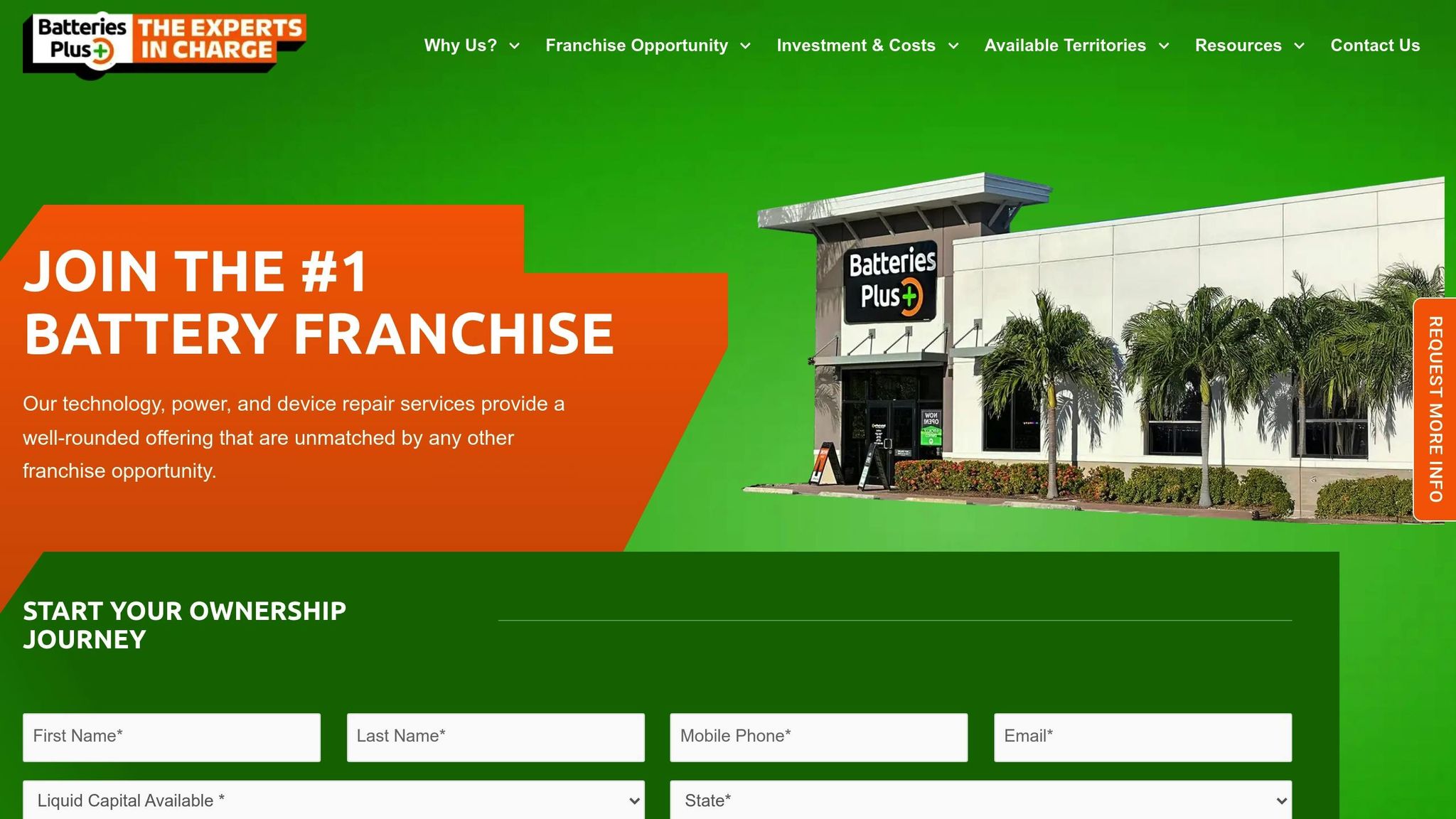
Batteries Plus stands out by offering a massive selection of 25,000 battery options and 15,000 lighting products - items you won’t typically find at big-box retailers [27,29]. Beyond that, the franchise diversifies its services with phone repair and car key fob programming, opening doors to multiple revenue streams. This versatility allows franchisees to cater to both everyday shoppers and commercial clients with specific needs.
Investment Requirements
Starting a Batteries Plus franchise requires an investment ranging from $262,646 to $496,996, which includes a $49,500 franchise fee. For those looking to own multiple units, the franchise offers a tiered fee structure: $39,000 for the first unit, $34,500 for the second, $29,500 for the third, and $25,000 for each additional unit. Ongoing costs include a 5% monthly royalty fee and a 1% national marketing fee based on net revenue.
New franchisees who open stores before the end of 2026 may qualify for over $107,000 in incentives, such as waived royalties and reduced fees, making the opportunity even more appealing.
Market Potential
Batteries Plus taps into a massive $652 billion market, covering batteries, lighting, car accessories, and phone repair [26,28]. In 2024, the average net revenue for its 494 franchised stores was $935,755, with the top 25% of locations averaging $1,608,969. The business model is built to weather economic downturns since its products and services remain essential no matter the economy.
The revenue split highlights its broad customer base: 59% of sales come from retail customers, while 41% are generated by commercial accounts like schools, hospitals, and manufacturers [26,27]. Across the U.S., the franchise serves over 250,000 commercial accounts, showcasing its extensive reach [27,30].
Support and Training
Batteries Plus ensures franchisees are well-prepared through intensive training programs and ongoing online support [27,32]. Its proprietary retail management system simplifies tasks like point-of-sale transactions, inventory tracking, and ordering [25,26]. A centralized 150,000 sq. ft. warehouse guarantees delivery of products within 1–2 days, enabling franchisees to hit the ground running. In fact, franchisees can start building commercial relationships even before their stores officially open [26,31,27,29].
"We just passed a milestone [in 2022] of $20 million in sales through our 13 stores… the commercial side of our business is critical to that growth."
– Miguel Perez, Multi-Unit Owner
3. The Back Nine
The Back Nine is redefining the golfing experience by blending technology with accessibility. Unlike traditional courses, it offers indoor simulators and driving ranges, attracting 27.9 million participants - outpacing the 25.6 million who frequent traditional courses. Launched in 2020 and franchising since 2022, The Back Nine provides 24/7 access to climate-controlled spaces equipped with top-tier simulators from Full Swing Golf and Trackman. Designed for semi-passive management, franchisees typically dedicate 10–15 hours per week, with the potential for full automation.
Investment Requirements
Starting a The Back Nine franchise requires an initial investment ranging from $250,000 to $400,000, which includes a $50,000 franchise fee [33,34]. Franchisees need $60,000 to $150,000 in liquid capital. Additionally, there’s an ongoing royalty fee of 7% on gross sales. This investment covers everything from state-of-the-art equipment and booking software to marketing, licenses, and training.
Market Potential
The Back Nine eliminates weather and time constraints, making golf more accessible to everyone. Facilities are typically 4,000–7,000 square feet and generate revenue through various channels, including memberships, hourly rentals, lessons, leagues, and corporate events. With over 100 locations already open or in development across the U.S., the franchise enjoys steady, year-round demand and reliable revenue streams [37,39].
Support and Training
Franchisees benefit from a comprehensive support system. This includes an exclusive training portal, hands-on assistance during the launch phase, and ongoing technical support. A dedicated real estate expert helps identify prime locations, and detailed facility design plans are provided. The proprietary booking software ensures smooth operations, offering 24/7 support for client management and subscription billing [37,38]. Marketing assistance includes a custom website, SEO training, and promotional materials to boost local visibility [37,38].
"By partnering with Full Swing Golf, we're equipping our facilities with the premier standard in golf simulator technology, ensuring every member has access to the same tools and experiences trusted by PGA Tour professionals like Tiger Woods." – Will Bangerter, CEO, The Back Nine Golf
4. BlueSage
BlueSage is making waves in the growing wellness and mental health sector in 2026. This industry is evolving quickly, with franchises blending cutting-edge technology with a strong sense of community. Many mental health franchises now offer services through mobile apps, teletherapy platforms, and even hybrid setups like co-working cafes that combine therapy and coaching in a shared space.
Investment Requirements
Starting a BlueSage franchise requires an initial investment of $144,498 to $345,648. To qualify, potential franchisees need at least $150,000 in liquid capital. A standout feature of the BlueSage model is its home-based business structure, which significantly lowers ongoing costs by removing the need for pricey commercial real estate. This lean cost model sets BlueSage apart in the competitive wellness industry.
Market Potential
The wellness and mental health sectors are on track for impressive growth in 2026. Within this space, advancements like AI-powered diagnostics, skin analysis tools, and subscription-based wellness memberships are gaining traction. These tech-driven solutions not only open up new revenue channels but also attract a broader audience looking for modern, convenient wellness services.
Revenue Model
BlueSage capitalizes on these trends by adopting a membership-based revenue model, which ensures a steady stream of recurring income. By combining in-person services, digital platforms, and subscription options, the franchise creates multiple revenue channels, offering financial stability. This approach reflects broader shifts in the wellness industry, where hybrid service delivery is quickly becoming the norm.
Comparison: Pros and Cons
Here’s a quick look at the strengths and challenges of each franchise option.
Fibrenew requires an initial investment ranging from $100,000 to $122,000, along with at least $15,000 in liquid capital. Its mobile service model is a standout feature, as it eliminates the need for a physical storefront. Plus, its focus on restoration taps into the growing appeal of sustainability trends. The downside? Franchisees must develop technical skills and stay actively involved in the hands-on aspects of the business.
Batteries Plus has a well-established retail model, backed by 30 years of steady growth. However, it comes with a higher upfront cash requirement of at least $100,000. Revenue streams include retail sales and battery-related services, but profit margins differ significantly - retail services typically yield 4%–8%, while business services can reach 12%–22%. This highlights the financial trade-offs between retail and service-based franchises.
The Back Nine and BlueSage represent newer franchise opportunities with forward-thinking business models. They emphasize modern, collaborative relationships between franchisors and franchisees, along with flexible support systems. Potential investors should take the time to dig deeper into these models to fully understand the investment requirements and operational details.
Conclusion
Finding the right franchise starts with understanding your ownership goals. If you're hands-on and prefer active management, options like Fibrenew might align with your needs. On the other hand, mobile or home-based franchises with lower startup costs are ideal for those focused on quick returns. For franchisees looking to build something bigger, scalable systems are key, while passive investors should lean toward franchises with proven, low-overhead management models.
Financial preparation is crucial. Plan for 3–6 months of operating capital in addition to the franchise fee. Carefully examine the Franchise Disclosure Document (FDD), paying close attention to Item 19 for earnings data and Item 7 for total investment requirements. If you're considering a trade-based franchise, ensure your agreement includes protected or exclusive territories to avoid internal competition. This groundwork sets you up to take advantage of market opportunities.
The franchise industry is projected to grow significantly, with over 20,000 new units and 210,000 jobs expected by 2025. The sector is anticipated to contribute around $936.4 billion to the U.S. economy, offering a strong case for niche brands. Lesser-known brands often present exciting opportunities, including prime territories, lower entry barriers, and the chance for early investors to influence brand growth. These trends underscore the importance of expert guidance when navigating such a dynamic market.
Expert consulting can make a world of difference, and that’s where Franchise Ki comes in. They offer free, personalized consulting services tailored to your lifestyle, financial goals, and business experience. Whether you're launching your first franchise or expanding into multi-unit ownership, their team provides hands-on support - from understanding legal details to assessing growth potential and franchisor strategies - all at no cost.
FAQs
What are the benefits of investing in lesser-known franchises like Fibrenew?
Investing in a franchise like Fibrenew comes with some unique perks, especially if you're looking for a business that's already proven itself across a variety of markets. Fibrenew focuses on leather and vinyl repair services, catering to industries such as residential, automotive, marine, aviation, and RVs. This setup allows franchise owners to tap into multiple revenue streams - all without needing to juggle multiple brands.
On top of that, Fibrenew offers strong support to its franchisees. From thorough training programs to ongoing resources and tools, they ensure you have what you need to deliver consistent, high-quality service. For entrepreneurs looking for a business that's flexible, scalable, and backed by a solid support system, Fibrenew is worth considering.
What are the typical startup and ongoing costs for niche franchise opportunities?
Niche franchises come with a wide range of startup and ongoing costs. For instance, low-cost options like home-based businesses or small service franchises might only require an initial investment of $700 to $25,000. On the flip side, specialized franchises in sectors such as fitness, retail, or hospitality often demand more significant investments - anywhere from $25,000 to over $150,000, depending on the concept and location.
Recurring fees also vary by industry. Smaller franchises typically charge royalties of 4%–12% of gross sales, along with marketing fees ranging from 1%–5%. While larger or well-established brands may have similar royalty percentages, they often come with higher upfront costs. Premium franchises, particularly in high-end fitness or hospitality, tend to charge royalties closer to 8%–12%, with marketing fees reaching up to 5%. It's crucial for potential franchisees to weigh both the initial costs and ongoing expenses to ensure the franchise aligns with their financial plans and goals.
What kind of training and support do new franchisees get from lesser-known franchise brands?
Emerging franchise brands often offer extensive training and support to set their franchisees up for success. One key area of assistance is site selection - franchisors typically help you identify a location that aligns with their standards. They might even assist with construction or setup to ensure the space reflects the brand’s image.
New franchisees usually participate in a comprehensive onboarding program that covers essential topics like daily operations, marketing strategies, financial management, and customer service. Once the business is up and running, the support doesn’t stop. Franchisees often gain access to marketing resources, including national campaigns, local promotions, and digital tools. Additionally, ongoing education - like webinars, refresher courses, and networking events - helps franchisees stay informed and confident as they navigate the growth of their business.
