Franchise Strategies
Jan 14, 2026
Compare emerging vs established franchises in 2025—costs, tech, market risk, and growth to help investors match opportunities to their goals and tolerance.

Emerging franchises are gaining traction in 2025, offering lower entry costs, modern systems, and untapped market opportunities. While established franchises provide proven models and strong brand recognition, they often come with higher fees, limited flexibility, and saturated markets. Here's what you need to know:
Emerging Franchises: Lower costs (often under $150,000), access to prime locations, and modern technology. However, they require franchisees to build local trust and navigate higher risks.
Established Franchises: Higher costs ($500,000+), predictable systems, and instant brand recognition. Challenges include market saturation, slower innovation, and less flexibility.
Key Stats:
Franchising grew by 2.4% in 2025, outpacing the U.S. economy's 1.9% GDP growth.
Emerging brands make up 25% of new franchise applicants.
Sectors like health and wellness grew by 8%, while fast-casual dining saw a 10% CAGR.
Quick Comparison:
Factor | Emerging Franchises | Established Franchises |
|---|---|---|
Entry Costs | Lower (<$150,000) | Higher ($500,000+) |
Market Presence | New, untapped territories | Saturated, limited growth |
Technology | Built-in modern systems | Slower to adopt |
Brand Recognition | Low, requires local effort | High, instant trust |
Risk | Higher, unproven models | Lower, predictable |
Emerging franchises are ideal for investors seeking lower costs and growth potential in evolving markets. Established franchises suit those prioritizing stability and proven systems. Choose based on your goals, risk tolerance, and market preferences.
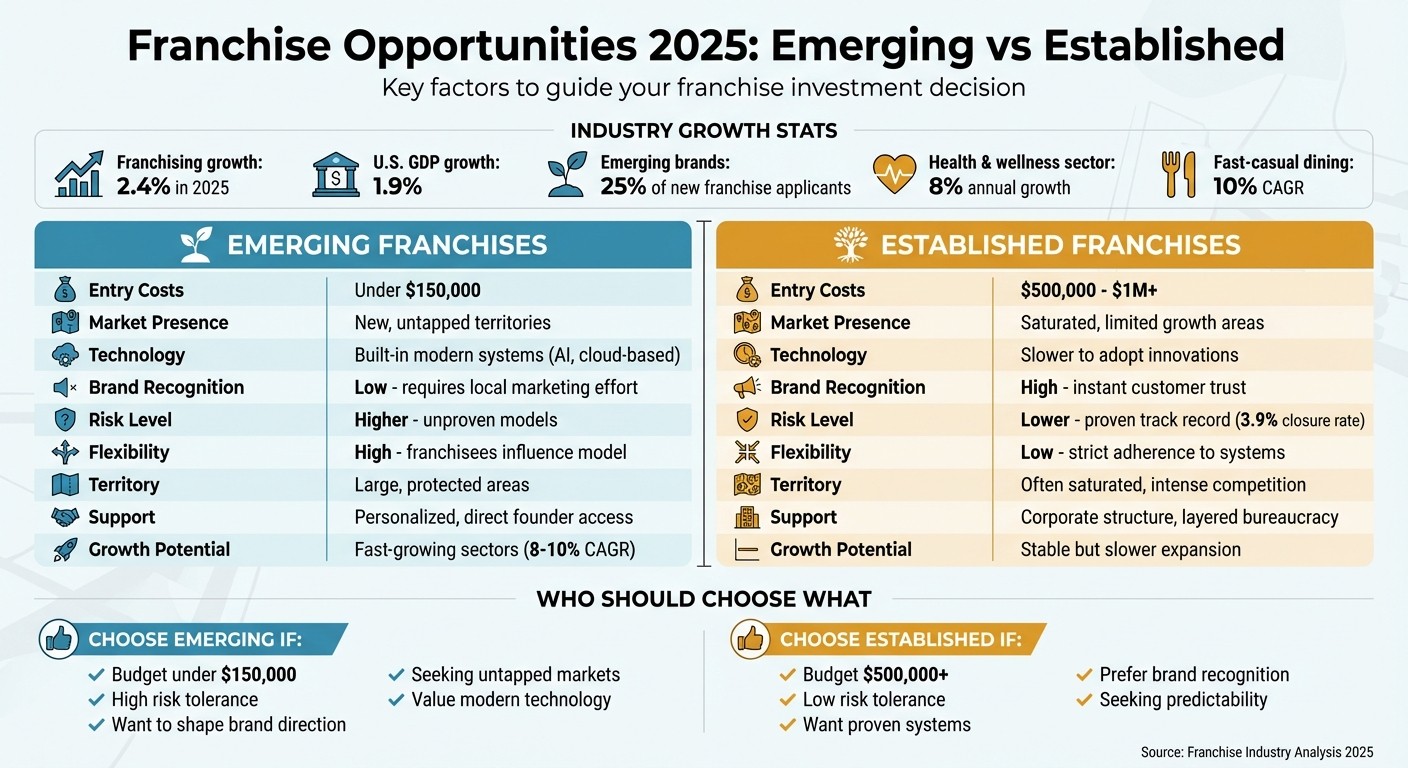
Emerging vs Established Franchises 2025: Cost, Risk & Growth Comparison
1. Emerging Franchises
Growth Potential
Emerging franchises open doors to new territories that established brands might have overlooked. For new franchisees, this means the chance to secure prime locations right from the start. This early positioning can lead to stronger market presence and greater long-term earnings.
The numbers back this up. Between July 2023 and July 2024, the top 150 fastest-growing franchises added 11,294 units across North America, marking a 9.5% growth compared to the previous year. Certain industries, like health and wellness, are expected to grow by 8% annually through 2025, while fast-casual dining boasts a 10% Compound Annual Growth Rate (CAGR). Emerging franchises are seizing these opportunities by focusing on niche markets rather than battling it out in oversaturated sectors.
Take Sticky Fingers Cooking, for example. Under the leadership of CEO Erin Fletter, this franchise operates as a "cooking school without walls." Its proprietary platform, The Dash, handles 85% of administrative tasks, enabling franchise owners to conduct programs in schools and libraries without needing permanent kitchen spaces. This approach not only cuts overhead costs but also broadens market reach.
With such a solid foundation, emerging franchises are well-positioned to thrive in fast-changing markets.
Market Adaptability
One of the strengths of emerging franchises is their ability to adapt quickly to shifting consumer preferences. They’re built with modern systems that allow for seamless integration of franchisee feedback.
Consider Massage Heights, which underwent a significant transformation in 2024. The franchise, led by co-founder and CEO Shane Evans, rebranded to Heights Wellness Retreat and expanded its offerings to include touchless therapies like lymphatic drainage, meditation, and infrared saunas. These changes not only addressed evolving wellness trends but also boosted revenue margins for franchisees. Similarly, Sigri, an Indian barbecue concept from Gregg Majewski of Craveworthy Brands, sold 10 units shortly after launching in 2025. Its appeal lies in offering authentic curry and fresh ingredients in a fast-casual, build-your-own format.
"Our agility allows us to innovate quickly, provide personalized support to franchisees, and build a brand that feels fresh and exciting. While larger brands may be tied to outdated systems, we've built our own technology to create a seamless experience." - Justin Wetherill, President, Jeff's Bagel Run
Entry Barriers
Emerging franchises often come with lower upfront costs compared to established brands. Many use asset-light models, mobile operations, or minimal staffing to keep overhead expenses low. For instance, Optic-Kleer, an auto-glass franchise planning expansion in 2026, requires a $59,900 franchise fee with total initial investments ranging from $194,000 to $428,000 (averaging $300,000). Mobile units generate an average of $218,000 in annual sales, with top performers reaching $437,000 at approximately 65% profit margins.
However, the trade-off is a lack of national brand recognition. Franchisees often need to act as local ambassadors, putting effort into building relationships and promoting the brand in their communities. Emerging franchises may still be refining their business models, which means franchisees have the unique opportunity to work closely with founders and help shape operations.
"Choosing an emerging franchise is not about avoiding risk - it's about choosing the right kind of risk." - Seth Lederman, Franchise Acquisition Specialist
While these cost advantages are appealing, they come with the challenge of needing proactive franchisees to establish local credibility, which can be risky.
Risk and ROI
Lower entry costs create opportunities but also introduce uncertainties. Emerging franchises often lack a long track record, so new owners must be diligent in reviewing Item 19 of the Franchise Disclosure Document (FDD) and assessing the experience of the founding team. Success typically demands hands-on involvement during the first 12–24 months.
That said, the potential for returns is promising. Emerging franchises in recession-resistant sectors like senior care (expected to grow at 7% CAGR) and pet services (9% annual growth) offer stability even in uncertain economic times. With lower startup costs, access to prime locations, and modern technology, these franchises can deliver higher returns compared to established brands that often come with hefty fees and saturated markets.
2. Established Franchises
Growth Potential
For legacy franchises, finding new avenues for growth can be tricky. Many have already tapped into the best markets, leaving limited opportunities for expansion. On top of that, internal bureaucracy often slows down decision-making and limits how much flexibility franchise owners have. This market saturation pushes well-established brands to get creative and innovate within the boundaries of their existing territories.
Market Adaptability
To keep up with changing consumer preferences, established franchises are gradually adopting modern technologies. Many are introducing AI-powered customer service tools and automated inventory systems into their operations. However, their pace of adoption tends to lag behind newer brands that integrate these technologies from the ground up. Ray Titus, Chairman and CEO of United Franchise Group, notes:
"Artificial intelligence will become more integral to franchise operations. Customer service, automated inventory systems and mobile apps are becoming essential tools for streamlining operations and enhancing user experiences"
Unlike newer franchises, which can pivot quickly, established brands often have to balance innovation with the constraints of their existing systems. Some, however, are finding ways to adapt. For example, Bonchon, a Korean fried chicken franchise, is expanding its U.S. presence from 150 to 500 planned locations by leaning into its signature sweet-and-spicy flavors. Similarly, Zoom Room, a dog-training franchise with nearly 70 locations, has shifted its focus from basic obedience training to addressing modern pet owners’ concerns, like socialization for anxious pets. CEO Mark Van Wye explains:
"I think the brands that are succeeding now aren't trying to lock people in... It's about making experiences so good that people are willing to opt in"
Still, maintaining consistency across a large network can make it harder for these brands to quickly respond to local market changes.
Entry Barriers
Joining an established franchise often comes with a steep price tag. The higher upfront costs reflect the value of a well-known brand and the comprehensive support systems they offer. Franchisees are usually required to have substantial capital reserves to keep operations running until they hit break-even. Another challenge? Prime locations are often already taken, leaving new franchisees to settle for less desirable or fragmented territories.
Take Greg Flynn, for instance. As of late 2024, he operated 1,245 restaurants, including Applebee's and Panera Bread, generating $2 billion in annual revenue. This level of consolidation makes it tougher for new entrants to carve out strong market positions. Additionally, established franchises typically seek candidates with solid financial resources and relevant industry experience. While these systems offer structure, they leave little room for franchisees to provide input or make changes. As Franchise Acquisition Specialist Seth Lederman puts it:
"Established franchises provide predictability, but often at the cost of high fees, limited flexibility, and intense competition from fellow franchisees"
Risk and ROI
Although high entry costs can feel risky, they come with the advantage of a proven business model. One of the biggest perks of joining an established franchise is the brand recognition, which can provide stability during uncertain economic times. Matt Haller, President & CEO of the International Franchise Association, explains:
"Franchising's strength lies in its unique ability to pair entrepreneurial ambition with the stability and name recognition of an established brand"
The numbers back this up. The sector is forecasted to add over 210,000 new jobs in 2025, with a growth rate of 2.4% - outpacing the U.S. economy’s projected 1.9% GDP growth. Quick-service restaurants alone brought in $250 billion in revenue in 2024, even as food prices climbed 29% over the previous four years.
That said, while established franchises offer predictability, their high overhead costs and internal competition can limit returns. Emerging brands, by comparison, often promise faster growth, albeit with higher risks.
Franchising 101 - Episode Forty Nine - Does the Size of the Franchise Matter?
Pros and Cons
When comparing emerging franchises to established ones, factors like entry costs, flexibility, and brand recognition stand out as key differentiators. Here's a closer look at how these two franchise models stack up:
Entry Costs can vary widely. Emerging franchises are generally more affordable, with many mobile or service-based options starting at under $150,000. On the other hand, established franchises often require larger investments - ranging from $500,000 to over $1 million. This higher cost reflects their established brand equity and operational infrastructure.
Flexibility and Innovation tend to favor emerging franchises. These newer businesses often integrate AI-driven tools and cloud-based platforms from the beginning. Franchisees also have the opportunity to collaborate directly with founders, influencing the direction of the business. In contrast, established franchises operate within rigid, time-tested systems that leave little room for creativity. As Seth Lederman, a Franchise Acquisition Specialist, explains:
"Choosing an emerging franchise is not about avoiding risk - it's about choosing the right kind of risk".
Brand Recognition and Proven Systems are key strengths of established franchises. They come with built-in customer trust and streamlined, turnkey operations. Established franchises also boast a low closure rate, averaging just 3.9%. However, many of the best territories are already taken, which can lead to competition among franchisees. Emerging franchises, by contrast, offer untapped "white space" opportunities with large, protected territories. The trade-off? Franchisees must build local brand recognition from the ground up.
Below is a summary of these differences:
Factor | Emerging Franchises | Established Franchises |
|---|---|---|
Entry Costs | Lower; often under $150,000 | Higher; $500,000–$1M+ |
Flexibility | High; franchisees can influence the model | Low; strict adherence to rules |
Brand Recognition | Low; requires building local trust | High; instant customer trust |
Systems | Agile, tech-forward | Proven, structured |
Territory | Large, protected areas | Often saturated |
Risk Level | Higher; unproven long-term viability | Lower; documented success rates |
Support | Personalized; direct founder access | Corporate; layered bureaucracy |
Ultimately, the choice between an emerging or established franchise depends on an investor's budget, risk tolerance, and growth goals. Each model offers distinct benefits and challenges, making it essential to weigh these factors carefully.
Conclusion
Based on the trends in growth, flexibility, and cost considerations, one thing is evident: by 2025, agility will hold more sway than tradition in the franchise world. Emerging franchises are gaining ground over established brands because they’re built with modern technology, offer access to prime territories, and can quickly adjust to changing consumer preferences. On the other hand, while established franchises come with the perks of proven systems and strong brand recognition, they often face challenges like outdated infrastructure and limited growth opportunities in oversaturated markets.
For those considering franchise ownership, it’s crucial to align your goals and risk tolerance with the right opportunity. If you’re drawn to shaping a brand’s direction, exploring untapped markets, and utilizing the latest technology, emerging franchises might be the right fit. As Jessica Fialkovich from Exit Factor puts it:
"As an emerging brand, we have a greater ability to be adaptable and incorporate franchisee feedback than an established brand".
The secret to success lies in doing your homework. Dive into Item 19 of the Franchise Disclosure Document, talk to current and former franchisees, and ensure the franchisor’s technology can handle growth. Look for a concept that resonates with the themes discussed here - growth potential, adaptability, and affordability - while focusing on sustainability, convenience, and meaningful services. This approach can set you up for long-term success in a fast-changing market.
And don’t forget, Franchise Ki’s free consulting services can help you find opportunities that align with your investment goals while providing ongoing support throughout your franchise journey.
FAQs
What are the benefits of investing in an emerging franchise over an established one?
Investing in a newer franchise can come with some compelling perks, starting with lower upfront costs and easier entry requirements. These businesses often demand less initial capital compared to big-name, established chains, making them a more approachable option for first-time franchise owners.
Another advantage is their alignment with current market trends. Many emerging franchises tap into areas like health-conscious services, tech-driven operations, or eco-friendly concepts. Plus, their ability to embrace new technologies - think AI and automation - can give them a leg up in staying relevant and competitive.
On top of that, these franchises often boast leaner operations. With reduced overhead and potentially higher profit margins, they can offer franchisees a more hands-on role. For instance, you might have more say in local marketing or business strategy - something that's harder to come by in larger, more rigid franchise systems. All in all, emerging franchises offer a chance to grow alongside a fresh, forward-thinking brand.
How do I evaluate the risks and potential returns of investing in an emerging franchise?
When assessing the risks and potential rewards of a new franchise, the first step is to dive into the Franchise Disclosure Document (FDD) and any financial statements you can access. Pay close attention to essential details like initial investment costs, royalty fees, and the overall financial stability of the franchise. It’s also smart to look into broader industry trends. For example, industries like health and wellness, fast-casual dining, or tech-driven services often show promising growth. Talking to current franchisees can give you firsthand insights into profitability and overall satisfaction.
To gauge your potential return on investment (ROI), compare upfront costs - typically ranging from $50,000 to $150,000 - with expected revenue and growth projections. A break-even analysis can be particularly useful for understanding how long it might take to recoup your initial investment. Franchises with low overhead costs, strong support systems, and scalable business models are often better positioned for long-term success. For added confidence, consult with a franchise attorney and accountant to ensure you're making a sound, informed decision.
Which industries offer the best growth potential for emerging franchise opportunities?
Emerging franchises are flourishing across several booming industries. Health and wellness continues to dominate, fueled by a growing need for senior care, mental health services, and programs aimed at children’s education and enrichment. Meanwhile, the pet-care industry is experiencing a surge, with services for pets becoming a popular pick for those looking to start a franchise. In the food world, fast-casual dining holds strong, particularly in niches like beverages, desserts, chicken, and Asian cuisine, which are expected to remain favorites heading into 2025.
On top of that, service-based franchises are on the rise. Areas such as AI-powered home services, business services, personal care, junk removal, restoration, and home improvement are expanding quickly. These sectors offer a mix of high consumer demand and relatively low barriers to entry, making them attractive options for entrepreneurs eager to invest in forward-thinking opportunities.
