Franchise Strategies
Jan 19, 2026
Explore high-margin, lower-cost franchise options in AI home services, mental health clinics, automated QSRs, eco-friendly cleaning, and senior fitness.
Looking for franchise opportunities with high returns and lower costs? Forget the big names like McDonald's - some of the best options in 2026 are in emerging industries like AI-powered home services, mental health clinics, and eco-friendly cleaning. These franchises offer higher profit margins, lower startup costs, and less competition. Here's what you need to know:
AI-Integrated Home Services: Franchises like Optic-Kleer and Juiced Fuel use automation to cut costs and increase efficiency, with profit margins up to 65%.
Mental Health Support: Brands like RCG Behavioral Health and Ellie Mental Health address rising demand for specialized care, generating up to $2.1M in annual sales.
Automated Quick-Serve Restaurants: VenHub and CafeXbot use robotics to slash labor costs, offering EBITDA margins over 50%.
Eco-Friendly Cleaning Services: Franchises like Stratus Building Solutions and Chem-Dry cater to the growing demand for non-toxic cleaning, with affordable startup costs.
Specialty Fitness for Older Adults: The Exercise Coach and Ageless Fitness target the aging population, combining compact spaces with tailored programs.
Key Takeaway: Emerging franchises in niche markets often outperform traditional ones in profitability and scalability. Whether you prioritize low entry costs, high margins, or recession-resistant industries, these options meet real consumer needs and offer strong growth potential.
One of the Best "BORING" Businesses to Start in 2026
1. AI-Integrated Home Services Franchises
Home service franchises have long been reliable money-makers, but with AI now in the mix, these businesses are seeing profit margins soar. By incorporating machine learning and automation, these franchises are transforming traditional services into highly efficient operations. We're not just talking about standard plumbing or lawn care anymore. These businesses are using AI to predict equipment failures, deploying chatbots for 24/7 customer support, and offering software-driven services that can bring in $250–$600 per job with nearly 100% profit margins. Let’s dive into some examples of how this works.
One standout is Optic-Kleer, which introduced an AI-powered auto glass franchise model in January 2026. A key feature of their service is integrating ADAS (Advanced Driver Assistance Systems) recalibration into windshield replacements. This is critical for modern vehicles, where safety features depend on precise calibration. By leveraging advanced AI tools, Optic-Kleer completes these jobs in under an hour. The franchise comes with a fee of $59,900, total startup costs between $194,000 and $428,000, and a liquid capital requirement of $100,000. Their mobile units can achieve profit margins as high as 65%.
Seth Lederman, a franchise acquisition expert, explains the appeal of these newer models:
"Newer franchises are launching with cloud-based systems, data-driven marketing, automation tools, and AI-supported operations integrated from day one - rather than retrofitted later".
This built-in technology allows for leaner operations and lower overhead. Tasks like scheduling, billing, and customer service, which traditionally required multiple employees, are now automated. This shift significantly cuts payroll expenses.
The home service industry itself is massive, valued at nearly $300 billion. Within this space, AI-powered franchises are carving out lucrative niches. For instance, Juiced Fuel uses a proprietary tech platform to handle automated ordering, routing, and customer communication for its mobile fuel delivery service. By adopting an asset-light model, they avoid costly real estate investments. Another example is Preservan, a wood restoration franchise that uses AI-driven marketing and customer management tools. With startup costs ranging from $81,400 to $130,000 and a franchise fee of $50,000, it offers an attractive entry point for investors.
2. Mental Health & Neurodiverse Support Franchises
The behavioral health industry, currently valued at $140 billion, is grappling with a shortage of providers while diagnoses continue to rise - for instance, 1 in 31 children are now diagnosed with autism. This growing demand for specialized services has opened the door for franchise models offering innovative care solutions, including center-based, in-home, and alternative therapy approaches.
Franchise models are stepping up to address these unmet needs in creative ways. RCG Behavioral Health is a standout in neurodiverse care, focusing on ABA therapy. Their centers operate with a 1:1 therapist-to-client ratio, offering both center-based and in-home services. Financially, their units generate impressive results, averaging over $2.1 million in sales with a 28% EBITDA margin. The required investment ranges from $282,100 to $584,067, which includes a $50,000 franchise fee and a 6% royalty.
Ellie Mental Health, another major player, has experienced rapid growth, expanding from zero to 183 locations between 2021 and 2023. Their model takes administrative burdens - like credentialing, billing, and intake - off clinicians' plates, letting them focus entirely on therapy. In 2023, their company-owned clinics averaged $1,646,099 in revenue, while newer franchise units averaged $395,689. The startup costs are higher, ranging from $392,275 to $679,575, with a $60,000 franchise fee and a 7.5% royalty.
For those seeking a lower-cost entry point, Nora Mental Health offers a more affordable model. Startup costs fall between $85,800 and $205,500, including a $40,000 franchise fee. Instead of traditional royalties, they charge a flat $550 monthly fee per active clinician. Outlets with six clinicians average $614,970 in revenue, with margins of 22.8%. The franchise has also signed a 31-unit development deal for the Western U.S., signaling its growth potential.
LearningRx, focusing on cognitive training for conditions like ADHD and dyslexia, serves a slightly different niche. Their centers report average gross revenues of $344,447, with top-performing locations nearing $900,000. Startup costs range from $148,000 to $220,000, with franchise fees between $30,000 and $45,000. This positions them well in the supplemental education market, which is projected to hit $155 billion by 2030.
In all cases, the ability to scale revenue depends heavily on recruiting and retaining qualified clinicians. The more providers these franchises can bring on board, the greater their potential for growth.
3. Quick-Serve Restaurants with Automation & Drive-Thru-Only Models
Quick-service restaurants are stepping into the future by embracing automation and drive-thru-only formats. These cutting-edge models are tackling labor shortages head-on while delivering profit margins that traditional setups often fail to match. Operating with minimal to no staff, these restaurants can run 24/7 and be up and running in as little as seven days - light-years ahead of the 12 to 16 months it takes to build a standard location. Combining lower startup costs with exceptional efficiency, these formats are carving out their place in new market niches.
Take VenHub, for example. Their automated units come with a price tag of $250,000 to $400,000 to build - just a fraction of the $750,000 to $1.5 million typically required for a traditional quick-service or convenience store. Plus, they only need between 160 and 600 square feet of space. These compact stores can stock anywhere from 300 to 1,600 SKUs and operate around the clock with theft-proof dispensing and closed-loop transactions. VenHub’s innovation hasn’t gone unnoticed - it was recognized at CES 2026 with awards for Best Automated Retail Innovation and Startup of the Year.
On the robotic cafe front, CafeXbot offers an equally intriguing proposition. With an initial investment of $80,000 to $123,000 per unit and no franchise fee, these kiosks boast EBITDA margins of over 50%, far outpacing the 3–9% margins seen in traditional setups. Maintenance is a breeze, requiring just 60 to 120 minutes daily, and strategically placed units have reported annual ROIs ranging from 80% to 300%. Some automated franchisors even sweeten the deal with passive income models, taking care of everything from location selection to maintenance in exchange for a share of the profits.
For context, top-performing traditional QSRs like McDonald’s and Chick-fil-A achieve EBITDA margins of approximately 12% and 15%, respectively, on annual sales of $3.65 million and $9.23 million per unit. By eliminating labor costs, cutting down on real estate expenses, and ensuring consistent quality through robotics, these automated models offer a powerful alternative for investors. With fewer operational headaches and the potential for higher returns, automation is reshaping the quick-service restaurant landscape and setting a new standard for profitability.
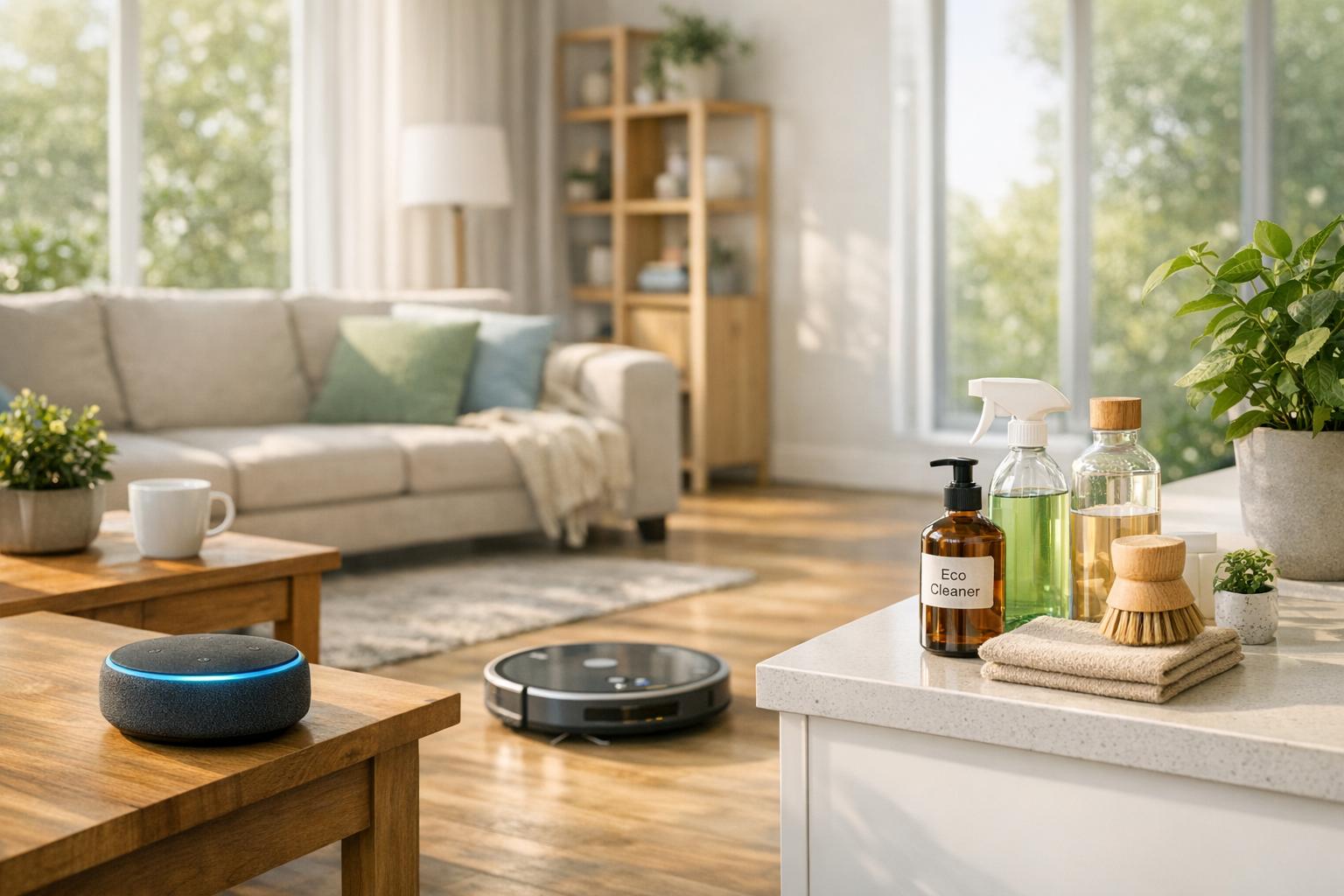
4. Clean Living & Eco-Friendly Cleaning Services
The cleaning services industry is undergoing a shift toward greener practices. In 2024, the global cleaning services market reached around $424 billion and is expected to climb to $734 billion by 2032, growing at an annual rate of 7.2%. In the U.S., the residential and commercial cleaning sector alone is projected to grow by $37.8 billion between 2025 and 2029. This growth is fueled by consumers who increasingly seek non-toxic, environmentally conscious cleaning services that not only ensure cleanliness but also improve indoor air quality. This demand has sparked innovative franchise opportunities tailored to eco-friendly solutions.
Eco-friendly cleaning franchise models cater to both residential and commercial markets. For example, Stratus Building Solutions requires an investment ranging from $4,450 to $79,750, The Cleaning Authority needs $92,850–$147,100, and Chem-Dry demands $71,145 to $241,000, each franchise offering unique royalty structures. Stratus has seen a 73% increase in its franchise units over the past three years. Meanwhile, The Cleaning Authority reported an impressive average gross revenue of $1,457,906 across 206 territories in fiscal year 2024. Chem-Dry, known for its mid-range investment, boasts a 96% customer retention rate, supported by its signature non-toxic cleaning solution, "The Natural".
The profitability of these franchises is shaped by their fee structures. The Cleaning Authority charges royalty fees of 4–6% based on revenue tiers, plus an additional 1% for a brand fund. Chem-Dry, on the other hand, opts for a flat monthly royalty fee of $452.44, along with a $160 national advertising fund fee. These franchises utilize tools like HEPA-filter vacuums and proprietary non-toxic cleaning solutions to appeal to health-conscious customers.
"The Cleaning Authority's mission is to deliver consistently exceptional, eco-conscious cleaning that frees customers to spend their time on the people and activities that matter most."
Eco-friendly cleaning services, much like specialized health services or AI-driven solutions, meet a growing demand for sustainable and high-quality options. Many cleaning franchises operate with an asset-light model, making them easier to scale. With over 10 billion square feet of new carpet installed annually in the U.S., specialized services like carpet cleaning remain in constant demand. Additionally, home-based franchise models eliminate the need for costly office spaces, and management-only structures allow franchise owners to focus on client acquisition rather than hands-on cleaning. This combination of low overhead costs, recurring revenue, and increasing consumer interest in sustainable practices positions eco-friendly cleaning franchises as a resilient investment choice, even during economic downturns.
5. Specialty Fitness for Aging & Adaptive Populations
The U.S. is experiencing a demographic shift as its population ages rapidly. By 2030, 73 million Americans are expected to be 65 or older, and by 2034, the number of older adults will reach 77 million, surpassing those under 18 for the first time in history. This group holds significant economic power, controlling 75% of the nation's wealth and 70% of disposable income.
This trend presents a growing opportunity for fitness franchises catering to aging and adaptive populations. These businesses fill a unique niche between physical therapy and traditional gyms. Take Ageless Fitness, for example, which requires an investment of $79,350–$227,000, including a $45,000 franchise fee and $80,000 in liquid capital. Impressively, it boasts a 95% conversion rate. Similarly, The Exercise Coach, targeting adults over 45, has grown its units by 61.8% over three years. It requires an investment of $136,009–$348,693, with a 6% royalty and 1% advertising fee. StretchLab, known for its focus on low-impact mobility and stretching, has achieved a 100% five-year continuity rate, with an average initial investment of $248,225.
Many of these franchises operate in compact spaces (800–2,000 sq ft), significantly reducing real estate costs compared to larger gyms. For instance, Live 2 B Healthy partners with senior living communities to deliver on-site group fitness classes, eliminating the need for dedicated facilities and requiring only $100,000 in liquid capital. The Exercise Coach takes a different approach, using bio-adaptive equipment like Exerbotics to offer personalized 20-minute strength training sessions. This model minimizes staffing needs while enhancing operational efficiency.
The financial potential in this market is substantial. Senior Helpers and ComForCare report average annual gross revenues of $1.49 million and $1.9 million, respectively, after five years. By 2034, the senior care market is projected to grow to $644 billion. Older adults also exhibit strong brand loyalty, with membership durations for those aged 50+ averaging nearly two years longer than younger demographics.
These fitness programs prioritize improving balance, mobility, and strength to reduce the risk of falls and enhance independence. Many also offer specialized programs for conditions like Parkinson's disease or Alzheimer's, fostering deeper client relationships. With fitness trainer roles expected to grow by 15% and physical therapy jobs by 18% through 2029, the demand for these services shows no signs of slowing. Moreover, many franchises operate on a semi-absentee ownership model, allowing investors to scale multiple locations while lead coaches manage daily operations.
Pros and Cons
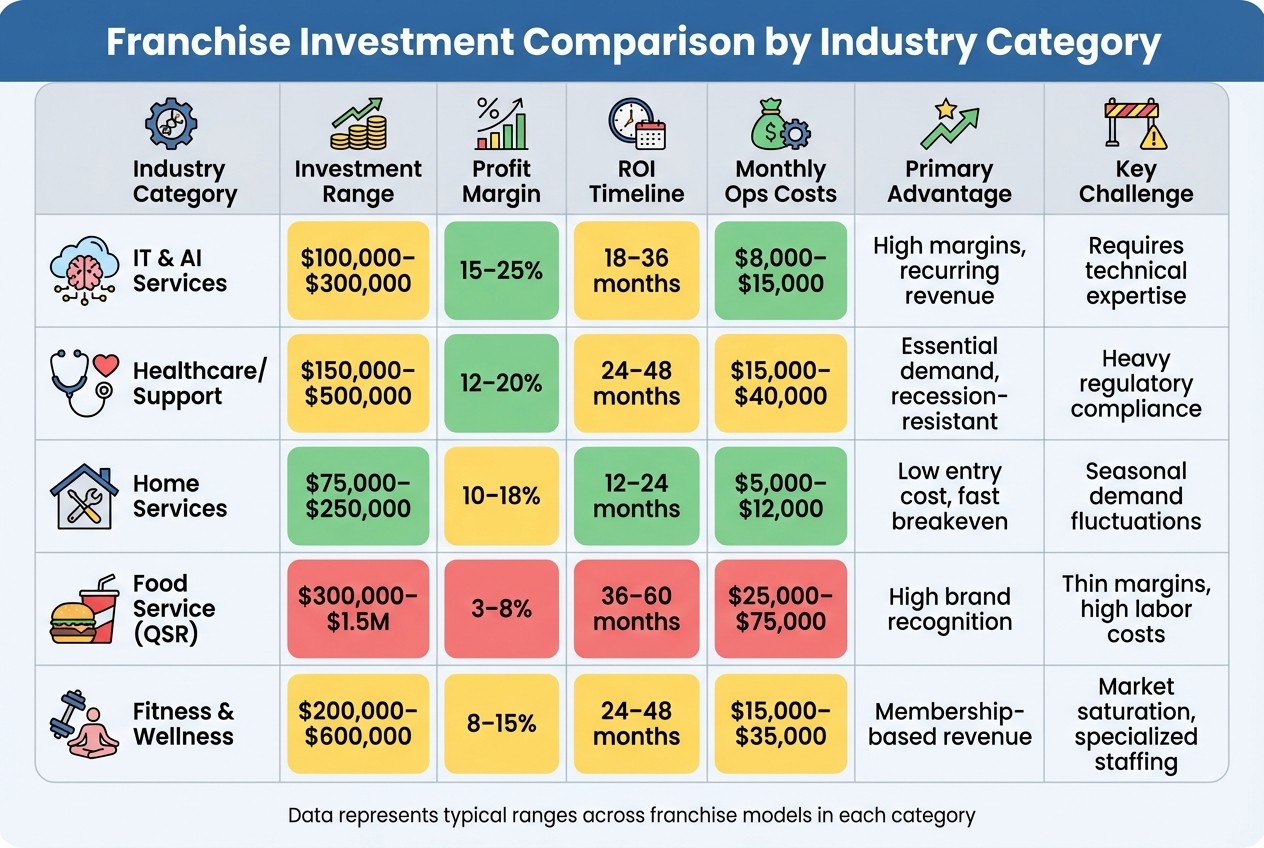
Franchise Investment Comparison: ROI, Costs, and Profit Margins by Industry
When diving into the world of franchise opportunities, it's essential to weigh the financial and operational tradeoffs unique to each category. Here’s a breakdown of the key benefits and challenges across different franchise types.
Franchise categories come with distinct advantages and hurdles that can significantly impact profitability. For example, food service franchises like Chick-fil-A boast impressive unit volumes (around $6.7 million annually), but their net margins hover between just 3–8%. On the other hand, IT and business service franchises can achieve much higher margins, ranging from 15–25%.
Investment levels also vary widely. Home services franchises require less upfront capital and tend to reach breakeven faster than food service models. Meanwhile, recurring revenue models, such as those found in IT services, offer more predictable cash flow and typically result in higher business valuations compared to one-off transactional models. IT services also enjoy the lowest monthly operating costs, which fall between $8,000 and $15,000, whereas food service franchises face significantly higher operating expenses, ranging from $25,000 to $75,000 per month.
Staffing needs play a major role in determining profitability as well. IT and home service franchises benefit from lower staffing requirements, which help boost efficiency. In contrast, restaurant franchises often face labor costs that eat up 25–35% of revenue, compounded by an annual employee turnover rate of 75%. The integration of AI and automation can provide a competitive edge across industries, though implementing these technologies requires technical expertise.
Here’s a side-by-side comparison of franchise categories:
Industry Category | Investment Range | Profit Margin | ROI Timeline | Monthly Ops Costs | Primary Advantage | Key Challenge |
|---|---|---|---|---|---|---|
IT & AI Services | $100,000–$300,000 | 15–25% | 18–36 months | $8,000–$15,000 | High margins, recurring revenue | Requires technical expertise |
Healthcare/Support | $150,000–$500,000 | 12–20% | 24–48 months | $15,000–$40,000 | Essential demand, recession-resistant | Heavy regulatory compliance |
Home Services | $75,000–$250,000 | 10–18% | 12–24 months | $5,000–$12,000 | Low entry cost, fast breakeven | Seasonal demand fluctuations |
Food Service (QSR) | $300,000–$1.5M | 3–8% | 36–60 months | $25,000–$75,000 | High brand recognition | Thin margins, high labor costs |
Fitness & Wellness | $200,000–$600,000 | 8–15% | 24–48 months | $15,000–$35,000 | Membership-based revenue | Market saturation, specialized staffing |
This comparison highlights how different franchise models align with varying levels of investment and operational challenges. For example, healthcare and support franchises often face heavier regulatory and licensing requirements, which can increase startup costs and delay timelines. On the flip side, essential services like IT support and restoration tend to be more resilient during economic downturns compared to franchises reliant on discretionary spending. By carefully matching your investment strategy with the right business model, you can maximize your chances of achieving strong returns.
Conclusion
When it comes to profitable franchises, the most lucrative opportunities often aren't the household names you might expect. Service-based models in areas like IT support, home services, and specialized healthcare consistently deliver net profit margins of 10–25%, far outpacing the slim 3–8% margins typical in food service franchises. The key is to align your investment with your personal goals and risk tolerance.
Start by examining Item 19 of the Franchise Disclosure Document to get a clear picture of actual financial performance, rather than relying on marketing claims. Then, take the time to speak with franchisees who have been operating for at least five years. Ask them direct questions about whether they’re able to pay themselves adequately and if the franchisor’s support meets their expectations. As CMIT franchisee Arvind Hariharan shared:
"CMIT's validation calls opened the books on year one through year ten, showing exactly how much franchisees invested and earned, giving me a clear blueprint and the confidence to launch my own franchise".
This kind of financial due diligence is essential for setting up a lean and efficient operation.
Another critical factor to consider is operational efficiency. Opting for home-based or mobile franchise models can significantly reduce overhead costs by eliminating the need for expensive storefronts. Additionally, recurring revenue streams - like commercial cleaning contracts or managed IT services - offer consistent cash flow, making it easier to manage budgets and scale your business.
Don’t forget to weigh opportunity costs. Compare safer investment options against franchises with a projected ROI of 25–50%. For example, home service franchises often break even within 12–24 months, while quick-service restaurant models may take 36–60 months to reach the same milestone.
Finally, choose a franchise that aligns with current market trends, such as AI-driven solutions, essential services, or sustainability-focused businesses. It’s also important to pick a model that fits your budget and lifestyle. Whether you’re leaning toward recession-proof restoration services or fitness concepts that adapt to evolving needs, success ultimately depends on thorough research and a realistic understanding of what you can manage.
FAQs
What are the startup costs and profit margins for AI-powered home service franchises?
When it comes to the startup costs and profit margins of AI-powered home service franchises, the numbers can differ significantly based on factors like the specific franchise brand, its location, and the range of services it provides. Generally, startup expenses might include items such as franchise fees, equipment purchases, training programs, and marketing efforts. On the other hand, profit margins are influenced by things like how efficiently the business operates and the level of demand in the market.
To get a more accurate picture, take the time to thoroughly research individual franchise options. Dive into their financial disclosures to ensure they align well with your investment objectives and expectations.
How do mental health franchises help address the shortage of providers?
Mental health franchises are stepping up to tackle the ongoing shortage of providers by rapidly increasing the number of clinic locations. They operate on a business model that’s already been tested and refined, giving franchisees a head start. With perks like established branding, built-in administrative systems, marketing support, and streamlined hiring processes, franchise owners can onboard qualified therapists much faster than independent practices. This efficiency helps clinics open in areas that often lack adequate care, cutting down wait times and improving access for local communities.
Many of these franchises also offer telehealth services and engage in community outreach, extending their services far beyond their physical locations. This dual approach ensures that clinicians can reach more people, even in remote or underserved areas. By blending clinical know-how with solid business infrastructure, mental health franchises are meeting the rising demand for services while offering communities a reliable and accessible way to get the care they need.
Why are eco-friendly cleaning franchises a smart and sustainable investment?
Eco-friendly cleaning franchises blend the reliable demand of the cleaning industry with the rising consumer interest in environmentally conscious services. The cleaning sector is known for its resilience during economic downturns, driven by consistent needs for residential, commercial, and specialized cleaning. Plus, these franchises often come with relatively low startup costs, making them an attractive option for first-time investors. Regular service contracts also create steady, recurring revenue.
What sets eco-friendly cleaning franchises apart is their focus on sustainability. By using non-toxic, biodegradable cleaning products and water-saving techniques, they not only appeal to eco-conscious customers but can also reduce operational expenses. This mix of financial reliability and a commitment to environmental responsibility makes these franchises a smart, forward-looking investment opportunity.
