Franchise Strategies
Mar 2, 2026
Five practical funding strategies for e-commerce franchises: revenue-based financing, crowdfunding, equipment and franchisor loans, and strategic partnerships.

Starting an e-commerce franchise? Funding is critical - especially in the first two years when cash flow issues can derail success. Here’s a quick breakdown of five effective funding options to help you secure capital and manage expenses:
Revenue-Based Financing: Flexible repayments tied to sales, ideal for bridging cash flow gaps. Approval often requires 6–12 months of revenue history.
Crowdfunding: Platforms like Kickstarter let you raise funds while generating early buzz. Success hinges on strong pre-launch planning and marketing.
Equipment Financing: Spread the cost of essential tools (e.g., software, inventory systems) over time without draining cash reserves.
Franchisor Direct Financing: Many franchisors offer funding for franchise fees or royalty deferrals, simplifying the process for new franchisees.
Partnerships: Collaborate with suppliers, private equity firms, or other businesses to secure funding and resources.
Each option has its pros and cons. Choose based on your cash flow, growth goals, and business model. For personalized advice, consult Franchise Ki, which offers free consulting services to help you navigate funding and franchise opportunities.
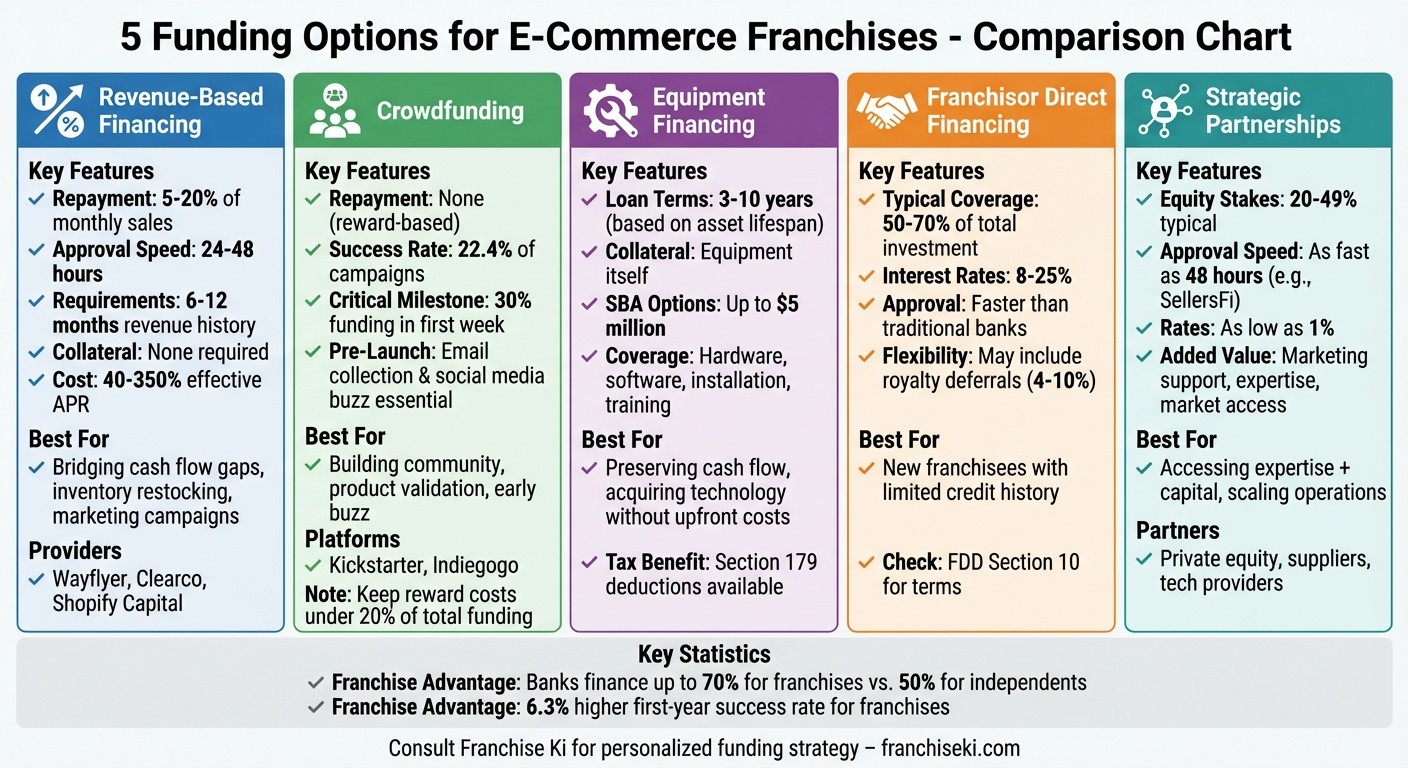
5 E-Commerce Franchise Funding Options Comparison Chart
How to Fund Your Franchise: Top Creative Financing Strategies
1. Use Revenue-Based Financing for Flexible Repayments
Revenue-Based Financing (RBF) offers a repayment model where a fixed percentage - typically 5% to 20% - of your monthly sales is used to pay back the loan. This setup automatically adjusts to your cash flow, making it a practical choice for online businesses dealing with inconsistent sales cycles.
One of the standout benefits of RBF is the speed of approval. Many providers integrate with platforms like Shopify or Amazon to analyze real-time sales data, enabling them to release funds within 24 to 48 hours. Plus, there’s no need to pledge physical assets as collateral, meaning you can keep full ownership of your franchise. This approach is particularly helpful for bridging cash flow gaps that e-commerce startups often face. As Stephen Brown from LedgerGurus notes:
If you want a good price on your capital, you need to have clean financial statements.
However, this flexibility comes at a cost. While lenders often advertise flat fees of 6%–12%, the effective APR can range from 40% to 350%. Additionally, many providers require a proven revenue history of 6 to 12 months before approving your application. Popular RBF providers include Wayflyer, Clearco, and Shopify Capital.
Before committing to RBF, ensure your business metrics - like gross margins (ideally 40%–60%), Customer Acquisition Cost (CAC), and Lifetime Value (LTV) - can handle the expense. Calculating the true APR is crucial to understanding the full cost. This financing option works best for growth-related investments, such as restocking inventory or funding marketing campaigns that directly boost revenue and help cover repayments. Up next, we’ll look at how crowdfunding can complement your funding approach.
2. Try Crowdfunding to Build Community Support
Crowdfunding platforms like Kickstarter and Indiegogo offer a way to raise funds while also creating a buzz around your e-commerce franchise before it officially launches. One major advantage of reward-based crowdfunding is that it doesn’t require repayment - your backers receive products or exclusive perks instead. However, only 22.4% of campaigns successfully reach their funding goals, so careful planning is essential.
Hitting at least 30% of your funding target within the first week is crucial. This creates a "herd effect", which enhances your campaign’s credibility. Jordan Stephanou, Head of Sales at Crowdcube, emphasizes this point:
The goal should be low enough that the company is likely to hit the funding goal (100%) by the end of the first week or so, and overfund for the majority of the campaign, where scarcity and FOMO kick in.
A great example of crowdfunding success is Ryan Grepper, who raised over $13 million on Kickstarter in 2014 for a high-tech cooler. His campaign stood out thanks to its transparency, polished visuals, and tiered reward system.
To make your campaign stand out, focus on creating high-quality videos and professional graphics that clearly communicate the why behind your franchise - not just the products you’re selling. Build excitement before launching by collecting email sign-ups and sharing teasers on social media. A small initial audience can slow down your momentum, so pre-launch buzz is key. Once your campaign is live, prioritize email marketing as your main traffic driver. Pair this with social media hashtags, influencer collaborations, and a dedicated team member to respond quickly to backer questions.
That said, crowdfunding isn’t without its challenges. It demands consistent updates and active engagement. Additionally, revealing your idea publicly before securing intellectual property protection can be risky. To minimize costs, aim to keep reward production and shipping expenses under 20% of your total funding. Between September 2020 and March 2021, Coolest Products raised over $188,000 for their "Coolest Coffee Table." They maintained trust and built long-term relationships with their 300 backers by providing 17 production updates throughout the campaign.
Transparency and engagement are the cornerstones of a successful crowdfunding campaign. Done right, it can turn backers into loyal advocates for your business.
3. Use Equipment Financing to Preserve Cash Flow
Equipment financing offers a practical way to acquire the tools you need - everything from warehouse shelving to server infrastructure - without depleting your cash reserves. By spreading payments over several years, you can keep more capital on hand to fuel other areas of growth.
One big advantage? The equipment itself usually serves as collateral. That makes approval easier compared to unsecured loans, which is especially helpful if you're a new franchisee without a long business track record. For e-commerce businesses, "equipment" doesn’t just mean physical machinery - it can also include inventory management software, CRM platforms, point-of-sale systems, and even automated picking robots. As Mariela Merino from Crestmont Capital points out:
Leasing ensures your e-commerce business can access the latest technology and equipment without the need for costly upgrades.
When financing, it's smart to align the loan term with the lifespan of the asset. For example, durable items like conveyor systems or forklifts might work well with 7–10 year loans. On the other hand, rapidly evolving technology, such as servers, is better suited for 3–5 year leases.
If you're looking for larger loans, SBA 7(a) and 504 loans allow you to finance up to $5 million in equipment with competitive rates. However, these loans often take more time to get approved compared to specialized equipment financing.
Of course, there’s a trade-off. Financing typically means higher overall interest costs and fixed monthly payments, which can feel burdensome during slow sales periods. But for many e-commerce franchisees, the ability to maintain liquid capital during the crucial startup phase outweighs these downsides. Many financing programs even cover "soft costs" like delivery, installation, and staff training as part of the total funding amount.
Before you dive in, take a close look at your FDD's Item 7 to understand the equipment you'll need and see if your franchisor offers direct leasing options. Also, don’t forget to explore Section 179 tax deductions - you might be able to deduct the full purchase price of the equipment in the year it’s put into service. These steps can help you secure favorable terms while keeping your business on track for future investments.
4. Consider Franchisor Direct Financing for Faster Access
Some e-commerce franchisors provide direct financing programs, making it easier and quicker for new franchisees to secure funding. Unlike traditional banks, franchisors are invested in your success and may be more flexible, even if your credit history or collateral is limited.
This option often involves a faster and simpler process compared to third-party lenders. In fact, many franchisees fund 50% to 70% of their total investment through franchisor-led financing programs. Alex Smereczniak, CEO of Franzy, highlights this approach:
Franchisor financing... can be the easiest and often the cheapest way to borrow money for a franchise.
To navigate this effectively, review Section 10 of the Franchise Disclosure Document (FDD). It outlines the available financing options and their terms, helping you make informed decisions while reducing risk. Ask whether the franchisor can finance the upfront franchise fee, as this is a common focus of such programs. Additionally, check if they offer royalty fee deferrals - some franchisors allow you to delay the typical 4% to 10% royalty payments during the initial months of operation. This can provide much-needed breathing room when cash flow is tight.
However, franchisor financing may come with rigid terms that leave little room for negotiation compared to working with multiple third-party lenders. Interest rates for franchisor-related loans can range from 8% to 25%, often higher than traditional prime-based loans. To ensure you’re getting the best deal, compare the franchisor’s offer with SBA loans or bank financing.
Before committing, speak with current franchisees to learn about their experiences with the financing program. Consult a franchise-savvy accountant or lawyer to review the agreement and ensure it aligns with your financial goals. Using tools like a franchise loan calculator can help you estimate your break-even point, ensuring your projected earnings cover loan payments and ongoing royalty fees. Careful planning like this can help you avoid financial stress down the road. Next, consider forming partnerships to expand opportunities for shared growth.
5. Form Partnerships for Shared Growth
Strategic partnerships can be a game-changer when it comes to securing both funding and expertise for your business. Unlike traditional lenders, such as banks that primarily provide capital, strategic partners often bring additional resources to the table. These might include marketing support, operational know-how, or access to new markets. For example, private equity firms and funding partners may require equity stakes ranging from 20% to 49%. Meanwhile, companies like SellersFi offer financing options with rates as low as 1% and approval times of just 48 hours.
Collaborations can also lead to impressive marketing wins. In August 2024, Fishwife teamed up with Fly By Jing to create a co-branded smoked salmon infused with Sichuan Chili Crisp. This partnership not only generated millions of media impressions - including mentions in The New York Times - but also brought in a significant number of new customers for both brands. Fishwife’s CEO, Becca Millstein, highlighted the importance of having clear agreements in place:
With most collabs where serious time, effort, and cash is invested, you need a document to establish your mutually agreed upon deliverables so that there's no confusion.
The best partnerships are those where both sides contribute meaningful resources. Suppliers, for instance, often make excellent partners because your success directly boosts their sales. Similarly, technology providers might help fund essential system upgrades, while real estate developers could support expansion efforts. A great example of this is Aura Bora, a beverage brand that partnered with Brex in 2024. Through this partnership, Aura Bora accessed credit limits 30 to 40 times higher than those offered by traditional business cards. Co-founder and CEO Paul Voge explained:
Access to higher limits and extended payment terms enables us to keep up with inventory without straining our working capital.
However, before entering into any partnership, it’s crucial to ensure your partner’s values and reputation align with your own. This helps safeguard your brand’s integrity. Consulting with franchise attorneys can also help you structure agreements that protect your interests. To measure the success of a partnership, establish clear performance metrics and track results with reliable analytics. And if there are any shifts in funding or business objectives, communicate these changes promptly so your partner can adjust their approach.
For guidance on forming strategic partnerships, check out Franchise Ki’s free consulting services at https://franchiseki.com.
Conclusion
Securing funding for an e-commerce franchise becomes much easier when you understand your options. Revenue-based financing offers flexibility by aligning repayments with your sales, which can be especially helpful during slower periods. Crowdfunding not only raises money but also validates your business idea and builds early support. With equipment financing, you can get the tools and technology you need without cutting into the cash reserves needed for inventory or marketing. These funding options allow you to secure capital while maintaining operational flexibility.
Franchisor direct financing simplifies the process, as franchisors are already familiar with the business model, while strategic partnerships bring in both funding and industry expertise to help you grow in a competitive market. As David Canet, Managing Director of SBA Lending at ConnectOne Bank, points out:
The strength of the franchisor is key in franchise lending. A strong franchisor with good financial health provides confidence in the success of the franchisee.
Choosing the best funding method depends on your unique needs, cash flow, and growth goals. For franchises, banks may finance up to 70% of the initial investment, compared to just 50% for independent startups. Franchise businesses also have a 6.3% higher success rate in their first year compared to independent ventures, making franchising an appealing option - provided you align the right funding source with your situation.
Before applying for financing, check the SBA Franchise Directory to confirm your franchise is pre-approved, which can significantly simplify the approval process. Use your Franchise Disclosure Document (FDD) to create credible revenue projections that lenders will trust, and ensure your unit economics reflect strong profit margins.
For tailored advice on funding and franchise selection, Franchise Ki offers free consulting services at https://franchiseki.com. Their team is ready to help you develop a funding strategy designed for long-term success.
FAQs
Which funding option fits my cash flow best?
The right funding choice largely depends on your financial situation and cash flow requirements. If you need flexibility that matches the ebb and flow of e-commerce sales, options like merchant cash advances, lines of credit, or inventory financing might be worth exploring. On the other hand, if you value predictable payments and have a stable cash flow, traditional bank loans could be a better fit. Franchise Ki provides free consulting services to help you identify funding solutions that align with your business goals and financial circumstances.
How can I estimate the true cost of revenue-based financing?
To figure out the cost of revenue-based financing (RBF), start by calculating how much you'll repay in total compared to the initial funding. Most providers set a repayment cap, usually between 1.2x and 1.6x the funding amount. Since repayments are tied to your revenue - typically ranging from 5% to 20% - you'll need to project your future revenue. Then, apply the agreed repayment percentage to your forecast to estimate the overall cost over the repayment period.
What should I check in the FDD before taking financing?
Before seeking financing, take the time to thoroughly review the Franchise Disclosure Document (FDD). This document outlines all costs and obligations tied to the franchise. Focus specifically on Items 5–7, which detail franchise fees, initial investments, and ongoing expenses. Also, check Item 19 for any financial performance information, if it's included.
To ensure you fully understand these sections and spot any potential financial risks or hidden costs, it's a good idea to consult with a franchise attorney or a CPA. Their expertise can help you make more informed decisions.
