Business Strategies
Mar 2, 2026
How AI cuts emissions and waste in supply chains with demand forecasting, inventory tuning, route optimization, transparency, and practical implementation tips.
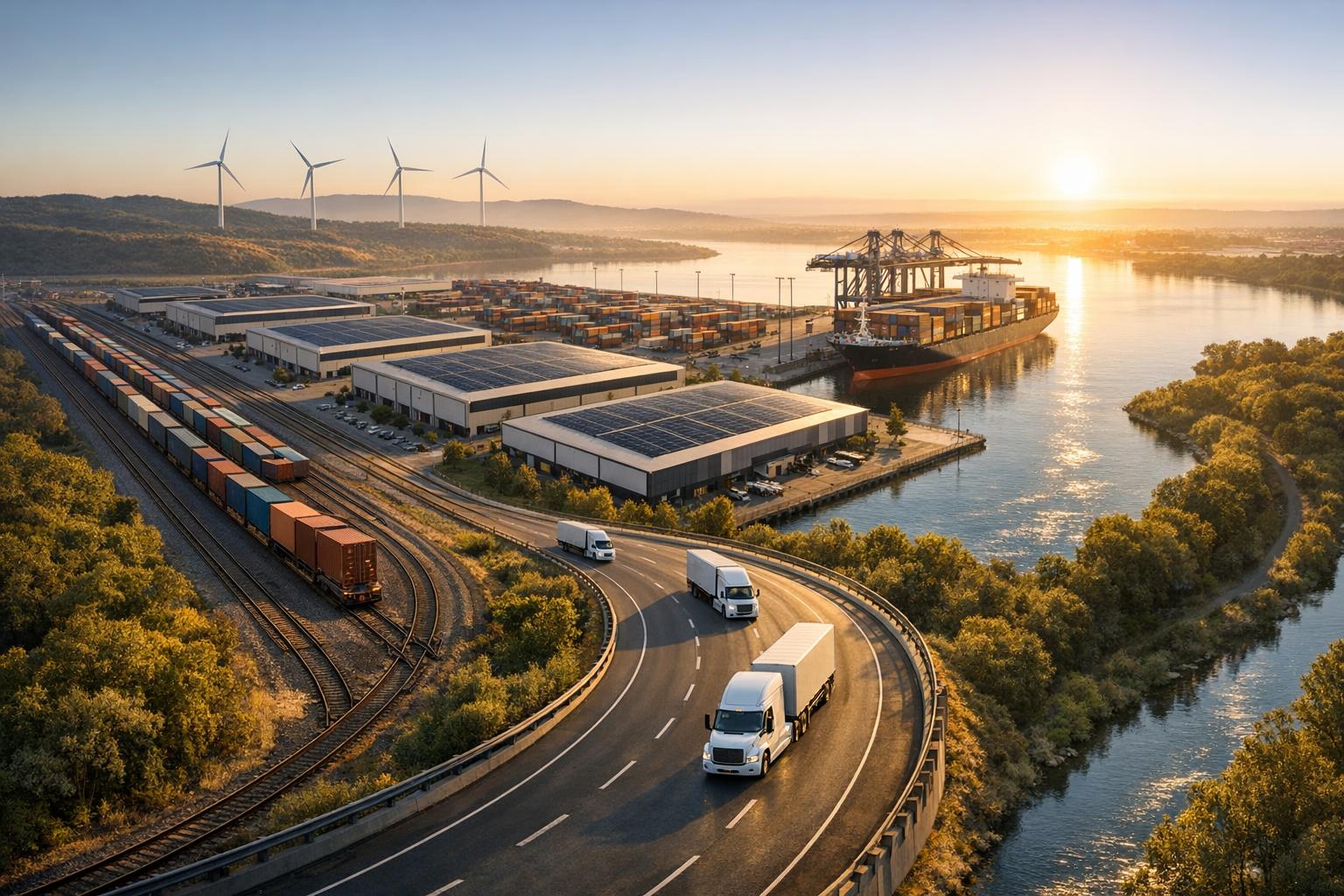
AI is reshaping supply chains by reducing emissions, cutting waste, and improving efficiency. Supply chain operations generate over 25% of global carbon emissions, with 80%-90% stemming from indirect sources like suppliers and logistics. AI tackles these challenges by predicting demand, optimizing inventory, and improving delivery routes. Companies using AI have already reduced emissions by 5%-10% and saved millions annually. However, only 25% of businesses currently leverage AI for sustainability goals, leaving significant room for growth.
Key AI technologies driving change:
Demand Forecasting: Reduces overproduction by predicting customer needs with precision.
Inventory Management: Optimizes stock levels to prevent waste and excess.
Route Optimization: Cuts fuel use and emissions by finding efficient delivery paths.
AI also enhances supply chain transparency, tracks ethical sourcing, and introduces digital product passports for lifecycle tracking. To implement AI effectively, businesses must focus on clear goals, reliable data, and pilot programs. Combining AI with IoT and blockchain can further improve efficiency and accountability.
How AI and Data Are Transforming Sustainable Supply Chains | Ganesh Gandhieswaran & Tom Raftery
Main AI Technologies for Sustainable Supply Chains
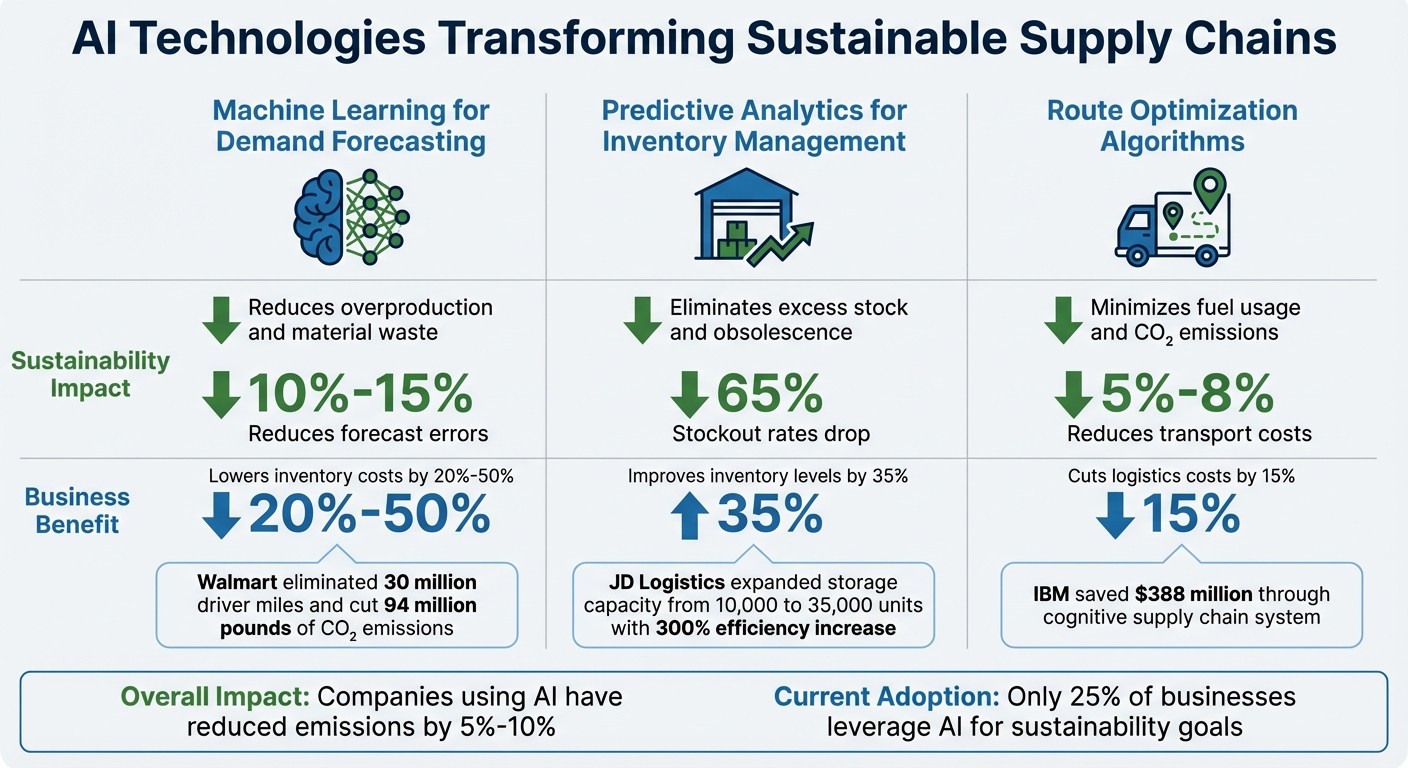
AI Technologies Impact on Sustainable Supply Chains: Sustainability vs Business Benefits
Three key AI technologies are reshaping how businesses create more sustainable supply chains: machine learning for demand forecasting, predictive analytics for inventory management, and route optimization algorithms. Each tackles specific inefficiencies that harm the environment while delivering measurable benefits for businesses. These technologies build on earlier advancements, directly addressing challenges to improve sustainability.
Machine Learning for Demand Forecasting
Machine learning (ML) isn’t just about crunching historical sales data. It pulls insights from a variety of sources - like weather forecasts, economic trends, social media activity, competitor pricing, and even satellite imagery - to predict customer demand with greater precision. This method, often called demand sensing, significantly enhances accuracy, reducing forecast errors to as low as 10%–15%.
Take Amazon, for instance. The company uses AI-driven demand forecasting across its massive catalog of over 400 million products, analyzing customer behavior and market trends to automate reordering during spikes in demand. Similarly, Walmart employs an AI system that fine-tunes restocking strategies at thousands of stores. This initiative not only eliminated 30 million driver miles but also cut 94 million pounds of CO₂ emissions. By mitigating the so-called bullwhip effect - where small changes in consumer habits lead to exaggerated shifts in production and procurement - ML helps align supply with actual demand. Companies that fully integrate AI into their supply chains have reported inventory reductions of 20% to 50% and stockout rate drops of 65%. The result? Lower costs and a more sustainable approach to supply chain management.
Predictive Analytics for Inventory Management
Once demand is forecasted, predictive analytics takes over to optimize inventory management. AI models, like Artificial Neural Networks (ANN) and Decision Trees, continuously adjust safety stock levels. This ensures companies strike the right balance between avoiding stockouts and preventing excess inventory. Businesses using these tools have seen inventory improvements of up to 35%, which directly cuts down on the carbon footprint tied to warehousing, handling, and disposing of unsold goods.
For example, JD Logistics operates self-managing warehouses where AI determines the best placement for goods based on demand trends and product dimensions. This approach expanded storage capacity from 10,000 to 35,000 units and increased operational efficiency by 300%. Predictive analytics minimizes waste and energy use, making inventory management leaner and greener.
Route Optimization Algorithms
Logistics efficiency gets a major boost with AI-powered route optimization. These algorithms do more than just calculate the shortest route - they analyze real-time traffic, weather conditions, fuel costs, vehicle performance, and delivery windows to determine the most efficient paths. The payoff? Reduced fuel consumption, lower CO₂ emissions, and a 5%–8% cut in overall transport costs.
IBM provides a compelling example. Over a decade-long transformation set to conclude in 2024, the company implemented a cognitive supply chain system featuring AI assistants and a "sense-and-respond" control tower. This overhaul saved IBM $388 million by reducing inventory costs, optimizing shipments, and speeding up decision-making - from days to mere seconds. The system also enhances resilience by identifying risks like weather disruptions or port congestion early, allowing for proactive rerouting that avoids costly rush shipments and emissions spikes.
AI Technology | Sustainability Impact | Business Benefit |
|---|---|---|
Demand Forecasting | Reduces overproduction and material waste | Lowers inventory costs by 20%–50% |
Inventory Management | Eliminates excess stock and obsolescence | Improves inventory levels by 35% |
Route Optimization | Minimizes fuel usage and CO₂ emissions | Cuts logistics costs by 15% |
How AI Improves Supply Chain Sustainability
AI is reshaping supply chains, not just by streamlining logistics and inventory but by tackling some of the most pressing environmental and ethical challenges. From cutting emissions to ensuring ethical sourcing, AI is driving measurable progress toward sustainability goals.
Cutting Waste and Emissions
AI helps prevent waste and reduce emissions by predicting demand and identifying inefficiencies throughout the supply chain. For instance, computer vision systems can detect manufacturing defects early, stopping flawed products from advancing further. This reduces wasted materials, energy, and transportation. Predictive maintenance also plays a role by monitoring equipment to prevent breakdowns and extend its lifespan.
AI-powered systems optimize energy use in factories and warehouses, including HVAC systems and industrial equipment. Many of these systems integrate renewable energy sources, further reducing emissions. Packaging efficiency is another area where AI shines, improving material usage and recyclability. These efforts add up - AI-enabled logistics can cut fuel consumption by 12%–15%. Considering that food waste alone accounts for 8%–10% of global greenhouse gas emissions, the potential impact is enormous.
However, it's worth noting that generative AI systems are energy-intensive, consuming around 33 times more energy than task-specific models. Companies aiming for sustainability are increasingly turning to specialized AI to minimize energy consumption while still achieving their goals. Beyond emissions, AI also addresses ethical challenges in supply chains.
Tracking Ethical Sourcing and Transparency
AI enhances visibility in supply chains, especially in areas prone to ethical risks. Using Graph Neural Networks, AI maps complex supply chains, identifying vulnerabilities among Tier‑2 and Tier‑3 suppliers that are often overlooked. It also evaluates suppliers based on environmental, social, and governance (ESG) criteria, enabling ongoing monitoring instead of relying on periodic audits.
Real-time risk monitoring adds another layer of transparency. AI analyzes external data - such as news articles, social media, and sentiment analysis - to flag issues like financial instability, regulatory violations, or ownership changes among suppliers. Natural Language Processing (NLP) tools even parse legal contracts to ensure compliance with ethical clauses, penalty terms, and termination rights. When combined with IoT sensors, satellite imagery, and blockchain, AI can verify factory activity levels and environmental conditions, creating an unalterable record of product origins and material flows.
This shift from annual audits to continuous monitoring represents a significant step forward in ethical sourcing. By 2026, 15% of supply chain software is expected to use software bills of materials (SBOMs) to improve transparency and prevent cyberattacks. With these tools in place, the next step is tracking products throughout their entire lifecycle.
Digital Product Passports for Lifecycle Tracking
Building on supply chain transparency, Digital Product Passports (DPPs) use AI to track products from raw materials to disposal, creating a detailed environmental record at every stage. These passports automate data collection and standardization across thousands of suppliers, even those with limited digital capabilities. AI also keeps up with evolving regulations - like the EU's Ecodesign for Sustainable Products Regulation (ESPR) - and automates compliance checks, reducing the need for manual reporting.
Starting in 2026, the EU will require digital product passports for all industrial and electric vehicle batteries. By April 19, 2025, manufacturers, importers, and retailers of priority products like steel and textiles must also provide DPPs. These AI-powered tools can estimate a product's remaining lifespan, optimize maintenance schedules, and extend usability. They also offer repair and disassembly instructions, enabling circular business models where products are maintained and reused rather than discarded.
"We're talking about mostly existing data. We're talking about a decentralised or distributed approach to the data. It does not have to move from where it's created." - William Neale, Adviser for Circular Economy, European Commission
DPPs could cut compliance costs in the consumer electronics sector by 15%, saving about $214 million annually. Advanced technologies like zero-knowledge proofs allow companies to verify sustainability claims - such as material composition - without exposing sensitive data. Additionally, blockchain technology, often used to secure DPP data, can improve supply chain efficiency by as much as 74%.
How to Implement AI in Your Supply Chain
Start by setting precise goals, like reducing Scope 3 emissions by 30%, and identifying the areas in your supply chain that contribute the most to environmental impact. Since Scope 3 emissions from suppliers and logistics often make up around 80% of a company's overall climate footprint, these areas are crucial to address. These initial steps lay the groundwork for integrating advanced tools effectively.
Launch pilot programs. Instead of revamping your entire supply chain at once, begin with a focused project - like optimizing delivery routes in one region or improving demand forecasts for a specific product. This lets you quickly demonstrate ROI and build confidence across your organization. As Deloitte’s Supply Chain Team suggests:
"Gain some quick wins and momentum and then accelerate".
Currently, only 30% of AI initiatives in supply chains factor in sustainability, so early successes can set your company apart.
Build a strong data foundation. Nearly half of companies cite poor data quality as the biggest hurdle to using AI for ESG goals. Address this by consolidating fragmented data through IoT sensors and standardized emissions reporting. Without reliable data, even the most advanced AI systems won’t deliver actionable insights.
Involve your team from the start. Integrate AI outputs into everyday tools like procurement dashboards or dispatch systems and provide training to help staff interpret AI-driven recommendations. With 95% of CEOs already investing in AI education programs, it’s clear that technology alone isn’t enough - team buy-in is essential. Overcome resistance by fostering transparency and embedding AI into daily workflows.
Using AI with IoT and Blockchain
Pairing AI with IoT sensors and blockchain creates what’s known as the "Trust Triad." Here’s how it works:
IoT sensors collect real-time data on factors like temperature, location, and humidity, creating a digital twin of your assets.
Blockchain locks this data into a secure, tamper-proof ledger by cryptographically recording events like custody transfers or temperature changes.
AI analyzes the blockchain data to predict arrival times, optimize routes, or flag quality issues and fraud.
To get started, focus on a high-value segment of your supply chain, such as temperature-sensitive pharmaceuticals or ethically sourced minerals. This allows you to prove ROI in a controlled environment before scaling. Adopting interoperable data standards like EPCIS (Electronic Product Code Information Services) ensures seamless communication with partners and prepares your system for future growth. Building a core group of collaborators, like a key supplier and logistics partner, is also essential to align on data sharing and legal frameworks. Blockchain, when used effectively, has been shown to improve supply chain efficiency by up to 74%.
Addressing Implementation Challenges
While AI, IoT, and blockchain offer significant benefits, challenges like data fragmentation, high energy use, and resistance to change can’t be ignored.
Data fragmentation: Supply chains often rely on scattered spreadsheets for carbon tracking. Solve this by investing in unified carbon accounting software and IoT sensors.
Energy demand and scalability: AI systems and data centers are energy-intensive, with electricity usage expected to exceed 9% of total U.S. power by 2030. Address this by optimizing code, using renewable-powered data centers, and tailoring AI models for specific sites.
Organizational resistance: Employees may hesitate to trust AI’s "black box" algorithms. Upskilling teams and creating transparent AI governance frameworks can help build trust. Using explainable AI (XAI) models and incorporating human oversight into anomaly detection systems can also improve accuracy and reduce alert fatigue.
Security and privacy risks: Sensitive data, like pricing, can be stored securely off-chain while only cryptographic hashes are saved on the blockchain for verification.
Implementation Challenge | Description | Potential Solution |
|---|---|---|
Data Fragmentation | Carbon data scattered across spreadsheets | Use carbon accounting tools and IoT sensors |
AI Energy Intensity | High power consumption of AI systems | Employ "Green AI" practices and energy-efficient hardware |
Organizational Resistance | Hesitancy to trust AI algorithms | Upskill teams and ensure transparent governance |
Scalability Issues | Adapting AI models to diverse sites | Use modular systems with site-specific tuning |
Best Practices for AI Adoption
To ensure success, co-develop AI use cases with supply chain leaders instead of leaving decisions solely to IT teams. This ensures alignment with operational needs and business goals. Use a mix of AI types:
Discriminative AI for recognizing patterns (e.g., demand forecasting)
Prescriptive AI for decision-making (e.g., inventory management)
Generative AI for summarizing unstructured data, like supplier ESG reports
Focus on preparing your data before deploying complex models. Invest time and resources in identifying, cleaning, and contextualizing data to ensure AI delivers meaningful results.
To address the energy demands of AI, schedule intensive tasks during times when renewable energy is most available. Establish internal governance committees to monitor AI performance and ethical considerations. These committees should define clear principles for accountability and data privacy, particularly when working with shared ledgers or permissioned blockchains.
As pilot programs prove their value, expand globally while maintaining strong governance. With 41% of CEOs planning to increase investments in Generative AI within the next year, companies that adopt these practices early will be better positioned to scale effectively.
Conclusion and Future Outlook
Key Takeaways
By 2026, AI is expected to be fully operational in helping businesses address Scope 3 emissions, which account for about 80% of their overall climate impact. As Sebastian Klotz from IntegrityNext explains:
"AI does not replace existing processes. It amplifies them. That means its quality, reliability and usefulness are directly shaped by what already exists underneath: data quality, regulatory interpretation, and expert judgment."
To succeed, companies need a solid data foundation before implementing advanced AI models. While sustainability is still a secondary focus in many current AI initiatives, there’s a shift happening. Leaders are starting to treat carbon emissions as an operational metric, tracking them in real time. By 2030, AI is anticipated to help reduce global greenhouse gas emissions by 5% to 10%. However, this progress comes with challenges, like the energy paradox - AI’s energy consumption could account for as much as 9% of total U.S. energy use by 2030.
Looking ahead, the next big step is leveraging AI to create self-healing supply chains.
What's Next for AI in Sustainability
As companies continue to refine their AI-driven sustainability efforts, the next phase will focus on self-correcting, autonomous supply chains. Kishan Kumar from Southern Connecticut State University describes this transformation:
"There will be a 'self-healing' supply chain as we move toward having systems that not only recognize issues, but can also autonomously take action to correct those issues."
By the end of this decade, AI is expected to manage around 90% of routine supply chain tasks, freeing up human workers to concentrate on strategic decisions, relationship management, and complex issues that require judgment. These future systems will autonomously resolve problems, automate contract and risk analysis, and leverage digital twins to simulate and address vulnerabilities. This will lead to a more efficient "physical internet", reducing empty trips and fuel waste.
However, this progress comes with a cautionary note. Marisa Brown from APQC highlights a critical concern:
"AI adoption is outpacing accountability for sustainability. APQC recommends that organizations account for increased energy consumption tied to AI when calculating their sustainability performance."
This underscores the need for businesses to balance AI advancements with responsible energy use as they move toward reshaping supply chains.
FAQs
What data do I need before using AI for supply chain sustainability?
To integrate AI effectively into supply chain sustainability efforts, start by collecting detailed, well-organized data. This should cover areas like carbon emissions, resource consumption, inventory levels, supplier operations, and compliance with regulations. The data must be accurate, consistent, and easy to interpret. This not only strengthens confidence in AI-driven insights but also promotes openness throughout the supply chain.
How can I measure AI’s impact on Scope 3 emissions?
AI plays a key role in measuring Scope 3 emissions by leveraging advanced tools for data collection, analysis, and real-time monitoring. It pulls together information from various sources, such as ERP systems, emails, and supplier portals, to provide precise and reliable reporting. Additionally, AI tracks the impact of decarbonization efforts by comparing data from before and after these initiatives, helping businesses stay compliant with regulations like the EU CSRD and California SB 253. This approach delivers clear, measurable insights into both emissions and reductions.
How do I start with a low-risk AI pilot that shows ROI fast?
To kick off an AI pilot with minimal risk and fast returns, start with small, focused projects that can make a noticeable difference - like demand forecasting or improving logistics. Pick a process where outcomes are easy to measure and ensure the AI integrates seamlessly with your current systems. Make sure your data is reliable, and keep models updated to maintain accuracy. This strategy helps minimize risk, speeds up results, and can deliver measurable ROI in just a few months.
