Education Strategies
Jan 18, 2026
Explore the key differences between traditional tutoring centers and free online education platforms, highlighting cost, accessibility, and flexibility.
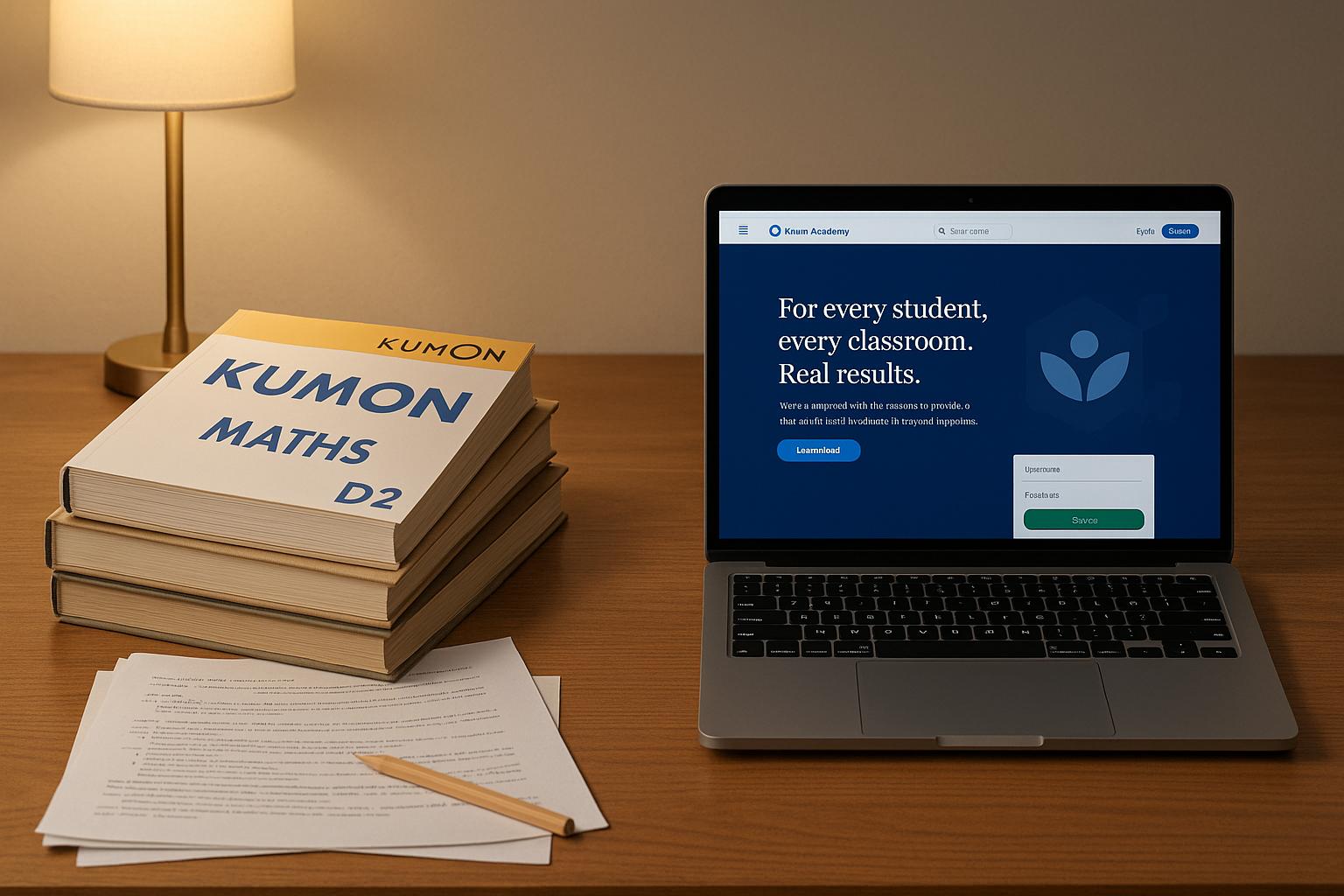
When deciding between Kumon and Khan Academy, the key differences come down to cost, accessibility, and learning flexibility:
Kumon charges monthly fees, requires travel to physical centers, and uses a worksheet-based system focused on math and reading. It offers a structured environment but can be expensive and less flexible.
Khan Academy, on the other hand, is entirely free, available online 24/7, and covers a broader range of subjects. Its self-paced, interactive platform caters to diverse learning styles and removes financial and geographic barriers.
For families, educators, or investors, Khan Academy provides a cost-free, scalable option with tools that support personalized learning, while Kumon relies on a more traditional in-person tutoring model with recurring expenses.
Quick Comparison
Feature | Kumon | Khan Academy |
|---|---|---|
Cost | Monthly fee required | Free |
Access | In-person, fixed hours | Online, 24/7 availability |
Subjects | Math and reading | Wide range, including SAT prep and programming |
Learning Style | Structured, worksheet-based | Self-paced, interactive |
Scalability | Limited by location/staff | Unlimited, global reach |
Khan Academy’s free, digital-first approach makes it a more accessible and flexible solution for modern learners, while Kumon’s in-person model may suit those who need a structured routine. Ultimately, Khan Academy’s ability to deliver quality education without financial barriers gives it a clear edge.
Is Khan Academy the Best Free Learning Tool? Pros, Cons, and My Thoughts! || Online Homeschooling
Kumon: A Franchise-Based Tutoring System
Kumon is known for its structured, worksheet-focused approach to learning. This program emphasizes building strong skills in subjects like math and reading by guiding students through a carefully designed series of exercises. The key idea is to let each student advance at their own pace, ensuring they fully grasp each concept before moving forward. The details of this worksheet-driven approach are explained below.
Worksheet-Based Learning Method
The heart of Kumon's approach lies in its meticulously organized worksheets, which are crafted to promote steady progress and solid understanding. By working through these exercises, students strengthen their foundational knowledge through consistent practice and repetition.
However, the reliance on a strict paper-based system may pose challenges for students who thrive with more varied or interactive learning methods.
Khan Academy: Free Online Education Platform
Khan Academy, launched in 2008 by Salman Khan, has transformed education by offering free, digital learning resources across the United States. Built on the principle that education should be accessible to everyone, the platform provides a wealth of tools and materials to learners at no cost.
Unlike traditional tutoring centers that require physical attendance and tuition fees, Khan Academy operates entirely online. Students can dive into thousands of video lessons, practice exercises, and personalized learning tools - all without spending a dime. This digital-first approach brings education into the modern age, redefining how we think about affordability and accessibility.
Free Access Anytime, Anywhere
One of Khan Academy's standout features is its commitment to breaking down financial barriers. By providing free, unlimited access to educational content, it saves families from the burden of costly tuition.
The online platform is available 24/7, allowing students to learn whenever it fits their schedules. Whether it's early in the morning, during a school break, or late at night, learning is just a login away. Plus, the mobile app - with offline capabilities - means students can study on the go, whether they’re at home, on a bus, or even in areas with limited internet access.
Broad Curriculum and Flexible Learning
Khan Academy's curriculum is as diverse as it is flexible. Covering everything from AP courses and SAT preparation to computer programming and art history, it serves as a one-stop resource for a variety of subjects. This breadth ensures that students of all interests and academic levels can find something valuable.
The platform’s video lessons are designed to explain concepts clearly and engagingly. Learners can pause, rewind, or replay videos to fully grasp challenging topics without feeling pressured to keep pace with others. This self-paced approach is further supported by mastery-based progression, which uses immediate feedback and personalized recommendations to guide each student’s learning journey. Teachers also leverage Khan Academy to assign practice exercises and track student progress, seamlessly integrating it into classroom instruction.
Scalability and Continuous Growth
Khan Academy’s digital model allows it to scale effortlessly, serving millions of learners simultaneously without the constraints of physical space or staffing. This scalability means the platform can continuously improve and expand its offerings. New courses and updated materials are added regularly, ensuring students always have access to the latest educational resources.
The platform uses data from user interactions to refine its teaching methods, creating a cycle of ongoing improvement. When large numbers of students encounter similar challenges, Khan Academy develops targeted resources to address those needs, enhancing the experience for everyone.
As a nonprofit, Khan Academy focuses solely on its mission to make education accessible and effective. Free from the pressure to turn a profit, it can prioritize student learning and continually evolve to meet the needs of its users. This commitment to growth and accessibility ensures that Khan Academy remains a vital resource for learners nationwide.
Direct Comparison: Cost, Access, and Growth
When you put Kumon and Khan Academy side by side, the differences are striking. Kumon operates through fee-based physical centers, while Khan Academy uses a digital platform that offers flexible, free access to its resources.
Cost is one of the most noticeable differences. With Kumon, families pay regular fees for tutoring services. Meanwhile, Khan Academy is entirely free, allowing families to allocate those savings toward other priorities like college funds or extracurricular activities.
Accessibility is another key distinction. Kumon centers run on fixed schedules and require in-person visits during business hours. Khan Academy, on the other hand, breaks these barriers by offering 24/7 online access. Whether you're in a bustling city, a quiet suburb, or a remote town, as long as you have an internet connection, learning is just a click away.
The scalability of these models also sets them apart. Kumon centers are bound by physical space and staffing constraints, meaning only a limited number of students can be served at any given time. Expanding these centers requires significant investment in facilities and personnel. In contrast, Khan Academy's digital platform can accommodate a virtually unlimited number of users. Its reach grows effortlessly, with the ability to refine and expand offerings based on real-time user feedback.
Here's a quick breakdown of how the two compare:
Feature Comparison Chart
Feature | Kumon | Khan Academy |
|---|---|---|
Monthly Cost | Requires a monthly fee | Free |
Annual Investment | Recurring expenses throughout the year | No annual cost |
Access Hours | Fixed business hours | 24/7 availability |
Location Requirements | Travel to a physical center | Accessible from any internet-connected device |
Subject Availability | Focused on core subjects | Wide range, including advanced topics |
Learning Pace | Fixed progression | Self-paced with mastery tracking |
Student Capacity | Limited by space and staff | Virtually unlimited |
Progress Tracking | Paper-based assessments | Real-time digital tools |
Teacher Qualifications | Varies by center, often part-time | Content developed and reviewed by experts |
Technology Integration | Limited, traditional methods | Fully digital and mobile-friendly |
Expansion Model | Requires physical investments | Global reach without physical barriers |
Content Updates | Updated periodically | Continuously improved through feedback |
This comparison makes it clear why digital platforms like Khan Academy are reshaping access to education. By removing the constraints of physical locations, fixed schedules, and recurring fees, Khan Academy opens the door to quality learning for a broader audience. The next step is to explore how these differences impact student performance and learning outcomes.
Learning Results and Student Performance
Building on earlier discussions of cost and accessibility, it’s essential to explore how these two learning models impact measurable student performance. Both Kumon and Khan Academy take distinct approaches to achieve their educational goals.
Student Progress and Achievement Data
Kumon focuses on developing strong foundational skills in math and reading through a highly structured, daily practice routine. The program's step-by-step approach ensures students master one concept before moving on to the next. However, its reliance on worksheets might not fully engage students who thrive with more interactive or visually stimulating content.
On the other hand, Khan Academy uses a mastery-based learning system that gives students the freedom to progress at their own pace. The platform’s interactive exercises, video tutorials, and instant feedback create a dynamic and engaging learning experience. With adaptive technology, Khan Academy tailors challenges to match a student’s performance, helping to strengthen understanding and retention.
These results have shaped how parents and educators perceive the effectiveness of each system.
Parent and Teacher Reviews
Parents often point out the financial burden of Kumon but acknowledge that its structured approach helps instill discipline and time management skills in children. Teachers have observed that students using Khan Academy benefit from its transparent progress tracking and diverse, real-world examples, which can boost problem-solving abilities and overall engagement.
Another advantage of Khan Academy is its real-time analytics, which parents find helpful for monitoring their child’s progress.
Weaknesses of Each Method
Both approaches have their drawbacks. Kumon’s reliance on physical centers can be a hurdle for families without easy access to a nearby location or reliable transportation. Additionally, its heavy use of repetitive worksheets may not appeal to students with different learning preferences and doesn’t cover subjects outside of math and reading comprehensively.
Khan Academy, while flexible and rich in digital resources, depends heavily on a student’s self-motivation. Without the structure provided by in-person guidance, some learners may struggle to maintain consistent study habits. Challenges such as limited internet access or a preference for face-to-face interaction can also hinder the platform’s effectiveness for certain students.
Decision Factors for Parents, Teachers, and Investors
Building on earlier comparisons of cost, access, and performance, let's dive into the factors influencing decisions for parents, teachers, and investors. Choosing between Kumon and Khan Academy isn't just about comparing price tags - it involves deeper considerations like educational philosophy, community needs, and overall value. These differences in cost and operation also shape how effectively each model serves learners and their communities.
Money vs. Value Analysis
Kumon operates on a monthly fee model, with additional registration costs for each child, which can add up quickly - especially for families with multiple children. In contrast, Khan Academy is completely free, removing financial hurdles for families and investors alike.
For franchise investors, Kumon requires an upfront fee and ongoing royalties, making profitability dependent on maintaining steady enrollment. On the other hand, Khan Academy’s digital-first approach avoids the overhead costs tied to physical locations, offering a fundamentally different financial model.
Educational outcomes also play a role in this analysis. Khan Academy’s adaptive learning technology provides personalized instruction, real-time progress tracking, and tailored feedback. These features mirror the benefits of private tutoring, but without the added expense.
Serving Different Communities
Cost isn’t the only factor - geography and socioeconomic conditions also set these models apart. Kumon centers are often located in suburban areas, which can make them less accessible for families in rural locations who face long travel distances.
Khan Academy, by leveraging the internet, bypasses these geographic barriers. Its content is available anywhere with an internet connection, and public institutions like libraries further expand access by offering free computers and Wi-Fi. This makes Khan Academy a valuable resource for communities with limited home connectivity.
Each platform also addresses unique community needs. Kumon’s in-person, structured environment creates a reliable routine, which can be particularly helpful for students who lack a quiet study space at home. Meanwhile, Khan Academy’s flexibility makes it a practical choice for working parents and underserved communities. Its multilingual content further extends its reach to families who may not speak English as their primary language.
Matching Student Learning Needs
The differences in cost and accessibility also influence how each model supports various learning styles. Khan Academy’s self-paced, interactive format works well for visual and independent learners. In contrast, Kumon’s structured, guided approach is ideal for students who thrive under direct supervision.
Advanced learners benefit from both platforms, but in different ways. Khan Academy’s extensive library of topics allows students to move ahead at their own pace, exploring beyond a fixed curriculum. Meanwhile, Kumon’s step-by-step progression ensures a solid grasp of foundational skills, which some students find invaluable.
Khan Academy also shines in accommodating diverse learning needs. Features like adjustable playback speeds, closed captions, and multiple explanation formats make its content accessible to a wide range of learners. This emphasis on flexibility can be a game-changer for students with unique learning challenges, offering tools to better support their educational journey.
Conclusion: Why Free Beats Franchise Every Time
Free online education stands out as a better choice than franchise tutoring when it comes to cost, accessibility, and scalability. As discussed earlier, while tutoring franchises come with recurring fees, free digital platforms offer top-notch educational content without adding financial strain to families.
The scalability of digital platforms is a game-changer. They can reach millions of users worldwide without being tied to the geographic limitations of physical centers. This ability to operate without borders allows digital models to adjust swiftly to evolving educational demands.
For users, this scalability brings real advantages. Parents benefit from platforms that use adaptive technology to tailor learning experiences and monitor progress in real time. The availability of flexible, multilingual content ensures these platforms cater to the diverse needs of modern learners.
Educators also gain access to data-driven tools that improve teaching methods and help track student performance more effectively.
In contrast, franchise models face challenges like ongoing royalty fees, territorial restrictions, and the constant pressure to maintain enrollment numbers. These hurdles highlight the efficiency and adaptability of digital learning solutions.
Digital platforms provide a sustainable, accessible way to meet educational needs. However, for those considering franchise opportunities, it’s crucial to carefully evaluate market conditions, financial expectations, and operational demands. For tailored investment advice, Franchise Ki offers free consulting services, including personalized matching, due diligence support, and expert guidance. Whether you're exploring educational franchises or other industries, their insights ensure that your decisions are based on in-depth market research rather than surface-level comparisons.
FAQs
How does Khan Academy's self-paced learning compare to Kumon's structured worksheet method in helping students stay engaged and understand concepts?
Khan Academy offers a self-paced learning model that allows students to progress at their own speed. This means they can revisit lessons as often as needed until they truly understand the material. By tailoring the learning process to individual needs, this method often leads to a deeper understanding and supports various learning preferences.
On the other hand, Kumon relies on a structured system of worksheets that follows a fixed progression. This method emphasizes repetition and gradual skill-building, which can help students develop strong foundational knowledge. However, it might feel less engaging for those who thrive on interactive or flexible learning experiences.
Both approaches have their benefits, but Khan Academy’s free and widely accessible platform stands out as a practical choice for families and educators looking for affordable and personalized education options.
What challenges might families face when deciding between an online platform like Khan Academy and a tutoring center like Kumon?
Families might find challenges with Khan Academy because it relies heavily on a self-paced approach, which means students need to be highly motivated and disciplined to stay on track. Meanwhile, Kumon often requires parents to play an active role in monitoring their child’s progress and ensuring regular practice.
Khan Academy stands out for being completely free and accessible from virtually anywhere, making it a flexible option. However, it doesn't offer the benefit of personalized, face-to-face support. On the flip side, Kumon provides structured, in-person guidance, but this comes with the trade-off of recurring costs and the need to commit time for attending sessions.
How does Khan Academy's online platform support continuous updates and the growth of its educational content?
Khan Academy's online platform is designed to grow and evolve, making it possible to frequently update and add to its educational offerings. This approach lets the platform adjust to modern teaching strategies, respond to user feedback, and introduce resources across a broad spectrum of subjects and grade levels.
Through the use of technology, Khan Academy ensures its content stays up-to-date and available to millions of learners worldwide, delivering quality education without the constraints of physical classrooms or franchise systems.
