Franchise Strategies
Feb 26, 2026
Breakdown of upfront tech setup ($25K–$150K), typical monthly software fees ($200–$700), and ongoing maintenance for early education franchises.
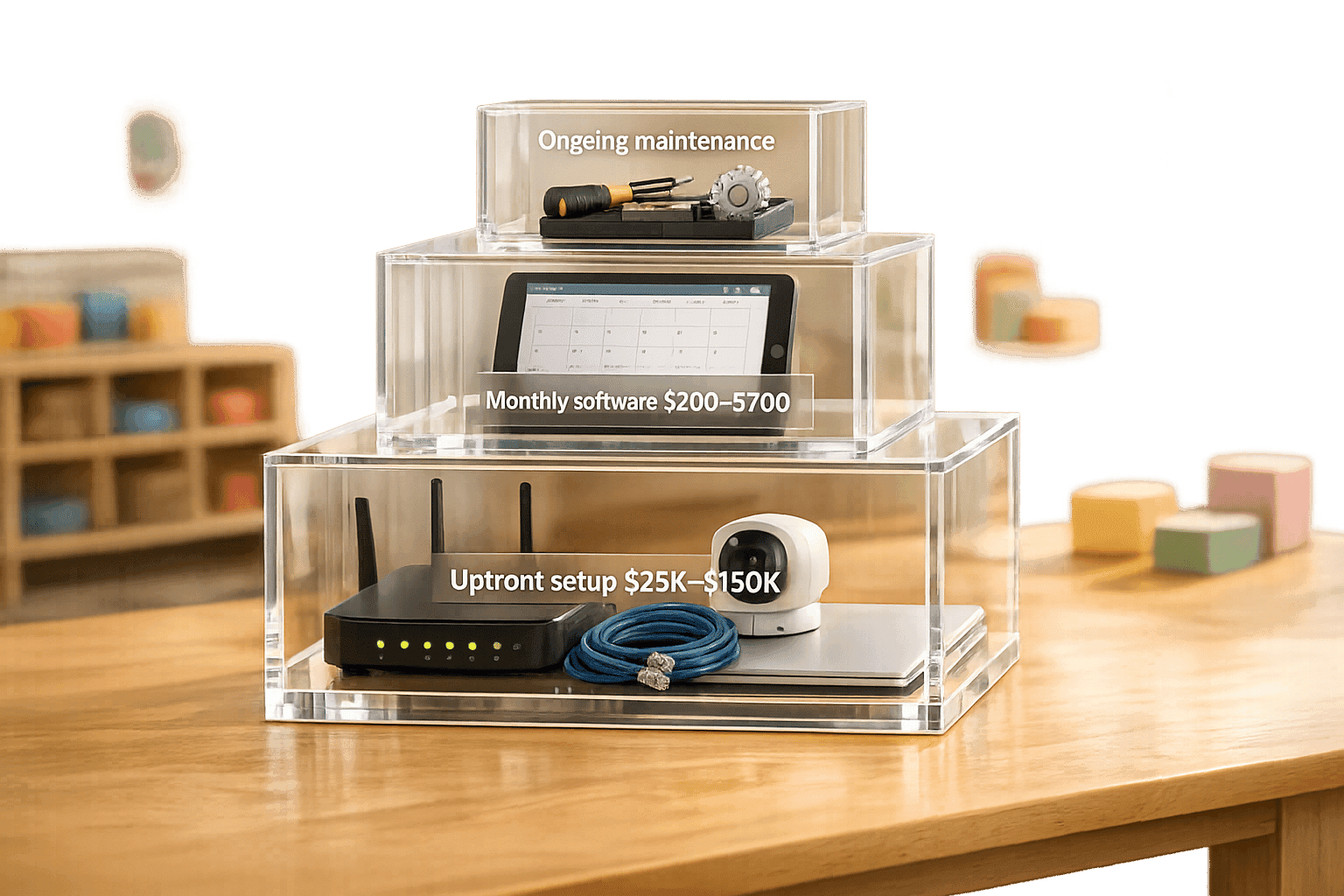
In 2026, early education franchises are spending more on technology than ever before. Whether it's for security systems, classroom tools, or parent apps, tech is now a core part of starting and running these businesses. Here's what you need to know:
Initial Setup Costs: Range from $25,000 to $150,000, depending on the franchise model.
IT infrastructure: $25,000–$75,000
Security systems: $5,000–$15,000
Classroom tech: $1,000–$17,500
Digital signage: $15,000–$35,000
Monthly Fees: Typically $200 to $700, covering software for parent communication, billing, and management systems.
Recurring Maintenance: Hardware upgrades and software updates add ongoing costs, with some franchises charging annual fees like $1,850 for maintenance.
Examples:
The Goddard School: $26,000–$40,000 for tech setup, plus $700/month for proprietary curriculum tools.
Engineering For Kids: $3,000–$6,000 for classroom laptops, $200/month for software.
Costs vary based on the franchise's focus, facility size, and location. Larger centers with advanced tools spend more upfront, while smaller, mobile franchises keep costs lower. Planning for both initial and recurring expenses is key to success.
One-Time Technology Costs for Starting an Early Education Franchise
Initial Tech Cost Breakdown
Starting an early education franchise involves an upfront technology investment ranging from $50,000 to $150,000. This budget typically covers essentials like computers, security cameras, classroom technology, and digital signage.
Here's a breakdown of these costs:
Core IT infrastructure: $25,000–$75,000 for items like computers, servers, software licenses, and networking equipment.
Security systems: $5,000–$15,000, which includes cameras, secure entry hardware, and remote monitoring systems.
Classroom technology: $1,000–$17,500, depending on whether you opt for basic tablets or advanced interactive flat panels.
Digital signage: $15,000–$35,000, including installation fees.
Additional expenses may include setup fees for parent-communication apps, which allow for real-time updates and digital billing systems.
These estimates align with data from franchise disclosure documents, offering a clearer picture of what to expect.
Real Examples from Franchise Models
For a more detailed view, let’s look at some real-world examples:
The Goddard School: As of February 2026, their Franchise Disclosure Document outlines a required technology budget of $26,000 to $40,000. This package includes computer systems, IT security, and digital signage. Notably, $15,000 is allocated specifically for a security system with network equipment and wireless access points, all professionally installed.
Kiddie Academy: Their "Computer Hardware, Software & Classroom Technology" costs range from $25,000 to $75,000, reflecting the flexibility needed for varying facility sizes and classroom numbers. This is part of their "Life Essentials" curriculum model.
Building Kidz School: They break down costs more granularly. For example, their "Building Kidz Connect" app hardware costs $1,000 to $4,000, with an additional $1,000 to $2,500 for CRM setup and hardware. Security systems require $5,000 to $10,000, while their "Learning Through Life Experience" (LTLE) curriculum setup is the largest expense, ranging from $25,000 to $45,000.
Engineering For Kids: As a mobile-based STEM franchise, their tech costs are much lower - just $3,000 to $6,000 for classroom laptops - since they don’t require permanent facility infrastructure.
These examples highlight how technology costs can vary widely depending on the franchise model, facility size, and the level of tech integration required.
Monthly and Annual Technology Expenses
Software and Platform Subscriptions
Early education franchises typically spend between $200 and $700 per month on technology, which includes tools like parent communication apps and franchise management systems. These costs are often structured in three ways: per-child ($1–$4 per student monthly), per-classroom (around $50 per room monthly), or as a flat fee. Each model has its pros and cons, depending on the size of the enrollment base.
This pricing reflects the industry's broader movement toward consistent tech investments. For example, within the Personal Services sector - where early education falls - the median annual technology fee is $2,388 (approximately $199 per month). However, fees can range widely, from $1,137 to $4,200 annually (or roughly $95 to $350 per month).
Some real-world cases show how these costs vary. Engineering For Kids charges $600 every three months, averaging $200 per month. The Goddard School imposes a $700 monthly Proprietary Curriculum Fee [30,31], while Buzz Franchise Brands collects about $350 per month per franchise for a tech package that includes VOIP, CRM, websites, and royalty management systems.
"The goal of the tech fee is as a means to help franchisees run their business more efficiently and effectively." – Kevin Wilson, CEO, Buzz Franchise Brands
Beyond subscription fees, budgeting for hardware maintenance and upgrades is essential for smooth operations.
Maintenance and Upgrades
After the initial setup, maintaining and upgrading hardware and software is key to keeping operations running efficiently. For example, classroom laptops - costing between $3,000 and $6,000 - will eventually need replacement. Similarly, essential systems like Wi-Fi, security cameras, and phone setups, which initially cost $30,000 to $45,000, require periodic updates and support.
Annual maintenance fees also add to the overall expenses. Brain Balance charges $1,850 annually for software maintenance, alongside $1,000 for third-party software access. Additional costs include tools like email collaboration software (about $248.40 per user per year beyond the first three users) and accounting software like QuickBooks, which costs $10 to $25 per month.
These investments are critical to staying competitive in the market. Franchise attorney Brian Schnell highlights this point:
"How a franchisor addresses technology fees is a great example of their strategic leadership for its brand and franchise network, and is a real difference-maker in the overall performance of the franchise system."
Unexpected expenses, such as payment processing fees, setup charges, or premium feature upgrades, can also arise. To avoid surprises, it's wise to ask software providers for a detailed breakdown of included features before committing.
The Future of EDUCATION FRANCHISING: Building Kidz Partner Shares Expert Insights 💡
Technology Cost Comparison Across Major Franchises
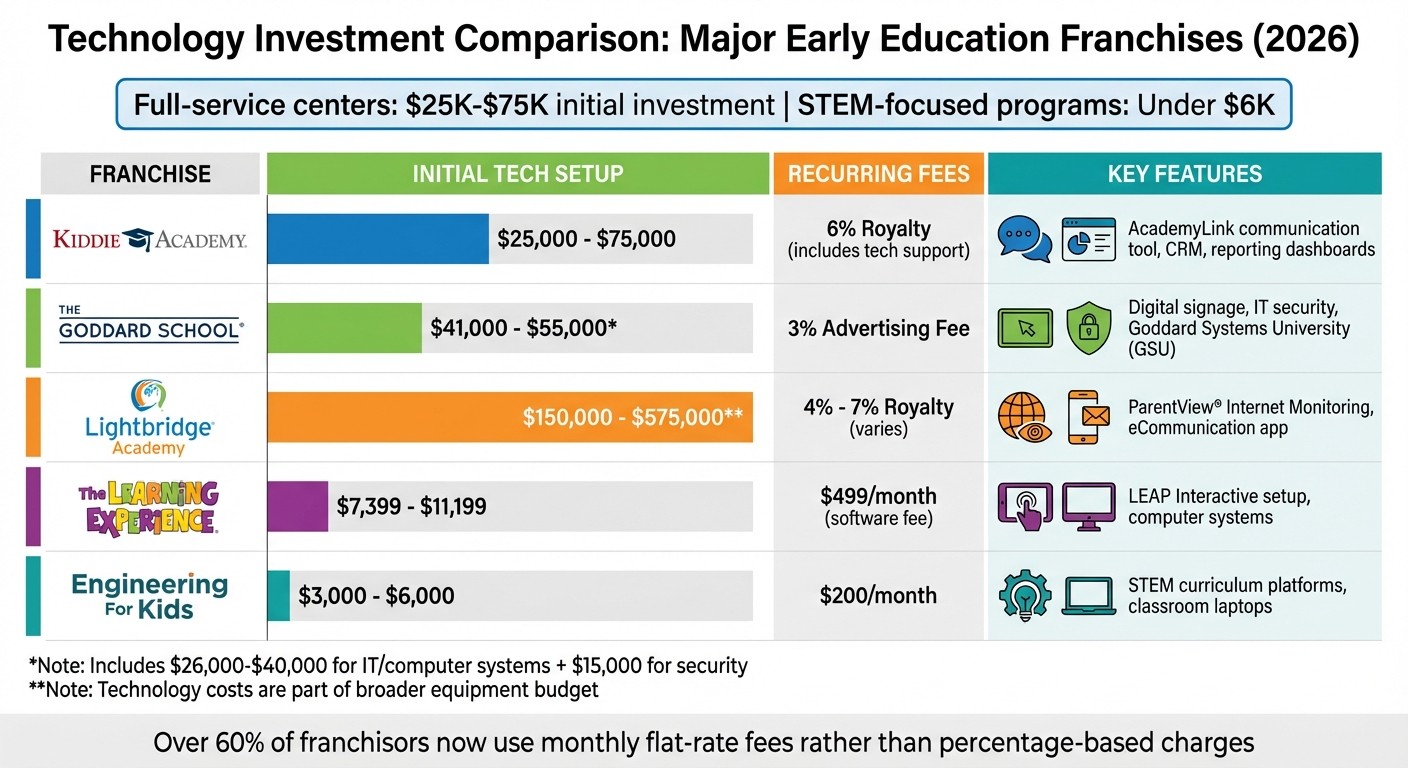
Early Education Franchise Technology Costs Comparison 2026
Cost Comparison Table
The table below provides a snapshot of how technology investments differ among major early education franchises, focusing on initial setup costs, recurring fees, and key technology features. These costs are shaped by each franchise's operational approach and infrastructure needs:
Franchise Brand | Initial Tech/IT Setup Cost | Recurring Technology Fees | Key Technology Features |
|---|---|---|---|
Kiddie Academy | $25,000 – $75,000 | 6% Royalty (includes tech support) | AcademyLink communication tool, CRM, reporting dashboards |
The Goddard School | $41,000 – $55,000* | 3% Advertising Fee | Digital signage, IT security, Goddard Systems University (GSU) |
$150,000 – $575,000** | 4% – 7% Royalty (varies) | ParentView® Internet Monitoring, eCommunication app | |
$7,399 – $11,199 | $499/month (software fee) | LEAP Interactive setup, computer systems | |
Engineering For Kids | $3,000 – $6,000 | $200/month | STEM curriculum platforms, classroom laptops |
*Includes $26,000–$40,000 for IT/computer systems plus $15,000 for security systems.
**Technology costs are part of the broader equipment budget.
This comparison highlights the wide range of technology investments, which are further analyzed below.
What the Numbers Show
The data reveals clear trends: full-service centers like The Goddard School and Kiddie Academy typically allocate between $25,000 and $75,000 for their initial technology setup. On the other hand, STEM-focused programs such as Engineering For Kids keep their hardware costs under $6,000, reflecting their narrower tech requirements.
Franchisors’ approaches to tech fees often correlate with the size of their initial investments. For instance, industries with higher capital demands, such as lodging, see nearly 90% of franchisors implementing structured tech fees. Similarly, larger education centers tend to integrate technology costs into royalty structures, making up less than 1% of the total capital in most cases.
Some brands, like The Learning Experience, opt for flat monthly fees ($499 for software) in addition to royalties. Meanwhile, Engineering For Kids takes a straightforward approach with a transparent $200 monthly fee. This shift toward bundled, flat-rate charges reflects a growing preference for integrating technology expenses into overall operational costs. In fact, over 60% of franchisors now use monthly flat-rate fees rather than percentage-based charges.
What Affects Technology Costs in 2026
Location and Facility Size
Where your facility is located and its size can heavily influence your technology expenses. For example, urban hubs like New York and San Francisco demand a 30% to 50% premium over national averages for construction and infrastructure costs, which include essentials like technology wiring and MEP systems.
Facility size also plays a big role. Outfitting a new child care center in 2026 with security and tech features typically costs between $20,000 and $50,000. Larger facilities naturally require more surveillance cameras, access control systems, and interactive learning tools. Internet costs vary by location too, with monthly rates ranging from $70 to $200 depending on speed and area.
Software pricing models add another layer of complexity. Per-classroom plans - averaging about $50 per room - offer predictable costs but can spike during periods of expansion. For franchises using "micro-pod" setups across multiple sites, managing logistics like educator travel and supply runs demands specialized platforms, increasing overall tech spending. These location and size factors serve as the foundation for understanding broader technology costs.
Custom Software and System Integration
Beyond hardware and recurring fees, software integration is a major contributor to long-term costs. By 2026, developing proprietary EdTech solutions costs roughly $53,183 per month for a basic development team, with payroll for engineers and product managers making up 55% to 65% of operating expenses.
Many early childhood education centers rely on fragmented systems - separate tools for enrollment, curriculum, HR, and meal tracking - leading to hidden costs like duplicate data entry, manual reporting errors, and wasted staff hours.
"Technology in early childhood education should be an enabler of connection, clarity, and care - not a hidden barrier to it." – Meghan Travinski, Vice President of Marketing and Enrollment at Big Blue Marble Academy
Switching to unified platforms with open APIs can significantly cut down on administrative burdens. Automating tasks like invoicing and ratio tracking saves staff hours every week.
However, the upfront investment for custom solutions can be steep. AI-driven curriculum engines cost between $800,000 and $3,000,000, while developing a mobile app for parent and educator use ranges from $150,000 to $400,000. Cloud services and content licensing fees can push these costs even higher. Additionally, fragmented systems drive up training expenses in high-turnover environments, as new staff must learn multiple platforms. By choosing unified systems, centers can reduce these hidden costs and improve operational efficiency.
Conclusion and Key Takeaways
When it comes to early education franchises, technology expenses break down into two main categories: one-time capital costs (like security systems and classroom hardware) and ongoing software fees. Upfront investments usually fall between $25,000 and $80,000, while monthly software fees average around $199.
One challenge many new franchise owners face is underestimating the working capital required during the initial enrollment period. To bridge the gap before tuition revenue covers operating costs, owners generally need liquidity between $150,000 and $300,000. This ensures there’s enough cash flow to handle tech subscriptions and other expenses.
The size and location of a facility can also heavily influence tech-related costs. For example, larger centers may need more extensive security measures, with costs for cameras, access controls, and interactive learning tools ranging from $10,000 to $40,000. Recognizing these variables is key to effective planning and managing risks.
To tackle these challenges, consulting services like Franchise Ki can be invaluable. They specialize in analyzing Franchise Disclosure Documents to identify hidden tech costs before you commit. Franchise Ki also offers free consulting to connect you with vetted franchise opportunities and provides funding advice tailored to your financial situation. Their guidance ensures you’re prepared for both the upfront and ongoing tech expenses tied to your investment.
FAQs
What tech costs are easy to miss in a franchise budget?
When planning a franchise budget, it's easy to miss certain tech expenses that can add up over time. Things like software updates, hardware replacements, and maintenance fees often fly under the radar. Yet, these costs are essential to keep operations running smoothly. Unfortunately, they’re frequently underestimated - or even completely overlooked - during the budgeting process.
How do tech fees scale as enrollment or classrooms grow?
Tech fees in early education franchises tend to grow alongside the expansion of operations. As enrollment numbers rise or new classrooms are added, the demand for technology naturally increases to handle the extra workload. While the exact pricing structure can differ from one franchise to another, these costs usually scale in proportion to the additional requirements.
What should I ask a franchisor about required software and upgrades?
When you’re talking software and upgrades with a franchisor, make sure to ask about ongoing technology fees, the cost of updates, and any required systems for running daily operations. Get clear on how frequently upgrades are needed - are they part of the initial fees, or will you need to budget for extra expenses? Also, find out if technical support is included. If not, ask about any additional charges for help with implementation or troubleshooting. Knowing these details upfront can save you from unexpected costs later.
