Franchise Strategies
Feb 26, 2026
A practical guide to investing in boutique fitness franchises—segments, startup costs, royalties, funding strategies, market research, and hybrid tech trends.

Niche fitness franchises are reshaping the fitness industry, moving away from large gyms to smaller, specialized studios that focus on specific workouts or demographics. These studios prioritize personalized coaching and community, with strong financial performance and high retention rates. By 2026, the boutique fitness market is expected to grow to $66.2 billion, driven by trends like strength training, hybrid models, and wearable tech integration.
Key takeaways:
Focus Areas: Pilates, HIIT, yoga, and women-focused studios dominate the market.
Financials: Startup costs range from $75,000 to $250,000, with profit margins up to 40%.
Trends: Strength training is now more popular than cardio, and hybrid models (in-person + virtual) are becoming standard.
Demographics: 72% of boutique members earn $100k+ annually, and 55% are Millennials.
Investing in a niche fitness franchise offers opportunities for profitability with fewer members compared to traditional gyms. Success requires thorough market research, financial planning, and choosing the right franchise model.
Meet the Fitness Franchise That’s Disrupting an Oversaturated Market
Popular Niche Fitness Franchise Segments
Boutique fitness studios are carving out their space by catering to specific audiences with tailored programs. As of early 2026, the global boutique fitness industry is valued at $5.4 billion, with expectations to hit $13 billion by 2032. Three key segments are driving this growth, each offering a fresh approach compared to traditional gyms.
Women-Focused Fitness Franchises
Women dominate the fitness market, making up 54% of gym memberships and an impressive 76% of group fitness participants. Franchises like Burn Boot Camp have seized this opportunity by creating welcoming, community-oriented spaces designed for women. These studios often go beyond workouts, offering features like on-site childcare, mental health support, and programs tailored to various life stages - think prenatal fitness or menopause-specific training. Burn Boot Camp's success speaks for itself, with $265 million in sales in 2024, reflecting a 33.4% increase. Similarly, Bodybar Pilates and The Bar Method cater almost exclusively to women, boasting female memberships of 97% and 98%, respectively.
High-Intensity Interval Training (HIIT) Studios
For time-crunched professionals, HIIT studios like Orangetheory Fitness and F45 Training are a game-changer. These franchises specialize in 30- to 45-minute sessions that pack in functional movements and performance tracking. Orangetheory uses heart-rate monitoring to help members stay in their optimal training zones, while F45 focuses on diverse functional exercises. Both brands have scaled rapidly, each surpassing 1,500 locations. This model resonates particularly well with busy professionals and parents, offering an efficient way to stay fit without sacrificing too much time.
Boutique Barre, Pilates, and Yoga Studios
The demand for low-impact, personalized wellness experiences is fueling growth in this segment. Participation in yoga alone has increased by 23.6%, while barre saw a 19.1% rise. These studios appeal to affluent individuals looking for workouts that emphasize form, core strength, and a mind–body connection. Leading the pack, Club Pilates operates over 1,200 studios, and Pure Barre has more than 600 locations. Premium pricing is common - Jetset Pilates charges between $229–$269 per month, while Bodybar Pilates offers packages averaging $200 per month for 10 classes. According to Tamara Galinsky, founder of Jetset Pilates:
Our reformer machines are what really differentiates us from other Pilates studios... but the biggest differentiator for us... is probably our brand and the culture we've created
. Jetset Pilates expanded significantly in 2025, opening 25 new studios and ending the year with 44 locations and 280 franchises sold.
Segment Overview
Here's a quick breakdown of these thriving segments:
Segment | Key Examples | Target Demographic |
|---|---|---|
Women-Focused Fitness | Burn Boot Camp, Bodybar Pilates, The Bar Method | Women seeking community-driven, supportive environments |
High-Intensity Interval Training (HIIT) | Orangetheory Fitness, F45 Training | Time-conscious professionals and parents |
Boutique Barre, Pilates, and Yoga | Club Pilates, Pure Barre, Jetset Pilates | Affluent clients prioritizing specialized, low-impact wellness |
Financial Considerations for Niche Fitness Franchises
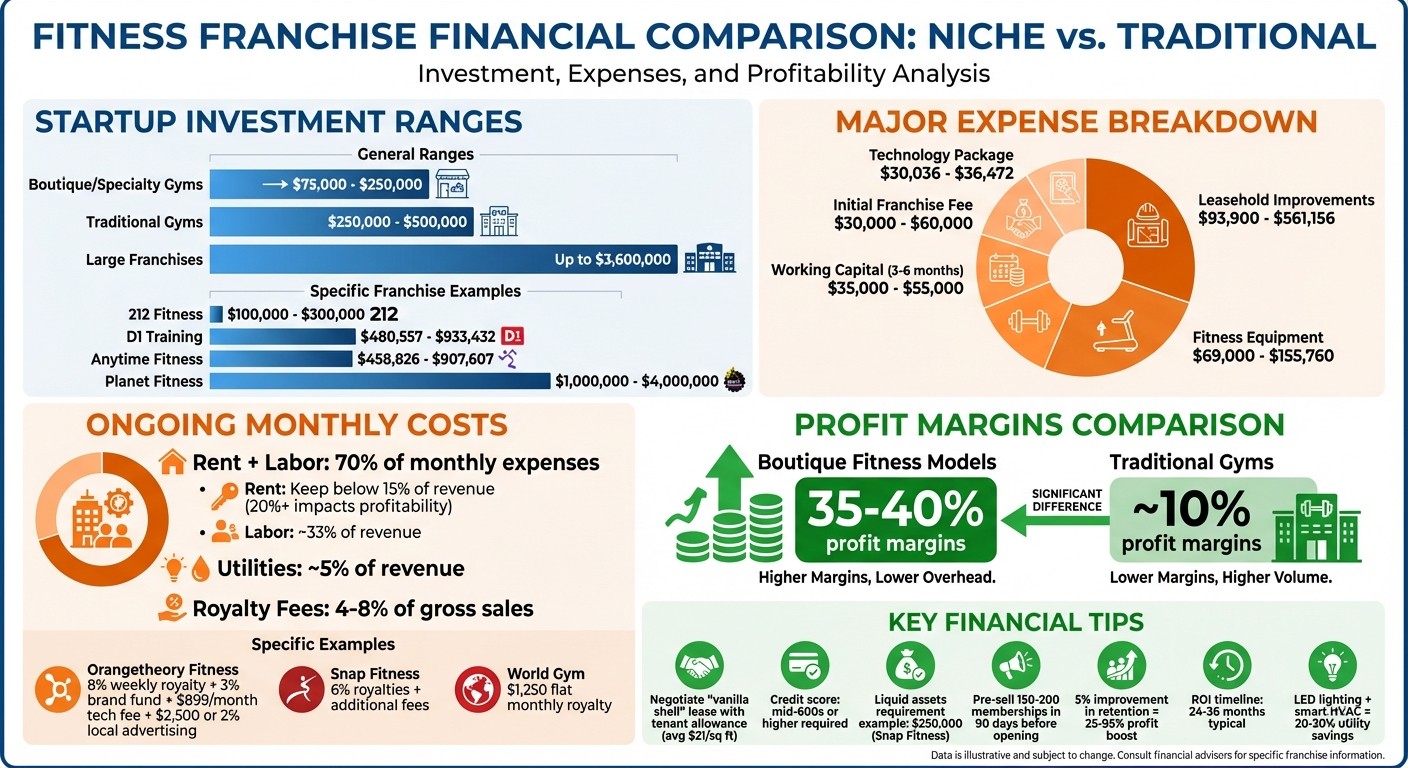
Niche Fitness Franchise Investment Costs and Profit Margins Comparison
Understanding the financial landscape is key to succeeding in the niche fitness franchise market. From startup costs to ongoing fees, knowing where your money goes can make or break your boutique fitness business.
Startup Costs and Investment Ranges
The cost to start a fitness franchise depends on the type of gym. Boutique and specialty gyms typically require an initial investment of $75,000 to $250,000, while traditional gyms range from $250,000 to $500,000. Larger franchises can reach as high as $3,600,000.
For example, D1 Training (focused on athletic training) costs between $480,557 and $933,432, while Anytime Fitness requires $458,826 to $907,607. On the lower end, 212 Fitness ranges from $100,000 to $300,000, whereas Planet Fitness can cost anywhere from $1,000,000 to $4,000,000. Major expenses include leasehold improvements, running $93,900 to $561,156, and fitness equipment, which adds another $69,000 to $155,760. Additional costs include a technology package priced at $30,036 to $36,472 and an initial franchise fee of $30,000 to $60,000.
Franchisors also expect you to have working capital to cover the first three to six months of operations, typically $35,000 to $55,000. To save on upfront costs, consider negotiating a "vanilla shell" lease, which includes basic HVAC and flooring, and request a tenant allowance (averaging $21 per square foot) to help with build-out expenses. The rewards for boutique models can be worth it, with profit margins of 35% to 40%, compared to traditional gyms at around 10%.
Once these initial costs are addressed, understanding recurring fees becomes crucial to maintaining profitability.
Royalty Fees and Recurring Costs
After the initial investment, franchise owners face ongoing costs, primarily royalty fees ranging from 4% to 8% of gross sales, or sometimes a flat fee. For instance, Orangetheory Fitness charges an 8% weekly royalty, a 3% monthly brand fund contribution, a $899/month technology fee, and a local advertising minimum of $2,500 or 2% of gross sales. Snap Fitness takes 6% in royalties, plus additional monthly fees for marketing, technology, and insurance. Meanwhile, World Gym opts for a simpler $1,250 flat monthly royalty.
Other recurring costs include rent and labor, which together make up about 70% of monthly expenses. Experts recommend keeping rent below 15% of your revenue - exceeding 20% can significantly impact profitability. Labor costs should account for around 33% of revenue, while utilities should stay near 5%. Emma Pearson from Franchising.com explains:
A fitness franchise that uses less equipment will equate more money in your pocket, but the potential profit is likely far less than a full-scale gym.
With these operating costs in mind, the next step is developing a solid funding plan to ensure financial stability.
Funding Strategies and Financial Planning
Before seeking funding, ensure your credit score is in the mid-600s or higher and prepare documentation of your liquid assets - this could include cash, stocks, or home equity. Many franchisors, like Snap Fitness, require a minimum of $250,000 in liquid assets.
Combining funding sources can strengthen your financial position. You might pair personal savings with a business line of credit or a Retirement Account Rollover (ROBS), which allows you to use 401(k) or IRA funds without penalties. Another option is a portfolio loan, enabling you to borrow up to 80% of your securities' value at interest rates between 2% and 5%.
From day one, monitor critical metrics like customer acquisition cost (CAC), lifetime value (LTV), and payback period. Even small changes can make a big difference - a 5% improvement in member retention could boost profits by 25% to 95%. Pre-selling 150 to 200 memberships in the 90 days before opening can also reduce your payback period by six months for every 50 additional members.
To optimize costs, automate billing, scheduling, and lead engagement - this can reclaim up to 80% of administrative time and reduce labor demands. Additionally, investing in LED lighting and smart HVAC systems can lower utility bills by 20% to 30%, helping to keep fixed costs (rent and utilities) below 47% of revenue.
Evaluating and Choosing the Right Niche Franchise
Picking the right niche fitness franchise takes more than just liking a brand. It requires a detailed approach that looks at everything from how the brand stands out to the local market's potential. The U.S. fitness industry is worth $34 billion, with franchises contributing around $4 billion. Fitness franchises also have a 15% higher survival rate in their first year compared to independent start-ups. These numbers highlight the importance of making informed decisions when evaluating franchise options.
Key Evaluation Criteria
Start by examining brand differentiation - what makes the franchise unique? Look for features like infrared training (offered by Hotworx), EMS technology, or specialized Pilates equipment that competitors can't easily copy. For example, the EMS market is forecasted to grow to over $980.8 million by 2030, signaling strong potential for tech-driven fitness concepts.
Talk to current franchise owners to get a clearer picture. Ask about daily operations, how long it took to become profitable, and whether the franchisor delivers on their promises. Visit studios as a "secret shopper" to see how they interact with customers, maintain equipment, and create a welcoming atmosphere. Interestingly, one in five consumers is more likely to choose a service if it’s part of a recognizable franchise brand.
Another key factor is the corporate leadership. A strong leadership team often drives long-term success. Review the Franchise Disclosure Document (FDD), especially Item 19, which outlines financial performance. Watch for red flags like high turnover rates. Determine if the franchise model supports semi-absentee ownership or multi-unit expansion. Many successful franchisees operate multiple locations, benefiting from shared resources and economies of scale.
Lastly, consider the scalability of the business. For instance, managing multiple locations can allow you to share staff like HR managers across 10 or more units, boosting your return on investment. Many franchisees agree that scalable models and strong franchisor support are critical for multi-unit operations.
Franchise Consultant Support
Navigating the franchise world can be tricky, but franchise consultants can simplify the process. They offer personalized recommendations based on your lifestyle, interests, and budget, helping you find opportunities that align with your goals. Consultants also evaluate whether a concept is a good fit for franchising and whether it's the right time for you to enter the market.
Consultants play a big role in due diligence, helping you understand the FDD, fee structures, and financial data. They also assist with site selection, analyzing local demographics and competition to pinpoint ideal locations. Beyond initial selection, many consultants provide ongoing business coaching to help with daily challenges.
Franchise Ki is one example of a service offering free franchise consulting. They connect entrepreneurs with pre-screened fitness franchise opportunities tailored to their goals and investment levels. Their services include franchise matching, access to a curated database, funding guidance, and support throughout the ownership process. With experts like Bennett Maxwell, who sold 300+ Dirty Dough Cookies franchise units in just two years, and Liam Chase, who scaled a client’s business from 13 units to nearly 70 in one quarter, Franchise Ki provides the expertise needed to make informed choices.
When working with consultants, decide your level of involvement early. Do you want to be hands-on as an owner-operator, or would you prefer a semi-absentee model where a manager handles daily operations? Consultants can help narrow your options based on this preference. Use their network to speak with at least three current franchisees to verify profitability and franchisor support. Also, aim for franchises with failure rates below 10%. While consultants provide valuable guidance, understanding your local market is equally important.
Conducting Market Research
Before committing to a niche fitness franchise, take a deep dive into your local market. Define your target demographics by analyzing factors like age, household income, and lifestyle trends. Niche fitness concepts thrive when they cater to specific groups, such as busy professionals in cities or families in suburban areas. Use the "catchment rule" to evaluate the market within a 2-mile radius or a 10–15 minute drive, as boutique fitness customers value convenience.
Pay attention to core market indicators like population growth (ideally 2–3%+ annually) and income levels that align with your pricing. Businesses that conduct thorough market research before expanding are 70% more likely to achieve growth targets within two years. Additionally, 82% of franchise owners report higher satisfaction when they choose markets based on detailed demographic research.
Look at both competitors and potential allies. Map out direct competitors, but also identify complementary businesses. Being near places like premium spas, organic grocery stores, or boutique shops can create synergy and attract more customers.
"The right location serves as a built-in marketing tool, attracting the right customers and setting the foundation for a thriving business."
Jordan Levine, COO of Stretch Zone
Visit local studios to perform a competitor audit. Check their pricing, observe class energy, and look for signs of high demand, such as waitlists. Combine hard data from sources like the Census Bureau with insights from talking to customers and other local business owners. Follow the 80/20 rule: focus 80% of your efforts on the factors that drive the most success, such as market size, competition, and demographic fit. Allocate 15–20% of your expansion budget to thorough market research to avoid costly mistakes.
Emerging Trends and Future Opportunities
The niche fitness franchise industry is evolving at a breakneck pace. By 2026, global spending on digital fitness - including wearables and apps - is expected to exceed $60 billion. The virtual fitness market alone is projected to surpass $30 billion, growing at an annual rate of around 25%. This rapid growth is paving the way for advancements in technology, mental wellness offerings, and hybrid business models.
Technology and Wearable Integration
Technology is no longer just an add-on - it’s become the backbone of modern fitness franchises. AI-powered tools now deliver personalized training plans with impressive accuracy and speed. Wearable devices track metrics like heart rate, sleep, and recovery, triggering automated suggestions to improve performance. Predictive analytics are also helping franchise operators identify trends in member activity, such as spotting potential cancellations before they happen.
"Technology is no longer optional - it's foundational."
Jerry Pugh, CEO of Workout Anytime
Hybrid memberships, which combine digital and in-person access, are now part of 41% of fitness memberships. To keep members engaged, franchises are turning to gamification, offering live-streamed classes with leaderboards and team challenges. Recovery technology is also gaining traction, with studios incorporating services like infrared therapy, cryotherapy, and PEMF (Pulsed Electromagnetic Field) therapy.
Bundling digital and physical memberships is a smart move. For example, offering both for around $120/month can increase average revenue per user (ARPU) by up to 40%. Tracking metrics like digital logins and class completions can help measure success. Smaller franchises can compete with larger chains by using white-label apps, which offer a branded digital experience without the hefty price tag. As technology continues to shape the industry, there’s also a growing emphasis on a more holistic approach to fitness.
Focus on Mental Health and Wellness
Fitness today is about more than just burning calories; it’s shifting toward a "whole-person" approach that includes recovery, nutrition, and stress management. In 2023, the global wellness economy reached $6.3 trillion and is expected to approach $9 trillion by 2028, growing at 7.3% annually. Wellness spending alone accounts for $1.8 trillion annually.
Niche franchises are responding by integrating mental health-focused services. Offerings like breathwork, float therapy, and infrared saunas are becoming increasingly common. Brands such as Restore Hyper Wellness (245 locations) and Stretch Zone (300+ locations) are leading this shift, offering treatments like IV drips, cryotherapy, and practitioner-assisted stretching. These franchises are positioning themselves as places where members can address emotional and physical well-being - a concept that resonates deeply with Gen Z, who value community and connection.
"Our goal is to make that one hour in our studio enhance the other 23 hours of their day."
Sarah Luna, President, Xponential Fitness
Established wellness brands report EBITDA margins of 18% to 28% once they stabilize. To tap into this growing demand, franchises can partner with corporations to access workforce wellness budgets, which help reduce absenteeism and healthcare costs. Pre-selling annual wellness packages during peak resolution periods - like January and September - can also drive revenue. Tiered membership models, such as recovery passes or family add-ons, can create steady cash flow while meeting diverse member needs.
Flexible and Hybrid Business Models
Today’s consumers expect fitness to fit seamlessly into their schedules. Hybrid memberships cater to this demand, with members typically staying 3 months longer than those with traditional memberships. Among Gen Z, 73% use digital tools in addition to in-club training, and 75% are likely to leave a gym that lacks a strong digital presence. The virtual fitness market is forecasted to hit $106.4 billion by 2030, growing at a 31.2% annual rate.
Boutique franchises like SWEAT440 are embracing this shift. By early 2026, SWEAT440 had 27 open studios and 105 more in development across 14 U.S. states. Their 40-minute HIIT sessions, broken into convenient 10-minute circuits, allow flexible drop-ins. Similarly, Iyengar Yoga Sarasota transitioned to a hybrid model in late 2025, using WellnessLiving’s FitLIVE and FitVID platforms to offer searchable, mobile-friendly live-streamed and on-demand classes.
"Hybrid isn't a trend - it's the new industry standard."
Wexer
Hybrid models also help optimize studio operations. On average, studios sit empty 70% of the time. Digital content can fill these "dead zones" while reducing reliance on live staff during labor shortages. By analyzing virtual traffic data, franchises can prioritize locations with high digital engagement. Metrics like logins, video completions, and churn rates are essential for fine-tuning these models. Flexible memberships, which combine digital and in-person options, are particularly effective at retaining younger members while boosting ARPU and overall retention. These strategies not only enhance member satisfaction but also strengthen financial performance.
Conclusion: Your Path to Niche Fitness Franchise Success
The niche fitness franchise market is thriving, with projections estimating it will hit nearly $13 billion by 2032. Whether your passion lies in Pilates, HIIT, or recovery-focused studios, there's a growing opportunity to create a profitable, community-centered business. Boutique fitness franchises stand out with lower operational demands, premium pricing structures, and the ability to achieve profitability with just a few hundred members - far fewer than the 1,000+ often needed by larger gym chains.
Start by assessing your management preferences. Do you enjoy being deeply involved, or would a semi-absentee model suit you better? Dive into market research by observing competitors during peak hours, exploring local demographics, and pinpointing underserved niches. As Luke Carlson, CEO of Discover Strength, explains:
You're either in the high-volume, low-price-point gym space or you're operating a boutique model. There really is no in between and those who try to appeal to everyone often lose.
This perspective will help you prepare for the financial requirements.
Most boutique franchises demand an initial investment ranging from $250,000 to $500,000, with ongoing royalties of 5% to 7%. To make an informed decision, review the FDD with legal experts and seek advice from current franchisees to gain insights into their profitability and experiences. Many owners see a return on investment within 24 to 36 months, with net margins reaching up to 30%.
Expert guidance can further simplify your journey. Services like Franchise Ki, as mentioned earlier, provide free consulting to connect you with pre-screened franchise opportunities that align with your budget and goals. Their robust database and expert advice ensure you're equipped to launch and grow your fitness franchise with confidence.
Success in this space comes from blending community engagement, technology, and specialization. Whether you're starting your first studio or scaling up to multiple locations, the formula is clear: pair your passion with a proven franchise model and use expert resources to bring your vision to life.
FAQs
How do I choose the best niche for my local market?
To get started, dive into researching your community's demographics, competition, and lifestyle trends. Who are the people in your area? Are they families, young professionals, retirees, or a mix? Understanding this will help you identify your target customers and their specific needs. For example, families might look for kid-friendly options, while busy professionals may value convenience and speed.
Next, look at the competition. What are other businesses in your area doing? More importantly, what are they not doing? Pinpoint the gaps - those unmet needs or untapped opportunities. Maybe there's a rising demand for healthier food options or a lack of pet-friendly spaces.
Take it a step further by studying successful niche concepts in markets similar to yours. What makes them work? Use that insight to craft a clear value proposition that sets you apart. Whether it's offering locally sourced products, personalized service, or something completely out of the box, make sure it resonates with your community's unique preferences and demands.
What monthly costs impact franchise profits the most?
Managing monthly expenses is crucial for franchise profitability. The most impactful costs often include rent or lease payments, equipment maintenance, and marketing expenses. These recurring charges can eat into profits if not monitored closely. Keeping a tight grip on these costs is essential for protecting your margins and ensuring long-term success.
How many members do I need to break even?
To cover costs in a gym franchise, you generally need around 340 members, each paying an average of $89 per month. However, this number can shift based on factors like your location, monthly expenses, and any extra income sources your gym might have.
