Franchise Strategies
Dec 20, 2025
Assess if a UPS Store franchise is worth the cost amid declining print/mail demand, rising fees, and tech-driven shifts, and which services still profit.
Thinking about investing in a UPS Store franchise? Here's what you need to know: The business model, while historically successful, is facing challenges from digital disruption. Services like printing and mail handling are declining as digital tools replace traditional methods. Meanwhile, competition from e-commerce giants like Amazon and shifting consumer preferences toward low-cost shipping options are squeezing profit margins.
Key points to consider:
Revenue Breakdown: In 2023, the average UPS Store made $721,274 in gross sales, with two-thirds coming from printing services - not shipping.
Costs: Initial investment ranges from $209,195 to $495,945, with 8.5% of gross sales going to fees. Mandatory store redesigns every 10 years add financial pressure.
Challenges: Declining demand for traditional mail services, rising labor costs, and competition from e-commerce platforms handling their own logistics.
Opportunities: Locations near small businesses, coworking spaces, or areas with high mailbox demand can perform better. Offering high-margin services like notary work, ID photos, and custom printing may offset declining shipping revenues.
Success depends on choosing the right location, managing costs, and diversifying services beyond shipping. Careful evaluation of financial projections and market demand is essential before making this investment.
How Much Can you Make with a UPS Store in 2025? (costs, sales, & fees)
The Digital Delivery Apocalypse: Challenges for the UPS Store
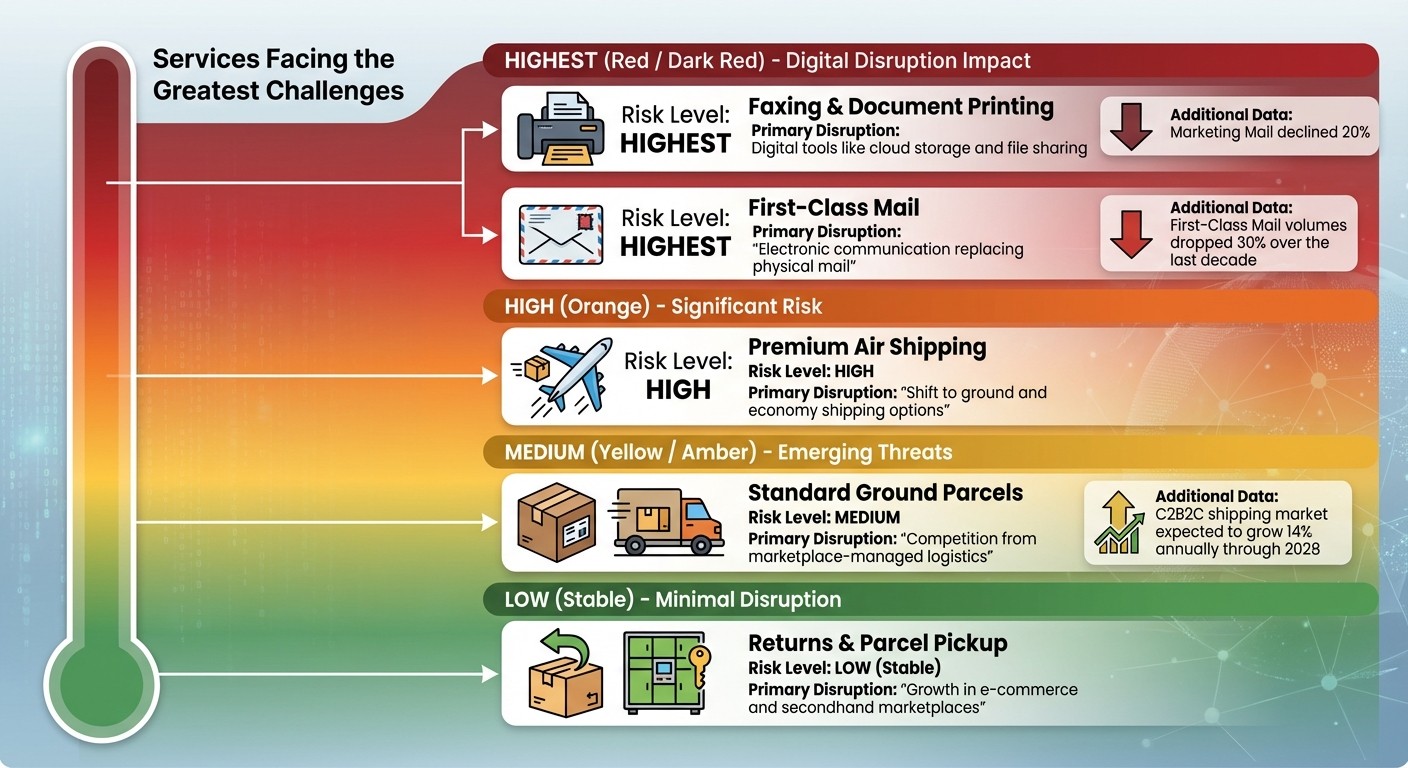
UPS Store Services Risk Assessment: Digital Disruption Impact by Category
How E-commerce and Digital Tools Are Reshaping Business
The rise of digital alternatives is reshaping how businesses operate, particularly for services tied to traditional mail. Tools like email, text messaging, e-signatures, and cloud file sharing have rapidly taken the place of traditional mail services. Over the last decade, First-Class Mail volumes dropped by 30%, while Marketing Mail saw a 20% decline. And the trend isn't slowing down - projections show an additional 14% to 41% decline in mail volumes between 2025 and 2035, with individual consumer mail being hit the hardest.
For UPS Store franchisees, this shift poses a serious challenge. Services like printing, faxing, and document handling are becoming less relevant as both consumers and businesses embrace digital solutions. This evolution not only impacts traditional mail services but also significantly alters the dynamics of parcel delivery.
Shifting Trends in Parcel and Mail Services
While e-commerce has fueled growth in package deliveries, many consumers now prioritize affordability over speed. This change has had a direct impact on UPS's bottom line.
In Q2 2024, UPS reported a 30.1% drop in operating profits, driven by customers moving away from high-margin air shipments in favor of more budget-friendly ground services and the SurePost option. UPS CEO Carol Tomé explained:
"Customers trade down between services... with new e-commerce entrants 'highly leveraging' SurePost, one of its cheaper services."
A decade ago, air shipments made up 25% of UPS's annual revenue. By 2023, that figure had fallen to just 17%. At the same time, retailers have been rethinking their supply chains, shifting toward regional fulfillment centers to enable next-day ground delivery. This shift further reduces demand for premium shipping services. Additionally, major online marketplaces now handle over 80% of their own order volumes, decreasing reliance on traditional retail shipping hubs.
Services Facing the Greatest Challenges
Given these disruptions, it's important to identify which services are most vulnerable. Here's a breakdown of key areas at risk:
Service Category | Risk Level | Primary Disruption Driver |
|---|---|---|
Faxing & Document Printing | Highest | Digital tools like cloud storage and file sharing |
First-Class Mail | Highest | Electronic communication replacing physical mail |
Premium Air Shipping | High | Shift to ground and economy shipping options |
Standard Ground Parcels | Medium | Competition from marketplace-managed logistics |
Returns & Parcel Pickup | Low (Stable) | Growth in e-commerce and secondhand marketplaces |
Traditional services like document printing and mail processing are seeing steep declines as digital communication becomes the norm. Similarly, premium shipping services are losing ground as consumers prioritize cost savings. However, some services - like package returns and out-of-home delivery options (such as parcel lockers and pickup points) - remain steady. These services are bolstered by the growing consumer-to-business-to-consumer (C2B2C) shipping market, which is expected to grow at an annual rate of 14% through 2028.
For investors, the message is clear: while physical document services and premium shipping are on the decline, certain parcel-related offerings still hold potential. Evaluating the revenue mix of a UPS Store location will be critical in determining its long-term viability.
Key Risks for UPS Store Investors
Recent market shifts have introduced financial and operational challenges that could impact the profitability of UPS Store franchisees.
Demand Risks in a Digital Market
The revenue landscape for UPS Store franchisees is undergoing a major transformation. While e-commerce has increased foot traffic, many of these customers - those dropping off packages with labels printed online - generate minimal revenue for franchisees. Surprisingly, about two-thirds of franchisee revenue now stems from copying and reproduction services rather than traditional shipping.
The shipping side of the business presents its own set of hurdles. More consumers are opting for lower-cost services, moving away from high-margin air shipments to cheaper ground and SurePost options. Compounding this, UPS is significantly reducing its Amazon delivery volumes - previously 11.8% of the company’s total revenue in 2024 - by over 50% by the latter half of 2026. CEO Carol Tomé explained:
"Amazon is our largest customer, but it's not our most profitable customer... the business is extraordinarily dilutive to margins".
To fill this gap, UPS is handling more packages from discount e-commerce platforms like Temu and Shein. However, these shipments often involve lightweight, low-profit methods, which means franchisees are processing more packages but earning less per transaction.
Cost Pressures and Margin Challenges
Running a UPS Store comes with hefty financial commitments. Initial investments range from $209,195 to $495,945, with leasehold improvements alone costing between $64,480 and $249,283. Franchisees also face ongoing fees amounting to 8.5% of gross sales - split into 5% royalties, 1% for marketing, and 2.5% for national advertising.
Profit margins are further strained by rising labor costs. New union agreements with the Teamsters have driven up costs, putting additional pressure on franchisees. Comparatively, traditional postal networks face labor expenses that are 20% to 40% higher than those of digital-first competitors. For franchisees already operating on tight margins, these increases could push the business into unprofitability.
Another financial burden comes from mandatory store upgrades. Franchisees are required to fund a full redesign every 10 years as part of their franchise renewal agreements. These redesigns demand significant capital investment, adding to the financial strain. Additionally, franchisees must handle the costs of keeping up with required technology upgrades, further squeezing their budgets.
Technology Dependence and Required Upgrades
Franchisees are becoming increasingly reliant on technology systems controlled by the franchisor, which dictates both the timing and costs of upgrades. These include automation tools and RFID package tagging systems, which are essential for offering features like real-time tracking, personalized delivery updates, and flexible rerouting options. Without these technologies, stores risk losing customers, but implementing them adds to the ongoing operational expenses.
UPS is also shifting its focus toward premium services, such as temperature-controlled healthcare shipments, as a way to counter declining mail volumes and the low margins of e-commerce shipping. For franchisees, this means adapting to new service offerings and investing in specialized equipment, often with little warning and at their own expense. The shift in global shipping trends underscores this challenge: by 2025, the ratio of letters to parcels is expected to reach 1:1, a dramatic shift from 13:1 in 2005. This evolving landscape forces franchisees to continually adapt their services to stay competitive.
Evaluating a UPS Store Investment in the Digital Age
The challenges posed by the digital landscape don’t necessarily eliminate the potential of investing in a UPS Store. However, they do call for a thorough evaluation to determine whether a specific location can succeed despite these obstacles.
Conducting a Location and Market Analysis
To navigate the impact of digital disruption, it’s essential to assess the market dynamics of your chosen location. Start by examining local demographics and the concentration of small and medium-sized businesses (SMBs) in the area. These businesses often require services like design, printing, and logistics support. Locations near coworking spaces, professional offices, or areas with a high number of remote workers and freelancers can be particularly promising, as these groups frequently need secure mail handling and other professional business services.
Another key factor is identifying areas with unmet demand for mailboxes. A strong mailbox business can help cover fixed costs, making it a critical component of your evaluation.
Urban areas tend to offer more opportunities, but if you’re considering a less populated region, check whether it qualifies for the rural program, which can reduce startup costs by over $40,000. Additionally, ensure the location is easy to find, has good visibility, and is close to major transportation routes to attract customers and offer quicker delivery options.
Stress Testing Financial Projections
When reviewing financial projections, avoid overly optimistic assumptions. Use conservative estimates based on data from the Franchise Disclosure Document (FDD) and historical performance. Pay close attention to Item 20 in the FDD, which outlines franchisee termination rates. If the termination rate consistently exceeds 15%, it could indicate potential risks. Perform a break-even analysis using conservative figures, keeping in mind that the typical payback period for a traditional UPS Store ranges from 4.3 to 6.3 years.
Account for ongoing expenses, including royalties (5%), a marketing fee (1%), a national advertising fee (2.5%), and the cost of mandatory store redesigns roughly every 10 years. It’s also wise to set aside 6 to 12 months of working capital to cover operational and personal expenses during the initial ramp-up period. With well-thought-out financial plans, you can also explore diversifying your service offerings to boost profitability.
Repositioning Services to Stay Competitive
To address the challenges of the digital age, it’s essential to reimagine your store as a full-service business center rather than just a shipping hub. Industry analyst Andy Brennan from IBISWorld highlights this shift:
"The increasingly digital business environment has eroded demand for printing and photocopying services, as businesses opt for more secure and convenient online transactions".
Many successful franchisees are adapting by introducing value-added services such as notary work, ID photos, shredding, blueprint printing, and complex packaging. These services help offset declining shipping revenues. Instead of relying heavily on shipping, focus on SMBs that occasionally need professional services like graphic design, high-quality marketing material printing, and logistics support. Package drop-offs generate minimal revenue, so profitability depends on offering higher-margin services that require expertise and personal interaction.
Finally, view technology upgrades and periodic redesigns as opportunities rather than just expenses. While they require an upfront investment, these improvements often lead to increased sales and help maintain a competitive edge in the market.
How Franchise Ki Can Help You Make an Informed Decision
Getting involved with a UPS Store franchise requires more than just enthusiasm - it calls for a deep understanding of the Franchise Disclosure Document (FDD), a clear evaluation of the territory, and an alignment with modern business goals. Franchise Ki offers the expertise you need to tackle these challenges and streamline your decision-making process. Here's how they can guide you every step of the way.
Tailored Franchise Matching and Expert Support
Franchise Ki connects you with specialists who tailor franchise recommendations to your interests and local market conditions. Using advanced tools, they identify open territories and opportunities for multi-unit growth. Within just 24 hours of your request, a specialist evaluates the opportunities in your area, helping you zero in on franchises that fit your goals and resources. These tools also highlight regions with strong potential for growth, setting the stage for a thorough and focused decision-making process.
Simplified Due Diligence and Risk Management
Understanding the FDD can be daunting, but Franchise Ki makes it manageable by breaking down key sections - like Items 19, 21, 7, 3, 6, and 11 - and offering a free financial calculator to evaluate costs, financing options, and growth potential. They also assist in reviewing critical details like litigation history, hidden fees, and the franchisor's pre-opening support. This ensures you’re fully aware of the risks and responsibilities before making a commitment. Armed with these insights, you’ll be better prepared to move forward with confidence.
Complimentary Consultations and Ongoing Assistance
Franchise Ki provides free consultations to help you navigate the entire process. They match you with suitable franchises, interpret the FDD, and connect you with funding experts to explore flexible financing options. Their guidance ensures your business plan accounts for essential updates like mandatory redesigns and tech upgrades. This preparation positions your location to offer profitable services such as mailbox rentals, printing, and notary work.
Conclusion: Is the UPS Store the Right Investment for You?
The UPS Store franchise faces challenges as digital trends continue to reshape traditional revenue streams. With average gross sales of $721,274 per location in 2023, you’ll need to weigh whether that income can cover the 8.5% ongoing fees, mandatory store redesigns every ten years, and competition from automation and digital alternatives.
Success in this business often comes down to how well you can reposition your store. Thriving locations tend to view shipping as a way to attract foot traffic rather than the main source of income. Instead, they focus on services like mailbox rentals, notary offerings, and professional printing - areas where stronger margins are possible. If your target area doesn’t have a demand for these types of "business center" services, the financial outlook may not work in your favor. Factors like location quality, territorial protection, and an honest evaluation of local demand are critical and require careful consideration.
"The real challenge for UPS franchisees isn't the UPS brand... The problem is the industry. Potential franchisees should consider whether they can make a living off mailboxes and office services, not just shipping." - Franchise Chatter
Entering this franchise model demands a thorough analysis of financial projections, especially in an industry facing digital disruption. Seeking professional advice can make this process more manageable. Franchise Ki offers free consultations to help you interpret the Franchise Disclosure Document, assess the viability of your chosen territory, and connect with funding experts who specialize in franchise financing. Their team can help you determine whether your local market has the demand to support a profitable UPS Store - or if exploring other franchise opportunities might be a better fit.
Digital disruption impacts markets differently. With the right combination of location and services, a UPS Store can still deliver strong returns. Success ultimately depends on aligning your market’s needs with a solid mix of business center services. This is where expert guidance and thorough due diligence can be the difference between a smart investment and a costly mistake.
FAQs
What challenges should I consider before investing in a UPS Store franchise in today’s digital world?
Investing in a UPS Store franchise comes with its fair share of challenges, especially in today’s increasingly digital world. Core services like printing, copying, and traditional mail are becoming less relevant as more businesses and consumers turn to digital tools like electronic document sharing and online shipping platforms. This shift can mean fewer customers walking through the door and slimmer profit margins for franchise owners.
From a financial perspective, the initial investment falls between $220,000 and $500,000, which is no small commitment. On top of that, ongoing royalties and fees can take a further bite out of profits. Franchise agreements also tend to be quite rigid, leaving little room to adapt pricing or services to meet the unique needs of your local market. Add to this the rising costs of rent and staffing, along with competition in saturated areas, and it becomes clear that maintaining steady revenue can be an uphill battle. Weighing these factors carefully is crucial to determine whether this opportunity aligns with your financial goals and appetite for risk.
How can UPS Store franchise owners adapt to the decline in traditional mail services?
UPS Store franchise owners have a unique opportunity to thrive, even as traditional mail services decline, by reimagining their locations as all-in-one business hubs. By offering services like packaging, custom printing, mailbox rentals, and e-commerce fulfillment, they can cater to the needs of small businesses, entrepreneurs, and local residents. Providing specialized solutions for tasks like document handling or shipping can open up new streams of revenue and attract a wider customer base.
Another game-changer is embracing technology to enhance customer experiences. Features like self-service kiosks, QR-code scanning, and real-time feedback systems can make transactions faster and more convenient for both walk-in customers and those who prefer digital-first interactions. These tools also help franchisees tailor their services, creating a smoother and more personalized experience that rivals online-only competitors.
Finally, staying attuned to the needs of the local community is crucial. Using customer feedback and keeping an eye on emerging trends can help franchise owners introduce services like same-day courier delivery, secure document shredding, or specialized packaging kits. This kind of flexibility ensures the business remains relevant and competitive in an ever-changing market.
What should I consider when selecting a location for a UPS Store franchise?
When picking a spot for a UPS Store, foot traffic should be a top priority. Aim for areas with consistent customer activity, like bustling residential neighborhoods or small-business hubs. These locations naturally draw online shoppers dropping off or returning packages, as well as local business owners seeking services like printing, mailbox rentals, and more.
You’ll also want to consider market saturation and competition. With over 4,000 UPS Store locations across the country, finding a site with fewer franchises nearby can help you avoid market overlap and boost your sales potential. Look for high-visibility locations with convenient parking and lease agreements that fit the local cost landscape to help ensure profitability.
