Franchise Strategies
Dec 3, 2025
Compare Tropical Smoothie Cafe vs Jamba Juice franchise costs, fees, revenue and support — Tropical Smoothie offers clear cost transparency and financing data.
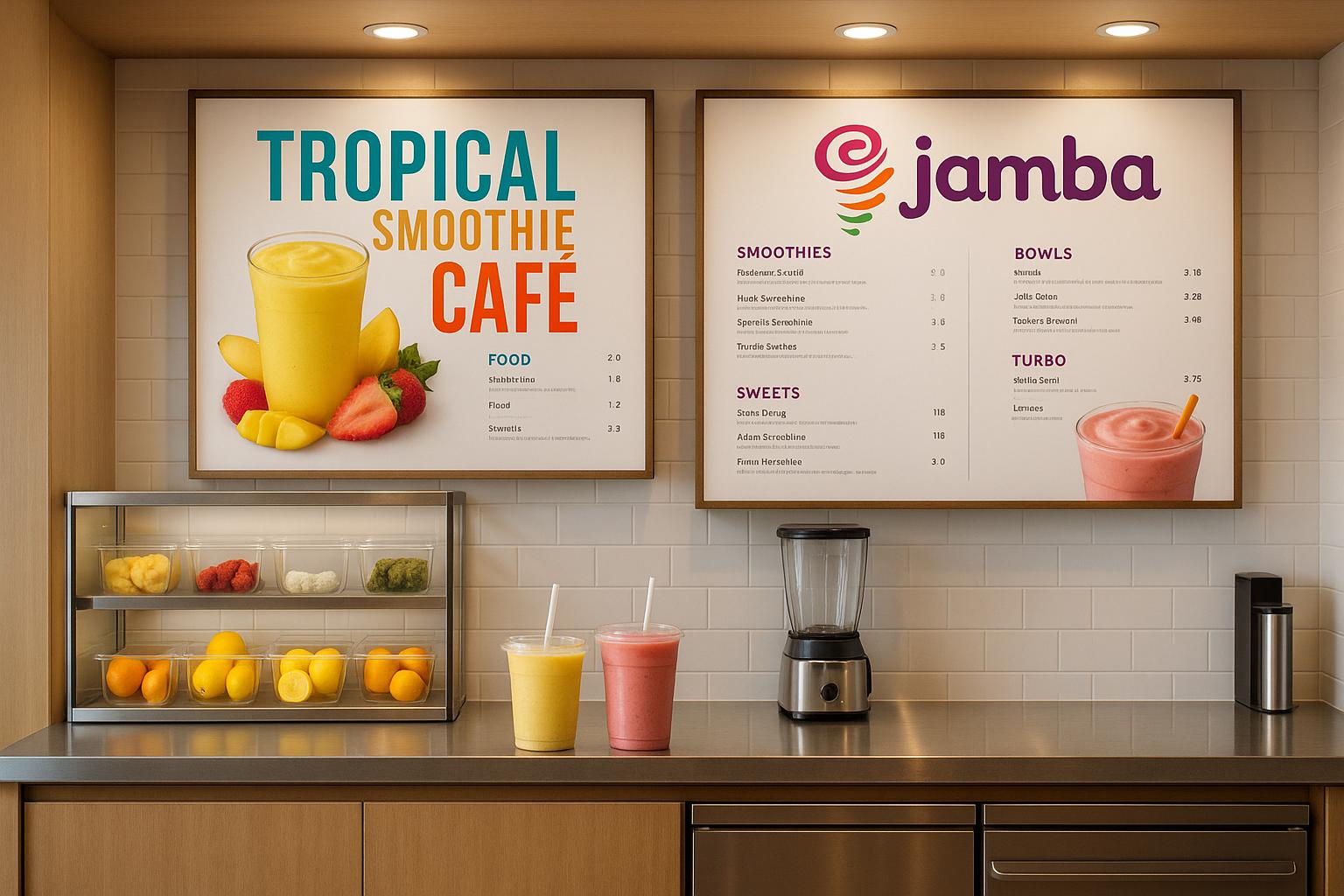
Thinking about opening a smoothie franchise? Here's a quick breakdown of what it takes to invest in Tropical Smoothie Cafe and how it stacks up against Jamba Juice.
Tropical Smoothie Cafe: Initial investment ranges from $340,750 to $814,500 (average ~$550,000). You'll need a net worth of $400,000 and $175,000 in liquid assets. Ongoing fees include a 6% royalty and 5–6% marketing contributions. Average annual revenue is $979,491, with potential earnings of around $249,600. Veterans get a discounted franchise fee of $17,500.
Jamba Juice: Financial details are not publicly disclosed, but costs include a franchise fee, real estate, equipment, and inventory. Ongoing royalties and marketing fees apply. Jamba Juice offers strong franchisee support but lacks transparency on exact figures.
Quick Comparison
Factor | Tropical Smoothie Cafe | Jamba Juice |
|---|---|---|
Initial Investment | $340,750–$814,500 (avg. $550,000) | Not disclosed |
Franchise Fee | $17,500–$35,000 ($17,500 for veterans) | Not disclosed |
Financial Requirements | $400,000 net worth; $175,000 liquid | Not disclosed |
Royalty Fee | 6% of gross sales | Not disclosed |
Marketing Fee | 5–6% of gross sales | Not disclosed |
Average Revenue | $979,491 (top 50%: $1,248,000) | Not disclosed |
Estimated Earnings | $114,570–$143,212 | Not disclosed |
Cost Transparency | Detailed breakdown available | Requires inquiry |
Bottom line: Tropical Smoothie Cafe provides clear financial details, making it easier to estimate costs and profits. Jamba Juice might appeal to those who prioritize franchisee support but are comfortable reaching out for specifics.
1. Tropical Smoothie Cafe

Ongoing Fees
Running a Tropical Smoothie Cafe comes with several operational fees, including royalties, marketing contributions, and technology charges, all of which are necessary to keep things running smoothly.
The royalty fee is set at 6% of gross sales, regardless of whether the business is profitable.
For marketing, franchisees contribute 5–6% of gross sales. This includes a national marketing fee of 3–4% for brand-wide campaigns and a local marketing fee of at least 2% to support regional promotions.
On top of these, there are various technology and operational fees:
Back-of-house fee: $179/month (following a one-time setup fee of $145)
Online ordering fee: $30/month
Managed firewall fee: $103/month
P/L data software: $14.95/month
TSC mobile app access: $75/month
In total, technology-related fees come to about $400 per month, covering essential tools for order management and cybersecurity.
Next, let’s break down Jamba Juice’s fee structure.
2. Jamba Juice
Initial Investment
Opening a Jamba Juice franchise requires a considerable upfront investment. The total cost depends on factors like location, store format, and local market conditions. Franchisees need to budget for a one-time franchise fee, real estate expenses, construction, specialized equipment, and initial inventory. Additionally, it's wise to set aside enough working capital to cover three to six months of operating expenses during the early stages.
Since Jamba Juice doesn’t publicly share detailed cost breakdowns or fee structures, it’s best to reach out to the company directly for the most accurate and location-specific information.
Beyond the initial investment, ongoing fees will also play a role in the overall financial commitment.
Ongoing Fees
While exact details on Jamba Juice’s ongoing fees aren’t widely available, they typically include recurring royalties and contributions to marketing efforts - standard practices in the franchise industry. For precise figures, contact Jamba Juice directly.
Franchisee Support
Jamba Juice offers a robust support system for its franchisees. This includes initial training on operations, food safety, and customer service, along with ongoing assistance like field visits, marketing guidance, and vendor management. Their partnerships with approved vendors can also simplify supply chain logistics.
For a clearer picture of what this support looks like in practice, prospective franchisees should consider speaking with current owners. These conversations can provide valuable insights into the effectiveness and practicality of the support offered by Jamba Juice.
This strong support system complements the financial considerations discussed earlier.
How Much Can You Make With a Smoothie Shop? (Costs, Sales, & Fees)
Pros and Cons
Let’s break down the practical advantages and challenges of investing in Tropical Smoothie Cafe versus Jamba Juice, focusing on key financial and operational factors.
Tropical Smoothie Cafe stands out for its transparent financial details. To qualify, you’ll need a net worth of $400,000, including $175,000 in liquid assets. The franchise fee ranges from $17,500 to $35,000, with a discounted $17,500 fee available for veterans.
When it comes to revenue, the numbers are promising. The top 50% of locations generate average gross revenues of approximately $1,248,000 annually, while the overall average sits at $979,491. With an estimated 20% profit margin, franchisees could potentially earn around $249,600 in yearly net profit. However, the investment payback period typically ranges from 5 to 7 years.
Ongoing fees include a 6% royalty on gross sales and a 5–6% national marketing fee. There are additional monthly charges, such as $179 for back-of-house services, $30 for online ordering, $103 for firewall support, and $75 for the mobile app. Late payments can incur an 18% annual interest charge (or the highest legal rate) plus a $25 weekly late fee, with non-compliance penalties reaching up to $500 per incident.
One standout feature is Tropical Smoothie Cafe's FRANdata FUND Score of 910 out of 950, the highest in the food industry, which can make securing financing easier. However, if you plan to add a drive-thru, prepare for an additional cost of $40,000 to $60,000. On average, franchisees received a tenant improvement allowance of about $43,000 in 2024.
In contrast, Jamba Juice requires direct inquiries for financial specifics, as it does not publicly disclose key investment figures. While this lack of transparency can be a drawback, Jamba Juice is known for offering comprehensive training and ongoing support, although details on these programs are also limited.
Here’s a side-by-side comparison of the two franchises:
Factor | Tropical Smoothie Cafe | Jamba Juice |
|---|---|---|
Initial Investment | $340,750–$814,500 (avg. $550,000) | Not publicly disclosed |
Franchise Fee | $17,500–$35,000 ($17,500 for veterans) | Not publicly disclosed |
Financial Requirements | $400,000 net worth; $175,000 liquid | Not publicly disclosed |
Royalty Fee | 6% of gross sales | Not publicly disclosed |
Marketing Fee | 5–6% of gross sales | Not publicly disclosed |
Average Revenue | $979,491 (top 50%: $1,248,000) | Not publicly disclosed |
Estimated Owner Earnings | $114,570–$143,212 | Not publicly disclosed |
Failure Rate | 1% (year 1), 3% (year 3) | Not publicly disclosed |
Financing Score | 910/950 FRANdata FUND Score | Not publicly disclosed |
Cost Transparency | Detailed breakdown available | Low – requires direct inquiry |
Support System | Standard franchise support | Comprehensive training and assistance |
If you prioritize detailed financial projections and clearly outlined costs, Tropical Smoothie Cafe offers a transparent model to help you make an informed decision. On the other hand, if you’re comfortable with reaching out for more information and value a system that emphasizes strong franchisee support, Jamba Juice may be worth considering.
Conclusion
Deciding between Tropical Smoothie Cafe and Jamba Juice comes down to your financial situation, need for clear information, and how comfortable you are with varying levels of transparency. These factors create a straightforward basis for comparison.
Tropical Smoothie Cafe stands out by offering clear and upfront financial details, making it easier to develop realistic expectations. This approach might resonate with first-time franchise owners or investors who prefer having a well-defined understanding of their investment from the beginning.
On the other hand, Jamba Juice does not publicly share financial figures. This means those with more experience in franchising - and who don’t mind reaching out directly for details - may find this option more suited to their style.
FAQs
What are the main costs involved in opening a Tropical Smoothie Cafe franchise?
The initial investment required to open a Tropical Smoothie Cafe franchise generally falls between $340,750 and $814,500, with the average cost landing around $550,000. This estimate covers franchise fees, equipment, build-out expenses, and other startup essentials.
It's important for potential franchisees to thoroughly assess these financial obligations. Beyond the initial costs, they should also account for ongoing expenses such as operational costs, royalties, and marketing fees when evaluating the overall opportunity.
What are the ongoing fees for a Tropical Smoothie Cafe franchise, and how do they affect profitability?
Tropical Smoothie Cafe franchise owners need to account for ongoing fees, which include a 6% royalty fee and a 5-6% national marketing fee. Both are calculated based on gross sales and can significantly influence your bottom line.
It's important for potential franchisees to incorporate these fees into their financial planning. By carefully evaluating how these costs fit with anticipated revenues, you can create a more realistic picture of your long-term profitability. Proper budgeting here isn't just smart - it's essential for success.
What kind of training and ongoing support does Tropical Smoothie Cafe provide to its franchisees?
Tropical Smoothie Cafe provides extensive support to its franchisees, beginning with a thorough training program. This program includes about a week of classroom instruction paired with three to four weeks of practical, in-cafe training.
Franchisees also have access to continuous learning opportunities, regular meetings, and a range of resources aimed at helping them run their businesses smoothly and efficiently.
This support structure ensures franchisees are well-prepared to navigate the challenges of the competitive smoothie market.
