Franchise Strategies
Dec 15, 2025
Why leading coffee chains block outside franchise ownership, how their ownership models differ, and where to find alternative franchise options.
Dutch Bros and Starbucks dominate the coffee industry, but neither allows traditional franchise ownership. Here’s the key difference:
Dutch Bros: Operates on an employee-only franchise model. Only internal employees can qualify to operate stores, requiring at least three years of service and meeting financial criteria. The brand prioritizes internal promotions to maintain control over its culture.
Starbucks: Avoids franchising entirely. It operates through corporate-owned stores and selective licensing, allowing only large-scale, experienced operators to run licensed locations, often in high-traffic areas like airports or campuses.
For aspiring coffee shop owners, these barriers mean you’ll need to look at other brands for franchise opportunities. Options like BIGGBY® COFFEE, Scooter’s Coffee, and Peet’s Coffee offer more accessible paths to ownership, with varying investment levels and support systems. The U.S. coffee market remains lucrative, with daily consumption exceeding 516 million cups and franchise revenues growing steadily.
If Dutch Bros or Starbucks isn't an option, exploring other franchise models could be your best bet.
Dutch Bros Ownership and Expansion Model
The Employee-Only Franchise Model
Back in 2008, Dutch Bros made a pivotal shift by halting external franchising. From that point on, all new locations have been company-owned, with operator roles reserved exclusively for employees who have demonstrated their dedication and service to the company.
To be considered for an operator role, employees must meet several criteria. They need a minimum of three years with the company, along with financial qualifications: at least $150,000 in cash, a total investment of $150,000, a net worth of $500,000, and the ability to pay a $30,000 fee. Operators also owe a royalty fee of either 5% of gross sales or $1,300 per month, whichever is higher.
This approach was shaped by a costly lesson in 1999, when Dutch Bros spent $1 million to repurchase a franchised store. That experience reinforced the decision to keep ownership within the company, creating a clear path for internal promotions.
Growth Through Internal Promotion
Dutch Bros has built a growth model that prioritizes promoting from within. Employees start as broistas, move up to shift leads, then assistant managers, and eventually take on store leadership roles. This progression ensures that leaders are deeply aligned with the company’s values and culture. When selecting candidates, the company looks for strong leadership skills, operational expertise, and a mindset focused on community and teamwork.
The results speak for themselves. Dutch Bros has developed a strong pipeline of operator candidates to fuel its expansion. Since its 2021 IPO, the number of candidates has tripled, reaching over 450 individuals with an average tenure of seven years. This pipeline is robust enough to support the company's ambitious plans to add 1,500 new locations. Currently operating 1,050 locations across 24 states, Dutch Bros is aiming to double its footprint to 2,029 shops by 2029, which requires opening more than 200 stores annually.
Sumi Ghosh, President of Operations, highlights how this strategy ties directly to their people-first philosophy:
"Our shop growth is predicated on our people. What that means is that we won't open new shops unless - and until - we have great people to operate them … As we're expanding into new markets, we're sending highly experienced people to represent our brand."
This internal promotion model is at the heart of Dutch Bros’ expansion strategy, ensuring that growth is built on a foundation of experienced and committed leaders.
Starbucks Corporate Structure and Licensing Approach
Company-Owned Stores vs. Licensed Locations
Starbucks operates over 38,000 stores worldwide, but it doesn't use the typical franchise model. Instead, its operations are split between company-owned stores and licensed locations. As of 2023, Starbucks managed 19,592 company-operated stores, while 18,253 locations were run by licensed operators.
In the United States, about 49% of Starbucks locations are licensed. Opening a licensed store requires an initial investment of $315,000, with total project costs ranging from $315,000 to $2,660,000. Additionally, licensees must have at least $700,000 in liquid assets. These licensed stores are typically found in high-traffic areas like airports, college campuses, hospitals, grocery stores, and large retail centers.
Despite making up 56% of all Starbucks locations, licensed stores contribute significantly less to the company’s overall revenue. In 2023, Starbucks generated $36 billion in revenue, with 82% of that ($29.46 billion) coming from company-operated stores, while licensed locations brought in just $4.51 billion. For licensees, individual stores can earn between $50,000 and $200,000 annually, and those managing up to 20 licenses could see earnings exceeding $2 million per year.
Starbucks’ licensing model reflects its selective approach to partnerships, emphasizing high standards and financial requirements. This dual structure helps the company maintain its reputation for quality and consistency across all locations.
Maintaining Brand Control and Quality
Starbucks deliberately avoids the traditional franchise model to maintain tight control over its brand and ensure a consistent customer experience. By focusing on quality, innovation, and brand management, Starbucks prioritizes steady growth over rapid, franchise-driven expansion. This approach reinforces its commitment to delivering the same level of service and product excellence, no matter the location.
Franchise Barriers: Why You Can't Join
The business models of Dutch Bros and Starbucks effectively shut the door on external franchise ownership, each for its own reasons.
Dutch Bros: Employees Take the Lead
If you're dreaming of owning a Dutch Bros franchise, here's the catch: they don't offer traditional franchise opportunities to outsiders anymore. Instead, all new locations are company-owned, and any regional operator roles are exclusively reserved for current employees. This "employees-only" approach is all about safeguarding their unique company culture and the high-energy customer service they're known for. For external investors hoping to dive into the coffee franchise world, this policy means Dutch Bros is off the table, making it necessary to consider other brands that welcome outside ownership.
Starbucks: A High Bar for Licensing
Starbucks takes a different route with its selective licensing model, which is not the same as traditional franchising. In the U.S. and Canada, licenses are typically awarded to large-scale, experienced operators rather than individual entrepreneurs. The financial requirements are steep, with investments climbing as high as $2,660,000. This model allows Starbucks to maintain tight control over its brand, ensuring consistency, quality, and operational efficiency. However, it also puts the opportunity out of reach for most small-scale investors. These strict conditions make it clear that Starbucks isn't an option for those seeking a conventional franchise, pushing potential coffee shop owners to explore other brands that align with their goals and resources.
Key Business Model Differences
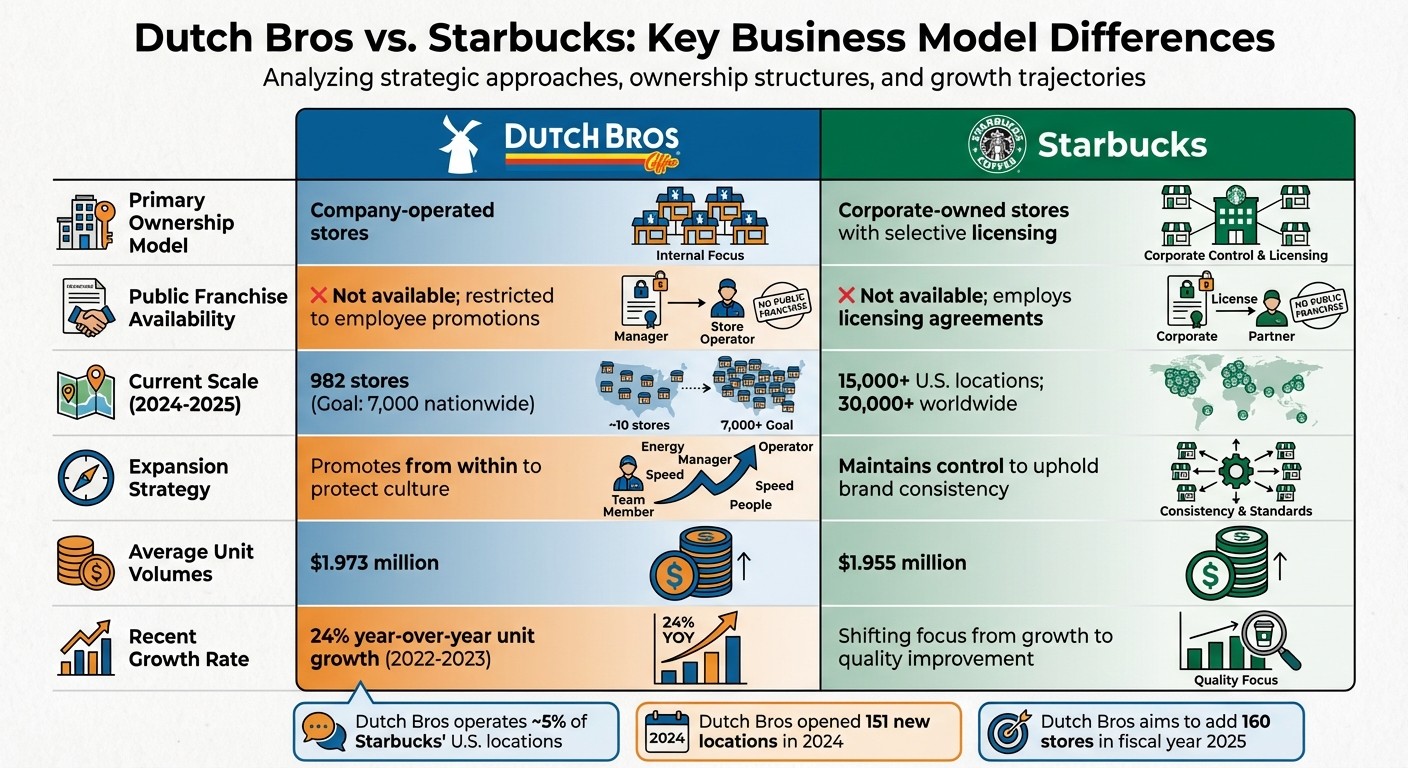
Dutch Bros vs Starbucks Business Model Comparison
Dutch Bros and Starbucks take notably different approaches to expansion and ownership. Dutch Bros focuses on growing through company-operated stores, while Starbucks leans on corporate ownership paired with selective licensing.
In 2024, Dutch Bros opened 151 new locations, almost all of which were corporate-operated. Looking ahead, they aim to add another 160 stores in fiscal year 2025. This employee-focused model has driven an impressive 24% year-over-year growth in unit count from 2022 to 2023.
Starbucks, on the other hand, oversees more than 15,000 locations in the U.S. and over 30,000 globally. Their strategy relies on a mix of company-owned outlets and carefully chosen licensing agreements, ensuring consistent quality across their vast network.
Comparison Table: Dutch Bros vs. Starbucks
Feature | Dutch Bros | Starbucks |
|---|---|---|
Primary Ownership Model | Company-operated stores | Corporate-owned stores with selective licensing |
Public Franchise Availability | Not available; restricted to employee promotions | Not available; employs licensing agreements |
Current Scale (2024-2025) | 982 stores with a goal of 7,000 nationwide | 15,000+ U.S. locations; 30,000+ worldwide |
Expansion Strategy | Promotes from within to protect its culture | Maintains control to uphold brand consistency |
Average Unit Volumes | $1.973 million | $1.955 million |
Recent Growth Rate | 24% year-over-year unit growth (2022-2023) | Shifting focus from growth to quality improvement |
The difference in scale is hard to miss: Dutch Bros operates just about 5% of the U.S. locations that Starbucks does. This disparity highlights the contrasting strategies of the two brands and explains why neither offers traditional franchise opportunities. Their approaches are laser-focused on maintaining control and protecting their respective brand identities.
Alternative Coffee Franchise Opportunities
If you're unable to invest in major coffee chains like Dutch Bros or Starbucks, there are plenty of other promising options to consider. The U.S. coffee franchise market is projected to hit nearly $14 billion by 2025, and with Americans consuming 516 million cups of coffee daily, there's no shortage of demand. These figures make coffee franchises a compelling choice for those seeking a traditional franchise business model.
Several well-established coffee franchises provide strong support systems, recognizable brands, and adaptable formats. Take BIGGBY® COFFEE, for instance. An initial investment ranges from $296,250 to $658,000, with a franchise fee of $20,000. Their top 25% drive-thru locations report average unit volumes of $1,015,792, and the average store generates over $1 million in sales. Meanwhile, Scooter's Coffee specializes in a drive-thru kiosk model, with top-performing locations reaching $1,268,540 in average unit volumes.
For those interested in a premium coffee experience, Peet's Coffee stands out. Named the #1 Coffee Chain by USA Today readers, Peet's requires a higher investment - between $1,035,000 and $1,697,000 - and a commitment to develop at least 10 units. Their top-performing locations boast gross sales of $2,755,214, with an annual average of $1,414,992.
On the financial side, coffee shops typically enjoy a gross margin of 75% to 80%, and franchise owners with businesses open for at least two years earn an average annual income of nearly $116,000. Consumer preferences are also shifting in ways that benefit coffee franchises. Over the past five years, consumption of espresso-based beverages has risen by 18%, while drinks like cold brew and frozen blended coffees have surged by 42%.
Explore Franchise Ki for Expert Guidance
If you're ready to dive into the coffee franchise world, Franchise Ki offers tailored guidance to help you find the right fit. Their free consulting services connect you with vetted opportunities that align with your financial capacity and business objectives. Founded by Bennett Maxwell, who successfully sold over 300 units of Dirty Dough Cookies, and Liam Chase, who helped a client grow from 13 to nearly 70 units in just one quarter, the team brings hands-on franchise expertise. They'll assist with financial planning, territory evaluation, and due diligence - all at no cost to you.
Conclusion
Dutch Bros and Starbucks maintain their stronghold in the coffee industry through tightly controlled business practices. Dutch Bros focuses on promoting employees exclusively from within, while Starbucks relies on company ownership and selective licensing to safeguard its brand identity and operations. These approaches are key to their success - Dutch Bros ensures steady growth through internal development, and Starbucks uses its model to address challenges like slight dips in same-store sales. However, these restrictive systems can make owning a franchise with either brand nearly impossible for most aspiring entrepreneurs.
Thankfully, the U.S. coffee market offers plenty of opportunities for those looking to dive into the industry. Valued at $71.3 billion, with 65% of Americans drinking coffee daily, the market is brimming with traditional franchise options that are far more accessible. These models provide a straightforward path to ownership without the hurdles of internal promotions or exclusive licensing agreements.
If you're exploring franchise opportunities, Franchise Ki can guide you through the process. Their free consulting services connect you with options that align with your financial goals and aspirations. With experts like Bennett Maxwell, who sold over 300 Dirty Dough Cookies units, and Liam Chase, who helped a client grow from 13 to nearly 70 locations in just one quarter, you'll get tailored advice and access to vetted franchise opportunities - no strings attached.
FAQs
Why can’t you open a Dutch Bros or Starbucks franchise?
Dutch Bros and Starbucks take a different approach when it comes to expansion - they don’t follow the traditional franchise model. Dutch Bros opts for company-owned locations, placing a strong emphasis on internal growth. This strategy helps them preserve their distinct culture and values. Starbucks, meanwhile, sticks to corporate ownership and licensing, ensuring a consistent experience for customers while maintaining tight control over its brand.
These choices reflect both companies' commitment to their standards and long-term goals. For those interested in investing in the coffee industry, this means exploring other brands that offer franchise opportunities.
What are the financial requirements to operate a licensed Starbucks store?
To run a licensed Starbucks store, you'll need to pay a licensing fee, which typically falls between $25,000 and $315,000. On top of that, expect ongoing royalties of around 5-6% of your gross sales and a marketing fee of approximately 4-5%. Unlike traditional franchises, Starbucks operates through licensing agreements rather than franchise models.
The total upfront investment can range significantly, from $315,000 to over $2 million. This variation depends on factors such as the store's location, its size, and the specific build-out requirements. It's also worth noting that Starbucks maintains strict oversight of licensed stores to ensure they meet the company's brand standards.
Why does Dutch Bros only allow employees to become franchisees, and how does this support their growth?
Dutch Bros has crafted an employee-only franchise model that prioritizes its internal culture and preserves the brand's identity. By limiting franchise opportunities to its own employees, the company ensures that franchisees are already well-versed in its core values, day-to-day operations, and customer service expectations. This approach not only strengthens loyalty but also minimizes turnover and nurtures leadership from within - a win-win for both the business and its team.
This strategy also emphasizes steady, quality-driven growth over rapid expansion. By keeping ownership in-house, Dutch Bros maintains consistency across its locations while building a network of dedicated, experienced franchisees who are deeply committed to the brand's long-term vision. It’s a model that puts people and purpose at the center of success.
